

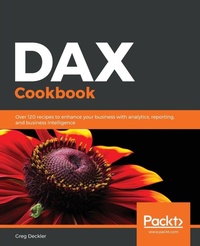
DAX Cookbook
Over 120 recipes to enhance your business with analytics, reporting, and business intelligence
Published on 18. March 2020
Book
Paperback/Softback
552 pages
978-1-83921-707-4 (ISBN)
Description
Solve real-world business problems by learning how to create common industry key performance indicators and other calculations using DAX within Microsoft products such as Power BI, SQL Server, and Excel.
Key Features
Learn to write sophisticated DAX queries to solve business intelligence and data analytics challenges
Handle performance issues and optimization within the data model, DAX calculations and more
Solve business issues with Microsoft Excel, Power BI, and SQL Server using DAX queries
Book DescriptionDAX provides an extra edge by extracting key information from the data that is already present in your model. Filled with examples of practical, real-world calculations geared toward business metrics and key performance indicators, this cookbook features solutions that you can apply for your own business analysis needs.
You'll learn to write various DAX expressions and functions to understand how DAX queries work. The book also covers sections on dates, time, and duration to help you deal with working days, time zones, and shifts. You'll then discover how to manipulate text and numbers to create dynamic titles and ranks, and deal with measure totals. Later, you'll explore common business metrics for finance, customers, employees, and projects. The book will also show you how to implement common industry metrics such as days of supply, mean time between failure, order cycle time and overall equipment effectiveness. In the concluding chapters, you'll learn to apply statistical formulas for covariance, kurtosis, and skewness. Finally, you'll explore advanced DAX patterns for interpolation, inverse aggregators, inverse slicers, and even forecasting with a deseasonalized correlation coefficient.
By the end of this book, you'll have the skills you need to use DAX's functionality and flexibility in business intelligence and data analytics.What you will learn
Understand how to create common calculations for dates, time, and duration
Create key performance indicators (KPIs) and other business calculations
Develop general DAX calculations that deal with text and numbers
Discover new ideas and time-saving techniques for better calculations and models
Perform advanced DAX calculations for solving statistical measures and other mathematical formulas
Handle errors in DAX and learn how to debug DAX calculations
Understand how to optimize your data models
Who this book is forBusiness users, BI developers, data analysts, and SQL users who are looking for solutions to the challenges faced while solving analytical operations using DAX techniques and patterns will find this book useful. Basic knowledge of the DAX language and Microsoft services is mandatory.
Key Features
Learn to write sophisticated DAX queries to solve business intelligence and data analytics challenges
Handle performance issues and optimization within the data model, DAX calculations and more
Solve business issues with Microsoft Excel, Power BI, and SQL Server using DAX queries
Book DescriptionDAX provides an extra edge by extracting key information from the data that is already present in your model. Filled with examples of practical, real-world calculations geared toward business metrics and key performance indicators, this cookbook features solutions that you can apply for your own business analysis needs.
You'll learn to write various DAX expressions and functions to understand how DAX queries work. The book also covers sections on dates, time, and duration to help you deal with working days, time zones, and shifts. You'll then discover how to manipulate text and numbers to create dynamic titles and ranks, and deal with measure totals. Later, you'll explore common business metrics for finance, customers, employees, and projects. The book will also show you how to implement common industry metrics such as days of supply, mean time between failure, order cycle time and overall equipment effectiveness. In the concluding chapters, you'll learn to apply statistical formulas for covariance, kurtosis, and skewness. Finally, you'll explore advanced DAX patterns for interpolation, inverse aggregators, inverse slicers, and even forecasting with a deseasonalized correlation coefficient.
By the end of this book, you'll have the skills you need to use DAX's functionality and flexibility in business intelligence and data analytics.What you will learn
Understand how to create common calculations for dates, time, and duration
Create key performance indicators (KPIs) and other business calculations
Develop general DAX calculations that deal with text and numbers
Discover new ideas and time-saving techniques for better calculations and models
Perform advanced DAX calculations for solving statistical measures and other mathematical formulas
Handle errors in DAX and learn how to debug DAX calculations
Understand how to optimize your data models
Who this book is forBusiness users, BI developers, data analysts, and SQL users who are looking for solutions to the challenges faced while solving analytical operations using DAX techniques and patterns will find this book useful. Basic knowledge of the DAX language and Microsoft services is mandatory.
More details
Language
English
Place of publication
Birmingham
United Kingdom
Target group
Professional and scholarly
US School Grade: College Graduate Student
Dimensions
Height: 235 mm
Width: 191 mm
Thickness: 30 mm
Weight
1018 gr
ISBN-13
978-1-83921-707-4 (9781839217074)
Copyright in bibliographic data and cover images is held by Nielsen Book Services Limited or by the publishers or by their respective licensors: all rights reserved.
Schweitzer Classification
Other editions
Additional editions
Greg Deckler
DAX Cookbook
Over 120 recipes to enhance your business with analytics, reporting, and business intelligence
E-Book
09/2024
Packt Publishing
€35.49
Available for download
Person
Greg Deckler is a seven-time Microsoft MVP for Data Platform and an active member of the Columbus Ohio IT community, having founded the Columbus Azure ML and Power BI User Group (CAMLPUG) and presented at many conferences and events throughout the country. An active blogger and community member interested in helping new users of Power BI, Greg actively participates in the Power BI community, having authored over 200 Power BI Quick Measures Gallery submissions and over 7,500 authored solutions to community questions. Greg is also vice president at a global consulting firm.
Content
Table of Contents
Thinking in DAX
Dealing with Dates and Calendars
Tangling with Time and Duration
Transforming Text and Numbers
Figuring Financial Rates and Revenues
Computing Customers KPIs
Evaluating Employment Measures
Processing Project Performance
Calculating Common Industry Metrics
Using Uncommon DAX Patterns
Solving Statistical and Mathematical Formulas
Applying Advanced DAX Patterns
Debugging and Optimizing DAX
Thinking in DAX
Dealing with Dates and Calendars
Tangling with Time and Duration
Transforming Text and Numbers
Figuring Financial Rates and Revenues
Computing Customers KPIs
Evaluating Employment Measures
Processing Project Performance
Calculating Common Industry Metrics
Using Uncommon DAX Patterns
Solving Statistical and Mathematical Formulas
Applying Advanced DAX Patterns
Debugging and Optimizing DAX