

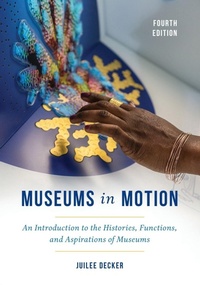
Museums in Motion
An Introduction to the Histories, Functions, and Aspirations of Museums
4th Edition
Published on 6. August 2024
Book
Paperback/Softback
366 pages
978-1-5381-5573-8 (ISBN)
Description
This book explores the histories and functions of museums while also looking at the current standing of museums and their ongoing efforts toward relevance, resiliency, and future-proofing. Section I examines the beginnings of museums with chapters dedicated to art and design museums; natural history and anthropological museums; science museums; museums focused history and the past; and gardens, zoos, and children's museums. Emphasis is on museums in the United States, with some historical framing beyond the U.S. Section II explores the primary functions of museums, including conservation, exhibition, interpretation, engagement, and service. Section III examines museums from within by exploring critical issues and contemporary movements facing museums and our society: transparency and openness, labor and equity, belonging and coalition-building, risk-taking and risk aversion, and sustainability and empathy. Advocating for change rather than "death to museums," Museums in Motion demonstrates the very premise that museums have been in motion all along, as they have shifted from their rather simple form of a treasury, storehouse, and tomb to something much more complex by deeply considering where museums have come from, where they are today, and where they are going.
Entirely new to this edition, Section III (Museum Aspirations) features five new chapters, each centered around topics, rather than a museum type or museum function. Each topic is meant to be a micro-narrative and springboard for a conversation about museums today and their sustainability in the future. The chapters examine museums from the inside (museum workers and their voices, especially, as well as power held by people and institutions) and DEIA without using those individual words as chapter headings. On their own, or in conjunction with the chapters in the previous sections of this book, these chapters serve as vignettes that can help readers to understand where, how, and why we need to apply critical lenses to institutions and articulate how doing so helps us to understand this historical moment and, ultimately how we can realize resiliency and sustainability for museums and those who make their existence possible.
Entirely new to this edition, Section III (Museum Aspirations) features five new chapters, each centered around topics, rather than a museum type or museum function. Each topic is meant to be a micro-narrative and springboard for a conversation about museums today and their sustainability in the future. The chapters examine museums from the inside (museum workers and their voices, especially, as well as power held by people and institutions) and DEIA without using those individual words as chapter headings. On their own, or in conjunction with the chapters in the previous sections of this book, these chapters serve as vignettes that can help readers to understand where, how, and why we need to apply critical lenses to institutions and articulate how doing so helps us to understand this historical moment and, ultimately how we can realize resiliency and sustainability for museums and those who make their existence possible.
Reviews / Votes
Since the last edition of Museums in Motion, much has happened to transform museum practices - massive civic unrest, increased demands for racial and economic justice, a major global pandemic, an elevated climate crisis and significant growth in the decolonization and repatriation movements. The new edition reminds museum workers that we are participants, not victims, in this change, and encourages us to focus on the exciting opportunities that are available to creatively meet new challenges. -- Jennifer Scott, executive director and chief curator of the Urban Civil Rights Museum Museums in Motion, Fourth Edition, provides a thorough overview of the various kinds of museums, the history of their development, and their functions. This title is an essential resource for all museum professionals. -- Lindsey Passenger Wieck, PhD, associate professor of history, director of Public History, St. Mary's UniversityMore details
Series
Edition
4th edition
Language
English
Place of publication
United States
Publishing group
Bloomsbury Publishing Plc
Target group
College/higher education
US School Grade: From College Freshman to College Graduate Student, Interest Age: From 18 to 22 years
Illustrations
88 BW Photos, 3 Tables, 4 Textboxes
Dimensions
Height: 254 mm
Width: 178 mm
Thickness: 20 mm
Weight
688 gr
ISBN-13
978-1-5381-5573-8 (9781538155738)
Copyright in bibliographic data and cover images is held by Nielsen Book Services Limited or by the publishers or by their respective licensors: all rights reserved.
Schweitzer Classification
Person
Juilee Decker, Ph.D., is professor of history at Rochester Institute of Technology where she directs the Museum Studies/Public History program and co-directs the Cultural Heritage Imaging Lab. She earned her Ph.D. from the joint program in art history and museum studies at Case Western Reserve University/Cleveland Museum of Art. She serves as editor of the peer-reviewed journal Collections (SAGE).
Content
Preface to the Fourth Edition
Acknowledgements
Section I: Museum Histories
Introduction to Section I: Museum Histories
Chapter 1: Art and Design Museums
Chapter 2: Natural History and Anthropological Museums
Chapter 3: Science Museums
Chapter 4: History, Place, and the Past
Chapter 5: Gardens, Zoos, and Children's Museums
Section II: Museum Functions
Introduction to Section II: Museum Functions
Chapter 6: To Conserve
Chapter 7: To Exhibit
Chapter 8: To Interpret
Chapter 9: To Engage
Chapter 10: To Serve
Section III: Museum Aspirations
Introduction to Section III: Museum Aspirations
Chapter 11: Transparency, Openness, and (Land) Acknowledgements
Chapter 12: Labor, Equity, and Inclusion
Chapter 13: Antiracism, Belonging, and Coalition-Building
Chapter 14: Risk Taking, Risk Aversion, and Leadership
Chapter 15: Sustainability, Empathy, and Collecting
Index
About the Author
In Memoriam: Edward P. Alexander, 1907-2003
In Recognition: Mary Alexander
Acknowledgements
Section I: Museum Histories
Introduction to Section I: Museum Histories
Chapter 1: Art and Design Museums
Chapter 2: Natural History and Anthropological Museums
Chapter 3: Science Museums
Chapter 4: History, Place, and the Past
Chapter 5: Gardens, Zoos, and Children's Museums
Section II: Museum Functions
Introduction to Section II: Museum Functions
Chapter 6: To Conserve
Chapter 7: To Exhibit
Chapter 8: To Interpret
Chapter 9: To Engage
Chapter 10: To Serve
Section III: Museum Aspirations
Introduction to Section III: Museum Aspirations
Chapter 11: Transparency, Openness, and (Land) Acknowledgements
Chapter 12: Labor, Equity, and Inclusion
Chapter 13: Antiracism, Belonging, and Coalition-Building
Chapter 14: Risk Taking, Risk Aversion, and Leadership
Chapter 15: Sustainability, Empathy, and Collecting
Index
About the Author
In Memoriam: Edward P. Alexander, 1907-2003
In Recognition: Mary Alexander