

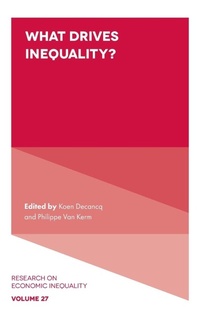
What Drives Inequality?
Published on 16. September 2019
Book
Hardback
208 pages
978-1-78973-378-5 (ISBN)
Description
There is a great deal of coverage on inequality, and the key determinants of recent trends are increasingly well-documented. However, much less is known about the driving forces behind international differences in inequality.
The nine contributions collected in this book set out to examine the fundamental question of What Drives Inequality? These drivers may be so diverse and deep-rooted in the cultural, historical, or geographical characteristics of countries that one can hardly expect comprehensive models or clear-cut causal inference. Nevertheless, the research presented in this book unpacks the reasons behind the wide variations in inequality.
Looking across country boundaries, chapters featured include in-depth insights into inequality in Europe, India, and the United States. It provides new results on the impact of public goods and services and on the role of demographic, labor market and, most importantly, fiscal policy determinants. It also brings fresh evidence and perspectives on the measurement of inequality, by examining wealth or broader measures of well-being, and provides some insights about potential "deeper drivers" such as individual perceptions, preferences, and beliefs about inequality and redistribution.
The nine contributions collected in this book set out to examine the fundamental question of What Drives Inequality? These drivers may be so diverse and deep-rooted in the cultural, historical, or geographical characteristics of countries that one can hardly expect comprehensive models or clear-cut causal inference. Nevertheless, the research presented in this book unpacks the reasons behind the wide variations in inequality.
Looking across country boundaries, chapters featured include in-depth insights into inequality in Europe, India, and the United States. It provides new results on the impact of public goods and services and on the role of demographic, labor market and, most importantly, fiscal policy determinants. It also brings fresh evidence and perspectives on the measurement of inequality, by examining wealth or broader measures of well-being, and provides some insights about potential "deeper drivers" such as individual perceptions, preferences, and beliefs about inequality and redistribution.
Reviews / Votes
This volume compiles nine essays that investigate the drivers of inequality across countries. Economics and other researchers from Europe and Canada address the role of labor markets, taxation, social protection, redistributive policies, political institutions, norms and attitudes, and preferences for redistribution in Europe, India, Indonesia, the US, and Canada. They examine income or expenditure inequality and the role of tax policy and redistribution, demographics, and labor market factors; measures of wealth, public goods, and non-monetary dimensions; and individual perceptions, preferences, and beliefs about inequality and redistribution. -- Copyright 2019 * Portland, OR *More details
Series
Language
English
Place of publication
Bingley
United Kingdom
Target group
Professional and scholarly
Dimensions
Height: 235 mm
Width: 157 mm
Thickness: 14 mm
Weight
403 gr
ISBN-13
978-1-78973-378-5 (9781789733785)
Copyright in bibliographic data and cover images is held by Nielsen Book Services Limited or by the publishers or by their respective licensors: all rights reserved.
Schweitzer Classification
Other editions
Additional editions
Koen Decancq | Philippe van Kerm
What Drives Inequality?
E-Book
09/2019
1st Edition
Emerald Publishing Limited
€97.99
Available for download
Persons
Koen Decancq is Associate Research Professor at the Herman Deleeck Centre for Social Policy at the University of Antwerp. His research interests are the measurement of (multidimensional) inequality, poverty and well-being with a special focus on the incorporation of individual preferences and the role of social policies. Philippe van Kerm is Professor of Social Inequality and Social Policy at the University of Luxembourg on a joint appointment with the Luxembourg Institute of Socio-Economic Research. His research interests are in applied micro-econometrics, welfare and labour with particular reference to poverty and income distribution dynamics, wealth inequality, social mobility, wage, tax, social protection, and social policy.
Content
1. Regional Income Distribution in the European Union: A Parametric Approach; Tsvetana Spasova 2. Vertical and Horizontal Redistribution: Evidence from Europe; Maurizio Bussolo, Carla Krolage, Mattia Makovec, Andreas Peichl, Marc Stoeckli, Ivan Torre, and Christian Wittneben
3. Sources of German Income Inequality across Time and Space; Franziska Deutschmann
4. Understanding Differences in Household Expenditure Inequality between India and Indonesia; Arip Muttaqien, Denisa Sologon, and Cathal O'Donoghue
5. Accounting for public services in distributive analysis; Gerlinde Verbist and Michael Foerster
6. Income and Wealth above the Median: New Measurements and Results for Europe and the United States; Lous Chauvel, Anne Hartung, Eyal Bar-Haim, and Philippe van Kerm
7. Decomposing the difference between multidimensional well-being inequality and income inequality: method and application; Marko Ledic and Ivica Rubil
8. Never Too Rich to be Middle-Class: an Assessment of the Reference-Group Theory and Implications for Redistributive Taxation; Antoine Genest-Gregoire, Jean-Herman Guay, and Luc Goodbout
9. Beliefs about the role of effort and luck during the Great Recession in Spain; Begona Cabeza and Koen Decancq
3. Sources of German Income Inequality across Time and Space; Franziska Deutschmann
4. Understanding Differences in Household Expenditure Inequality between India and Indonesia; Arip Muttaqien, Denisa Sologon, and Cathal O'Donoghue
5. Accounting for public services in distributive analysis; Gerlinde Verbist and Michael Foerster
6. Income and Wealth above the Median: New Measurements and Results for Europe and the United States; Lous Chauvel, Anne Hartung, Eyal Bar-Haim, and Philippe van Kerm
7. Decomposing the difference between multidimensional well-being inequality and income inequality: method and application; Marko Ledic and Ivica Rubil
8. Never Too Rich to be Middle-Class: an Assessment of the Reference-Group Theory and Implications for Redistributive Taxation; Antoine Genest-Gregoire, Jean-Herman Guay, and Luc Goodbout
9. Beliefs about the role of effort and luck during the Great Recession in Spain; Begona Cabeza and Koen Decancq