

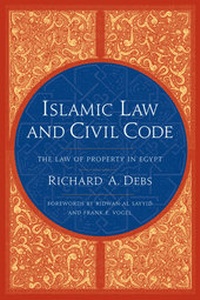
Islamic Law and Civil Code
The Law of Property in Egypt
Published on 28. July 2010
Book
Hardback
216 pages
978-0-231-15044-6 (ISBN)
Description
Richard A. Debs analyzes the classical Islamic law of property based on the Shari'ah, traces its historic development in Egypt, and describes its integration as a source of law within the modern format of a civil code. He focuses specifically on Egypt, a country in the Islamic world that drew upon its society's own vigorous legal system as it formed its modern laws. He also touches on issues that are common to all such societies that have adopted, either by choice or by necessity, Western legal systems. Egypt's unique synthesis of Western and traditional elements is the outcome of an effort to respond to national goals and requirements. Its traditional law, the Shari'ah, is the fundamental law of all Islamic societies, and Debs's analysis of Egypt's experience demonstrates how Islamic jurisprudence can be sophisticated, coherent, rational, and effective, developed over centuries to serve the needs of societies that flourished under the rule of law.
Reviews / Votes
(A) fascinating read, and a core addition to community and college library collections focusing on international law. Midwest Book Review This book is a perfect study of the reform of Islamic law in the Muslim world... It will certainly be a useful guide to graduate students and researchers of Islamic law. -- Harun Karcic Symposia Extremely well-written and highly-informative... This is a very welcome addition to the English language Islamic law library. I suspect that those who teach courses on modern Islamic law will quickly place it on their mandatory reading lists. -- Mohammad Fadel Journal of Islamic StudiesMore details
Language
English
Place of publication
New York
United States
Target group
Professional and scholarly
Product notice
Trade binding
Dimensions
Height: 210 mm
Width: 140 mm
Weight
363 gr
ISBN-13
978-0-231-15044-6 (9780231150446)
Copyright in bibliographic data and cover images is held by Nielsen Book Services Limited or by the publishers or by their respective licensors: all rights reserved.
Schweitzer Classification
Other editions
Additional editions
E-Book
09/2015
1st Edition
De Gruyter
from
€65.95
Available for download
Persons
Richard A. Debs is an advisory director of Morgan Stanley, having been president of Morgan Stanley International and previously a Federal Reserve official. He is chairman emeritus of the American University of Beirut and a trustee of the Institute of International Education, the Carnegie Endowment for International Peace, the Federation of Protestant Welfare Agencies, the Barenboim-Said Foundation, and Carnegie Hall. He is also cochair of the Advisory Board of Columbia University's Middle East Institute and has been decorated by the governments of Saudi Arabia and Lebanon. Frank E. Vogel is is the founding director of the Islamic Legal Studies Program at the Harvard Law School where he taught for twenty years. He is the author of Islamic Law and Legal System: Studies of Saudi Arabia and Islamic Law and Finance: Religion, Risk, and Return. Ridwan Al-Sayyid has been a visiting professor at Harvard University and the University of Chicago and was the director of the Higher Institute for Islamic Studies in Beirut, as well as the director of the Arab Development Institute.
Content
Foreword by Frank Vogel Foreword by Ridwan Al-Sayyid Preface Acknowledgments Introduction Transliterations and Abbreviations 1. The Classical Islamic Law of Property The Classification of Lands in the Shari?ah ?Ushri Lands Kharaji Lands State Lands: The Private Domain Mawat Lands Public Lands and Servitudes Waqfs Land Tenure and Property Rights Private Property: Mulk Land Enjoyment of the Right of Ownership Acquisition and Disposition of the Right of Ownership Waqf Lands Holdings of State-Owned Lands Later Development of the Islamic System of Tenure in Egypt 2. Traditional Islamic Law in the Modern Era The System of Land Tenure Created by Muhammad Ali Kharaji Lands Masmuh Lands Rizqah Lands Ab?adiyah Lands Usiyah Lands The Traditional System of Land Tenure Prior to the Civil Codes State Lands Mulk Lands: Private Property Waqf Lands 3. The Introduction of a Western Civil Code System Ottoman Sovereignty and the Capitulations Tribunals of the Reform: The Mixed Court System Mixed Courts Consular Courts Native Courts Mahkamahs Millah Courts The Civil Codes 4. Property Law Under the First Civil Codes State Lands Kharaji Lands Mawat Lands The Public Domain The Private Domain Waqf Lands Waqf Law in the Civil Courts The Law of Waqf State Administration of Waqfs Private Property The Right of Ownership Ownership and Other Real Rights Enjoyment of the Right of Ownership The Transfer of Ownership Rights Inheritance and Testament Gifts Accession Appropriation Prescription Preemption Agreements and Contracts 5. The Development of a National Legal System Unity of Jurisdiction The Civil Courts The Administrative Courts The Courts of Personal Status Law Reform The Shari?ah Law of Personal Status The Law of Waqf The Civil Law 6. Property Law Under the Civil Code of 1949 Rules of Property Law in the Civil Code Private Property The Principal Real Rights The Right of Ownership The Transfer of Ownership Rights Inheritance Testamentary Dispositions Accession Appropriation Prescription Preemption Contract Pledge and Mortgage State Lands Waqfs Developments Under the Revolutionary Government Notes Appendix Bibliography Index