

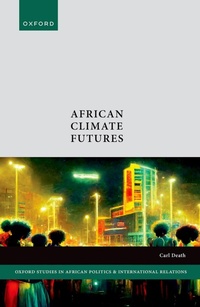
African Climate Futures
Published on 10. July 2025
Book
Hardback
272 pages
978-0-19-896074-4 (ISBN)
Description
African Climate Futures shows how climate-changed futures are imagined in Africa and by Africans, and how these future visions shape political debates and struggles in the present. Scientific climate scenarios forecast bleak futures, with increased droughts, floods, lethal heatwaves, sea level rises, declining crop yields, and greater exposure to vector-borne diseases. Yet, African climate futures could also encompass energy transitions and socio-economic revolutions, transformed political agency and human subjectivities, and radically reparative more-than-human climate politics.
At the heart of the book is an original and interdisciplinary approach. It studies official climate policy strategies and fictional texts side-by-side, as ecopolitical imaginaries that envision low-carbon, climate-changed futures, and narrate pathways from 'here' to 'there'. It discusses net zero strategies from Ethiopia, The Gambia, Nigeria, South Africa, and Zimbabwe and draws on postcolonial, feminist, and queer theory, arguing that Africanfuturist climate fiction can inspire more radical, reparative, more-than-human ecopolitical imaginaries. These stories can help us to understand the debts we all owe, imagine what reparations might entail, and explore the contours of living convivially alongside more-than-human others in heterotopian, climate-changed futures.
Stories can help explore how we might feel in climate-changed futures and can help us to narrate a path through them. This book uses Africanfuturist climate fiction to inspire new ways of challenging and enriching theoretical debates in global climate change politics, including how we understand the places, temporalities, ecologies, and politics of climate futures. If we want to survive to tell new stories in liveable futures then we need to urgently and radically transform carboniferous capitalism.
Oxford Studies in African Politics and International Relations is a series for scholars
and students working on African politics and International Relations and related
disciplines. Volumes concentrate on contemporary developments in African political
science, political economy, and International Relations, such as electoral politics,
democratization, decentralization, gender and political representation, the political
impact of natural resources, the dynamics and consequences of conflict, comparative
political thought, and the nature of the continent's engagement with the East and
West. Comparative and mixed methods work is particularly encouraged. Case studies
are welcomed but should demonstrate the broader theoretical and empirical
implications of the study and its wider relevance to contemporary debates. The focus
of the series is on sub-Saharan Africa, although proposals that explain how the region
engages with North Africa and other parts of the world are of interest.
Series Editors: Nic Cheeseman (University of Birmingham), Peace Medie (University of Bristol), and Ricardo Soares de Oliveira (University of Oxford).
At the heart of the book is an original and interdisciplinary approach. It studies official climate policy strategies and fictional texts side-by-side, as ecopolitical imaginaries that envision low-carbon, climate-changed futures, and narrate pathways from 'here' to 'there'. It discusses net zero strategies from Ethiopia, The Gambia, Nigeria, South Africa, and Zimbabwe and draws on postcolonial, feminist, and queer theory, arguing that Africanfuturist climate fiction can inspire more radical, reparative, more-than-human ecopolitical imaginaries. These stories can help us to understand the debts we all owe, imagine what reparations might entail, and explore the contours of living convivially alongside more-than-human others in heterotopian, climate-changed futures.
Stories can help explore how we might feel in climate-changed futures and can help us to narrate a path through them. This book uses Africanfuturist climate fiction to inspire new ways of challenging and enriching theoretical debates in global climate change politics, including how we understand the places, temporalities, ecologies, and politics of climate futures. If we want to survive to tell new stories in liveable futures then we need to urgently and radically transform carboniferous capitalism.
Oxford Studies in African Politics and International Relations is a series for scholars
and students working on African politics and International Relations and related
disciplines. Volumes concentrate on contemporary developments in African political
science, political economy, and International Relations, such as electoral politics,
democratization, decentralization, gender and political representation, the political
impact of natural resources, the dynamics and consequences of conflict, comparative
political thought, and the nature of the continent's engagement with the East and
West. Comparative and mixed methods work is particularly encouraged. Case studies
are welcomed but should demonstrate the broader theoretical and empirical
implications of the study and its wider relevance to contemporary debates. The focus
of the series is on sub-Saharan Africa, although proposals that explain how the region
engages with North Africa and other parts of the world are of interest.
Series Editors: Nic Cheeseman (University of Birmingham), Peace Medie (University of Bristol), and Ricardo Soares de Oliveira (University of Oxford).
More details
Series
Language
English
Place of publication
Oxford
United Kingdom
Target group
Professional and scholarly
Product notice
sewn/stitched
Cloth over boards
Dimensions
Height: 226 mm
Width: 152 mm
Thickness: 25 mm
Weight
567 gr
ISBN-13
978-0-19-896074-4 (9780198960744)
Copyright in bibliographic data and cover images is held by Nielsen Book Services Limited or by the publishers or by their respective licensors: all rights reserved.
Schweitzer Classification
Person
Carl Death is a Senior Lecturer in International Political Economy at the University of Manchester. He was previously at the Department of International Politics, Aberystwyth University, and the School of Law and Government, Dublin City University. His work focuses on environmental politics in Africa with a particular interest in critical and postcolonial approaches.