

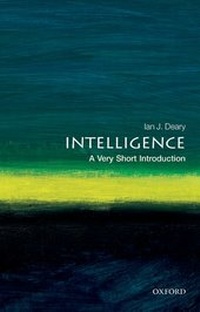
Intelligence: A Very Short Introduction
A Very Short Introduction
Published on 22. February 2001
Book
Paperback/Softback
160 pages
978-0-19-289321-5 (ISBN)
Description
People value their powers of thinking and most of us are interested in why some people seem to drive a highly tuned Rolls Royce brain while others potter along with a merely serviceable Ford Fiesta. This Very Short Introduction describes what psychologists have discovered about how and why people differ in their thinking powers.
The book takes readers from no knowledge about the science of human intelligence to a stage where they are able to make judgements for themselves about some of the key questions about human mental ability differences. Each chapter deals with a central issue that is both scientifically lively and of considerable general interest, and is structured around a diagram which is explained in the course of the chapter. The issues discussed include whether there are several different types of
intelligence, whether intelligence differences are caused by genes or the environment, the biological basis of intelligence differences, and whether intelligence declines or increases as we grow older.
ABOUT THE SERIES: The Very Short Introductions series from Oxford University Press contains hundreds of titles in almost every subject area. These pocket-sized books are the perfect way to get ahead in a new subject quickly. Our expert authors combine facts, analysis, perspective, new ideas, and enthusiasm to make interesting and challenging topics highly readable.
The book takes readers from no knowledge about the science of human intelligence to a stage where they are able to make judgements for themselves about some of the key questions about human mental ability differences. Each chapter deals with a central issue that is both scientifically lively and of considerable general interest, and is structured around a diagram which is explained in the course of the chapter. The issues discussed include whether there are several different types of
intelligence, whether intelligence differences are caused by genes or the environment, the biological basis of intelligence differences, and whether intelligence declines or increases as we grow older.
ABOUT THE SERIES: The Very Short Introductions series from Oxford University Press contains hundreds of titles in almost every subject area. These pocket-sized books are the perfect way to get ahead in a new subject quickly. Our expert authors combine facts, analysis, perspective, new ideas, and enthusiasm to make interesting and challenging topics highly readable.
Reviews / Votes
it is short and extremely readable * Journal of Advanced Nursing 2001 *More details
Series
Language
English
Place of publication
Oxford
United Kingdom
Illustrations
drawings and halftones
Dimensions
Height: 179 mm
Width: 112 mm
Thickness: 8 mm
Weight
138 gr
ISBN-13
978-0-19-289321-5 (9780192893215)
Copyright in bibliographic data and cover images is held by Nielsen Book Services Limited or by the publishers or by their respective licensors: all rights reserved.
Schweitzer Classification
Other editions
New editions
Book
03/2020
2nd Edition
Oxford University Press
€13.00
Shipment within 15-20 days
Person
Ian Deary is Professor of Psychology at Edinburgh University, and author of Personality Traits (1998, with Gerald Matthews). His next book, Looking Down on Human Intelligence, will be published this year by OUP.
Content
Preface ; List of illustrations ; A word about correlation ; 1. To see 'g' or not to see 'g': How many types of intelligence are there? ; 2. Ageing and intelligence - senility or sagacity? What happens to mental abilities as we grow older? ; 3. Brainy? Why are some people cleverer than others? ; 4. 'They **** you up your Mum and Dad': Are intelligence differences a result of genes or environments or both? ; 5. The (b)right man for the job: Does intelligence matter? ; 6. The lands of the rising IQ: Is intelligence changing generation by generation? ; 7. Twelve angry men: Getting experts to agree about human intelligence differences ; Further reading ; Index