

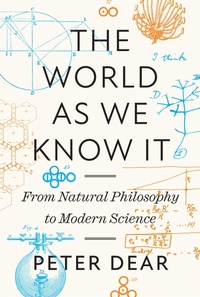
The World as We Know It
From Natural Philosophy to Modern Science
Published on 21. October 2025
Book
Hardback
384 pages
978-0-691-23584-4 (ISBN)
Description
From the award-winning author of Revolutionizing the Sciences, a monumental historical account of how we came to see the world through the lens of science
Science is the basis of our assumptions about ourselves and our world, from ideas about our evolutionary past to our conceptions of the vast expanses of space and the smallest particles of matter. In this panoramic book, acclaimed historian of science Peter Dear uncovers the roots of such beliefs, revealing how they constitute a natural philosophy that has been developed and refined over the course of centuries-and how the world as we have come to know it was by no means inevitable.
In a sweeping, multifaceted narrative, Dear describes some of the most breathtaking accomplishments in the advance of human knowledge, such as Isaac Newton's laws of motion and gravitation, Carl Linnaeus's taxonomy, Antoine Lavoisier's new chemistry, Charles Darwin's theory of evolution, and Albert Einstein's theories of relativity. Challenging the notion that science is only about "making discoveries," he shows how our world has been formed by people, institutions, and cultural assumptions, giving rise to disciplines ranging from biology and astrophysics to electromagnetism and the social sciences.
Taking readers from the early eighteenth century to today, The World as We Know It reveals how our ideas about our place in the universe were bequeathed to us by individuals, cultures, and a curiosity that knows no bounds.
Science is the basis of our assumptions about ourselves and our world, from ideas about our evolutionary past to our conceptions of the vast expanses of space and the smallest particles of matter. In this panoramic book, acclaimed historian of science Peter Dear uncovers the roots of such beliefs, revealing how they constitute a natural philosophy that has been developed and refined over the course of centuries-and how the world as we have come to know it was by no means inevitable.
In a sweeping, multifaceted narrative, Dear describes some of the most breathtaking accomplishments in the advance of human knowledge, such as Isaac Newton's laws of motion and gravitation, Carl Linnaeus's taxonomy, Antoine Lavoisier's new chemistry, Charles Darwin's theory of evolution, and Albert Einstein's theories of relativity. Challenging the notion that science is only about "making discoveries," he shows how our world has been formed by people, institutions, and cultural assumptions, giving rise to disciplines ranging from biology and astrophysics to electromagnetism and the social sciences.
Taking readers from the early eighteenth century to today, The World as We Know It reveals how our ideas about our place in the universe were bequeathed to us by individuals, cultures, and a curiosity that knows no bounds.
Reviews / Votes
"Winner of the PROSE Award in History of Science, Medicine, and Technology, Association of American Publishers" "In a sweeping, multifaceted narrative, Dear describes some of the most breathtaking accomplishments in the advance of human knowledge."---Mark Beumer, Kleio-Historia "An engaging and rigorous account, offering readers a broad and coherent education in the making of modern science."---Deyan Mihaylov, Nature Astronomy "This valuable introduction to the transition from natural philosophy to modern science can also provide those familiar with this history with challenging interpretations. . . . Recommended." * Choice * "The World as We Know It offers a series of sharp and succinct engagements with many of the iconic episodes that compose the much-maligned canon of the history of science. . . . [It] should be fodder for the historiographical canon."---Joseph D. Martin, History of European IdeasMore details
Language
English
Place of publication
New Jersey
United States
Target group
College/higher education
Professional and scholarly
Product notice
Trade binding
Illustrations
44 b/w illus.
Dimensions
Height: 240 mm
Width: 159 mm
Thickness: 32 mm
Weight
688 gr
ISBN-13
978-0-691-23584-4 (9780691235844)
Copyright in bibliographic data and cover images is held by Nielsen Book Services Limited or by the publishers or by their respective licensors: all rights reserved.
Schweitzer Classification
Other editions
Additional editions
E-Book
10/2025
1st Edition
Princeton University Press
€33.99
Available for download
Person
Peter Dear is professor emeritus of history at Cornell University. His books include Revolutionizing the Sciences: European Knowledge in Transition, 1500-1700 (Princeton), The Intelligibility of Nature: How Science Makes Sense of the World, and Discipline and Experience: The Mathematical Way in the Scientific Revolution.