

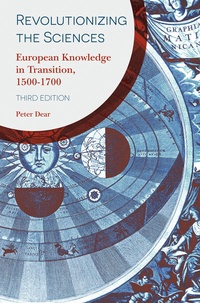
Revolutionizing the Sciences
European Knowledge in Transition, 1500-1700
3rd Edition
Published on 3. December 2018
Book
Paperback/Softback
XII, 220 pages
978-1-352-00313-0 (ISBN)
Description
This heavily revised third edition of an award-winning text offers a keen insight into the development of scientific thought in early modern Europe. Including coverage of the central scientific figures of the time, including Copernicus, Kelper, Galileo, Newton and Bacon, this book provides a comprehensive overview of how the Scientific Revolution happened and why. Highlighting Europe's colonial and trade expansion in the sixteenth and seventeenth centuries, Peter Dear traces the revolution in scientific thought that changed the natural world from something to be contemplated into something to be used.
This book is ideal for undergraduate and postgraduate students of Early Modern History, European History, History of Medicine, History of Science and Technology and the History and Philosophy of Science. The first edition was the winner of the Watson Davis and Helen Miles Davis Prize of the History of Science Society.Reviews / Votes
This book is required reading for students and teachers of science in early modern Europe. With clear prose and a strong narrative, Dear guides the reader through the methodological and metaphysical upheavals that defined early modern science. * Michael Bycroft, University of Warwick, UK * Revolutionizing the Sciences is a highly-engaging and readable history that both explains traditional interpretations of the Scientific Revolution and offers challenging and innovative revisions to those accounts. The book is a critical starting-point for understanding the many fascinating debates around the origins of modern science going on today. * Simon Werrett, University College London, UK *More details
Edition
3rd ed. 2019
Language
English
Place of publication
London
United Kingdom
Publishing group
Bloomsbury Publishing PLC
Target group
College/higher education
Dimensions
Height: 23.5 cm
Width: 15.5 cm
Thickness: 16 mm
Weight
361 gr
ISBN-13
978-1-352-00313-0 (9781352003130)
DOI
10.26777/978-1-352-00314-7
Schweitzer Classification
Other editions
Additional editions
Book
02/2019
3rd Edition
Red Globe Press
€92.01
Shipment within 15-20 days
E-Book
11/2018
3rd Edition
Bloomsbury Academic
€60.99
Available for download
Previous edition
Book
12/2008
2nd Edition
Red Globe Press
€97.36
Article exhausted; check for reprint
Person
PETER DEAR is Professor of History and of Science and Technology Studies, Cornell University, USA.
Content
Preface.- Introduction: Natural Philosophy and Instrumentality.- 'What Was Worth Knowing' in 1500.- Humanism and Ancient Wisdom: How to Learn Things in the Sixteenth Century.- Paracelsus and Bacon: Philosophy as Practical Knowledge.- Mathematical Practitioners and Mathematical Philosophers.- Mechanism and Corpuscles: Descartes Builds a Universe.- Extra-Curricular Activities: New Places for Natural Knowledge.- Experiment: How to Learn Things about Nature in the Seventeenth Century.- Cartesians and Newtonians.- Conclusion: What Was Worth Knowing by the Eighteenth Century?.- Notes and References.- Documentation and Further Reading.- Dramatis Personae.- Glossary of Major Terms.- Index.