

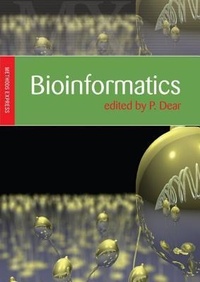
Bioinformatics
Methods Express
Will be published approx. on 24. September 2007
Book
Hardback
294 pages
978-1-904842-23-1 (ISBN)
Description
Bioinformatics: Methods Express is unique. It is a book on bioinformatics that makes sense to non-bioinformaticians.
Bioinformatics: Methods Express helps you answer common questions such as:
*what else is similar to my gene?
*does this protein have any transmembrane regions?
*how do I visualize an alignment between these DNAs?
*where can I find specific transcription factor sequences?
The book provides the clear advice and explicit protocols that non-bioinformaticians need in order to understand what to do - and how to avoid common pitfalls. Each chapter guides you through the major databases and tools with worked examples - all accompanied by sample data files available online.
Topics covered include:
*data access
*sequence searches and alignments
*identification and annotation of features
*the transcriptome
*protein structure and function
*comparisons and phylogeny
Bioinformatics: Methods Express is a comprehensive manual for all wet-bench scientists who need to use bioinformatics - from postgraduate student to principal investigator.
www.scionpublishing.com/bioinformatics contains comprehensive datasets which allow the reader to practise the techniques described in the book.
Bioinformatics: Methods Express helps you answer common questions such as:
*what else is similar to my gene?
*does this protein have any transmembrane regions?
*how do I visualize an alignment between these DNAs?
*where can I find specific transcription factor sequences?
The book provides the clear advice and explicit protocols that non-bioinformaticians need in order to understand what to do - and how to avoid common pitfalls. Each chapter guides you through the major databases and tools with worked examples - all accompanied by sample data files available online.
Topics covered include:
*data access
*sequence searches and alignments
*identification and annotation of features
*the transcriptome
*protein structure and function
*comparisons and phylogeny
Bioinformatics: Methods Express is a comprehensive manual for all wet-bench scientists who need to use bioinformatics - from postgraduate student to principal investigator.
www.scionpublishing.com/bioinformatics contains comprehensive datasets which allow the reader to practise the techniques described in the book.
More details
Language
English
Place of publication
Bloxham
United Kingdom
Target group
College/higher education
Professional and scholarly
Product notice
sewn/stitched
Cloth over boards
Dimensions
Height: 234 mm
Width: 156 mm
Thickness: 20 mm
Weight
850 gr
ISBN-13
978-1-904842-23-1 (9781904842231)
Copyright in bibliographic data and cover images is held by Nielsen Book Services Limited or by the publishers or by their respective licensors: all rights reserved.
Schweitzer Classification
Other editions
Additional editions
E-Book
09/2007
1st Edition
Scion Publishing
€44.99
Available for download
Content
INTRODUCTION
(Paul H. Dear)
1. Database resources for wet-bench scientists (Neil Hall and Lynn Schriml)
2. Navigating sequenced genomes (Melody Clark and Thomas Schlitt)
3. Sequence similarity searches (Jaap Heringa and Walter Pirovano)
4. Gene prediction (Marie-Adele Rajandream)
5. Prediction of non coding transcripts (Alex Bateman and Sam Griffiths-Jones)
6. Finding regulatory elements in DNA sequence (Debraj GuhaThakurta and Gary Stormo)
7. Expressed sequence tags (Arthur Gruber)
8. Protein structure, classification and prediction (Arthur Lesk)
9. Gene ontology (Vineet Sangar)
10. Prediction of protein function (Rodrigo Lopez)
11. Multiple sequence alignment (Burkhard Morgenstern)
12. Inferring phylogenetic relationships from sequence data (Peter Foster)
Appendix
Index
(Paul H. Dear)
1. Database resources for wet-bench scientists (Neil Hall and Lynn Schriml)
2. Navigating sequenced genomes (Melody Clark and Thomas Schlitt)
3. Sequence similarity searches (Jaap Heringa and Walter Pirovano)
4. Gene prediction (Marie-Adele Rajandream)
5. Prediction of non coding transcripts (Alex Bateman and Sam Griffiths-Jones)
6. Finding regulatory elements in DNA sequence (Debraj GuhaThakurta and Gary Stormo)
7. Expressed sequence tags (Arthur Gruber)
8. Protein structure, classification and prediction (Arthur Lesk)
9. Gene ontology (Vineet Sangar)
10. Prediction of protein function (Rodrigo Lopez)
11. Multiple sequence alignment (Burkhard Morgenstern)
12. Inferring phylogenetic relationships from sequence data (Peter Foster)
Appendix
Index