

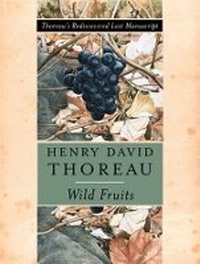
Wild Fruits
Thoreau's Rediscovered Last Manuscript
Published on 17. November 1999
Book
Hardback
432 pages
978-0-393-04751-6 (ISBN)
Description
The distinctly American gospel--never before published--of our great nature writer, mystic, ecologist, and prophet. "Above all, we cannot afford not to live in the present . . . . There is something suggested by [the cockcrow] not in Plato nor the New Testament. It is a newer testament--the Gospel according to this moment," Henry David Thoreau wrote in "a sort of introduction" to Wild Fruits--his last manuscript and his transcendental gospel of the sacredness of nature. The difficulties of his handwriting, method of composition, notations, and pagination have kept his final observations and meditations from publication until now; thanks to the assiduous efforts of Thoreau specialist Bradley Dean, this great work can finally be brought to light. Wild Fruits is beautifully illustrated throughout with line drawings of the "wild fruits" Thoreau considers, as he writes, for example, "Famous fruits imported from the East or South . . . do not concern me so much as many an unnoticed wild berry whose beauty annually lends a new charm to some wild walk . . ." This work may be considered Thoreau's last will and testament, in which he protests our desecration of the landscape and envisions a new American scripture. As Dean writes, "the Thoreau New Testament suggests that the Holy Land is under our feet, as well as over our heads."
More details
Language
English
Place of publication
New York
United States
Target group
College/higher education
Professional and scholarly
Dimensions
Height: 244 mm
Width: 185 mm
Thickness: 36 mm
Weight
986 gr
ISBN-13
978-0-393-04751-6 (9780393047516)
Copyright in bibliographic data and cover images is held by Nielsen Book Services Limited or by the publishers or by their respective licensors: all rights reserved.
Schweitzer Classification
Persons
Bradley P. Dean, an independent scholar living in West Peterborough, New Hampshire, has written extensively on Thoreau's life and writings, and has edited two of Thoreau's previously unpublished booklength manuscripts. Henry David Thoreau spent almost his entire life in the village of Concord, Massachusetts, where he was born in 1817. After graduating from Harvard College in 1837, he developed a deep friendship with the writer and philosopher Ralph Waldo Emerson, the foremost figure in the Transcendentalist movement. Emerson's emphasis on the cultivation of intuition and experience as keys to personal and social enlightenment profoundly influenced Thoreau. In 1845, Thoreau built a small cabin on a parcel of land Emerson owned near Walden Pond, where he lived for most of two years, seeking a new relationship to nature, society, and his own self. His experiences there are the raw material of his masterpiece, Walden, or Life in the Woods. Although he was first and last a writer and outdoorsman, Thoreau worked as a surveyor and handyman and was an active abolitionist and opponent of war and imperialism. He died in 1862 of tuberculosis.