

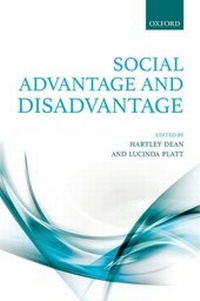
Social Advantage and Disadvantage
Published on 21. January 2016
Book
Hardback
392 pages
978-0-19-873707-0 (ISBN)
Description
Social advantage and disadvantage are potent catch-all terms. They have no established definition but, considered in relation to one another, they can embrace a wide variety of more specific concepts that address the ways in which human society causes, exacerbates or fails to prevent social divisions or injustices. This book captures the sense in which any conceptualisation of disadvantage is concerned with the consequences of processes by which relative advantage has been selectively conferred or attained. It considers how inequalities and social divisions are created as much by the concentration of advantage among the best-off as by the systematic disadvantage of the worst-off.
The book critically discusses - from a global and a UK perspective - a spectrum of conceptual frameworks and ideas relating to poverty, social exclusion, capability deprivation, rights violations, social immobility, and human or social capital deficiency. It addresses advantage and disadvantage from a life course perspective through discussions of family and childhood, education, work, old age, and the dynamics of income and wealth. It considers cross-cutting divides that are implicated in the social construction and maintenance of advantage and disadvantage, including divisions premised on gender, 'race', ethnicity, migration and religion, neighbourhood and the experience of crime.
The book critically discusses - from a global and a UK perspective - a spectrum of conceptual frameworks and ideas relating to poverty, social exclusion, capability deprivation, rights violations, social immobility, and human or social capital deficiency. It addresses advantage and disadvantage from a life course perspective through discussions of family and childhood, education, work, old age, and the dynamics of income and wealth. It considers cross-cutting divides that are implicated in the social construction and maintenance of advantage and disadvantage, including divisions premised on gender, 'race', ethnicity, migration and religion, neighbourhood and the experience of crime.
Reviews / Votes
... this book represents significant progress towards positioning the concept of social advantage and disadvantage as a core concern of social policy scholarship. * Peter Saunders, Journal of Social Policy *More details
Other editions
Additional editions
Hartley Dean | Lucinda Platt
Social Advantage and Disadvantage
E-Book
01/2016
1st Edition
OUP eBook
€40.49
Available for download
Hartley Dean | Lucinda Platt
Social Advantage and Disadvantage
E-Book
01/2016
1st Edition
OUP eBook
€40.49
Available for download
Persons
Hartley Dean is Professor of Social Policy at the London School of Economics. Before his academic career he had been a welfare rights worker in one of London's most deprived multi-cultural neighbourhoods. His principal research interests stem from concerns with poverty and social justice. He is a past editor of the Journal of Social Policy and among his more recently published books are Social Policy (Polity, 2006 and 2012), Understanding Human Need (The Policy Press, 2010) and Social Rights and Human Welfare (Routledge, 2015).
Lucinda Platt is Professor of Social Policy and Sociology at the London School of Economics and Political Science. Before joining the LSE she worked at Essex University and at UCL Institute of Education, where she was Director of the Millennium Cohort Study. A quantitative sociologist, Lucinda's main research interests are in inequalities and social stratification, in particular child poverty, ethnicity, immigration and disability, and in longitudinal approaches to analysis of these issues. Her most recent book was Understanding Inequalities: Stratification and Difference (Polity, 2011), and she is co-author of Intergenerational Consequences of Migration (forthcoming Palgrave Macmillan).
Lucinda Platt is Professor of Social Policy and Sociology at the London School of Economics and Political Science. Before joining the LSE she worked at Essex University and at UCL Institute of Education, where she was Director of the Millennium Cohort Study. A quantitative sociologist, Lucinda's main research interests are in inequalities and social stratification, in particular child poverty, ethnicity, immigration and disability, and in longitudinal approaches to analysis of these issues. Her most recent book was Understanding Inequalities: Stratification and Difference (Polity, 2011), and she is co-author of Intergenerational Consequences of Migration (forthcoming Palgrave Macmillan).
Content
PART ONE; PART TWO; PART THREE; PART 4