

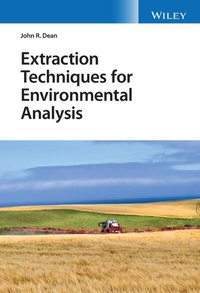
Extraction Techniques for Environmental Analysis
1st Edition
Published on 24. March 2022
Book
Hardback
384 pages
978-1-119-71904-5 (ISBN)
Description
Extraction Techniques for Environmental Analysis Explore the analytical approach to extraction techniques
In Extraction Techniques for Environmental Analysis, accomplished environmental scientist and researcher John R. Dean delivers a comprehensive discussion of the extraction techniques used for organic compounds relevant to environmental analysis. In the book, extraction techniques for aqueous, air, and solid environmental matrices are explored and case studies that highlight those techniques are included.
Readers will find in-depth treatments of specific extraction techniques suitable for adoption in their own laboratories, as well as reviews of relevant analytical techniques used for the analysis of organic compound extracts (with a focus on chromatographic separation and detection).
Extraction Techniques for Environmental Analysis also includes a chapter that extensively covers the requirements for an analytical laboratory, including health and safety standards, as well as:
A thorough introduction to pre-sampling, as well as the extraction of aqueous samples, including the classical approach for aqueous extraction and solid phase extraction
Comprehensive explorations of the extraction of gaseous samples, including air sampling
Practical discussions of the extraction of solid samples, including pressurized fluid extraction and microwave-assisted extraction
In-depth examinations of post-extraction procedures, including pre-concentration using solvent evaporation
Extraction Techniques for Environmental Analysis is a must-read resource for undergraduate students of applied chemistry, as well as postgraduates taking analytical chemistry courses or courses in related disciplines, like forensic or environmental science.
In Extraction Techniques for Environmental Analysis, accomplished environmental scientist and researcher John R. Dean delivers a comprehensive discussion of the extraction techniques used for organic compounds relevant to environmental analysis. In the book, extraction techniques for aqueous, air, and solid environmental matrices are explored and case studies that highlight those techniques are included.
Readers will find in-depth treatments of specific extraction techniques suitable for adoption in their own laboratories, as well as reviews of relevant analytical techniques used for the analysis of organic compound extracts (with a focus on chromatographic separation and detection).
Extraction Techniques for Environmental Analysis also includes a chapter that extensively covers the requirements for an analytical laboratory, including health and safety standards, as well as:
A thorough introduction to pre-sampling, as well as the extraction of aqueous samples, including the classical approach for aqueous extraction and solid phase extraction
Comprehensive explorations of the extraction of gaseous samples, including air sampling
Practical discussions of the extraction of solid samples, including pressurized fluid extraction and microwave-assisted extraction
In-depth examinations of post-extraction procedures, including pre-concentration using solvent evaporation
Extraction Techniques for Environmental Analysis is a must-read resource for undergraduate students of applied chemistry, as well as postgraduates taking analytical chemistry courses or courses in related disciplines, like forensic or environmental science.
More details
Language
English
Place of publication
Hoboken
United States
Publishing group
John Wiley and Sons Ltd
Target group
Professional and scholarly
Dimensions
Height: 244 mm
Width: 170 mm
Thickness: 24 mm
Weight
851 gr
ISBN-13
978-1-119-71904-5 (9781119719045)
Copyright in bibliographic data and cover images is held by Nielsen Book Services Limited or by the publishers or by their respective licensors: all rights reserved.
Schweitzer Classification
Other editions
Additional editions
John R. Dean
Extraction Techniques for Environmental Analysis
E-Book
02/2022
1st Edition
Wiley
€109.99
Available for download
John R. Dean
Extraction Techniques for Environmental Analysis
E-Book
02/2022
1st Edition
Wiley
€109.99
Available for download
Person
John R. Dean is Professor of Analytical and Environmental Sciences at Northumbria University in the United Kingdom. His research is focused on investigating organic and inorganic pollutants in the environment using a range of analytical techniques.
Content
Section A: Initial Considerations
1. The Analytical Approach
Learning objectives
1.0 Introduction
1.1 Environmental organic compounds of concern
1.2 Essentials of practical work
1.3 Health and safety
1.4 Considerations for data presentation
1.5 Use and determination of significant figures
1.6 Units
1.7 Calibration and quantitative analysis
1.8 Terminology in quantitative analysis
1.9 Preparing solutions for quantitative work
1.10 Calibration graphs
1.11 The internal standard
1.12 Limits of detection / quantitation
1.13 Dilution or concentration factors
1.14 Quality assurance
1.15 Use of certified reference materials
1.16 Applications
Further Reading
Section B: Sampling
2. Sampling and storage
Learning objectives
2.0 Introduction
2.1 Sampling strategy
2.2 Types of aqueous matrices
2.3 Types of soil matrices
2.4 Physicochemical properties of water and solid environmental matrices
2.4.1 Aqueous (water) samples
2.4.2 Solid (soil) samples
2.5 Sampling soil (and/or sediment)
2.6 Sampling water
2.7 Sampling air
2.8 Sampling and analytical operations inter-relationships and terminology
2.9 Storage of samples
2.9.1 Choice of storage container for liquid samples
2.9.2 Cleaning of storage container for liquid samples
2.10 Preservation techniques for liquid samples
2.11 Preservation techniques for solid samples
2.12 Preservation techniques for gaseous samples
2.13 Applications
Reference
Section C: Extraction of Aqueous Samples
3. Classical approach for aqueous extraction
Learning objectives
3.0 Introduction
3.1 Liquid-liquid extraction
3.1.1 Theory of liquid-liquid extraction
3.1.2 Selection of solvents
3.1.3 Solvent extraction
3.1.4 Problems with the liquid-liquid extraction process and their remedies
3.2 Liquid microextraction techniques
3.2.1 Single drop microextraction (SDME)
3.2.2 Dispersive liquid-liquid microextraction (DLLME)
3.3 Purge and trap
3.4 Headspace extraction
3.4.1 Procedure for static headspace sampling
3.4.2 Procedure for dynamic headspace sampling
3.5 Application
4. Solid phase extraction
Learning objectives
4.0 Introduction
4.1 Types of SPE sorbent
4.2 SPE formats and apparatus
4.3 Method of SPE operation
4.4 Solvent selection
4.5 Factors affecting SPE
4.6 Selected methods of analysis for SPE
4.6.1 Application of reversed phase SPE
4.6.2 Application of normal phase SPE
4.6.3 Application of ion exchange SPE
4.6.4 Application of mixed mode SPE
4.7 Automation and on-line SPE
4.8 Applications
4.9 Summary
References
5. Solid phase microextraction
Learning objectives
5.0 Introduction
5.1 Theoretical considerations for SPME
5.2 Practical considerations for SPME
5.2.1 SPME agitation methods
5.2.2 Other SPME operating considerations
5.3 Application of SPME
5.4 Summary
Reference
6. In-Tube extraction
Learning objectives
6.0 Introduction
6.1 Microextraction in a packed syringe (MEPS)
6.1.1 Procedure for MEPS
6.1.2 Main issues in MEPS
6.2 In-tube extraction (ITEX)
6.2.1 Procedure for ITEX-DHS
6.3 Application of ITEX-DHS
6.4 Summary
7. Stir-bar sorptive extraction
Learning objectives
7.0 Introduction
7.1 Theoretical considerations for SBSE
7.2 Practical issues for SBSE
7.2.1 Main issues in SBSE
7.3 Application of SBSE
7.4 Summary
8. Membrane extraction
Learning objectives
8.0 Introduction
8.1 Theoretical considerations for membrane extraction
8.1.1 Mass transfer coefficient model
8.1.2 Chemical reaction kinetic model
8.2 Passive sampling devices
8.3 Application of passive sampling using Chemcatcher (R)
8.4 Summary
Reference
Section D: Extraction of Solid Samples
9.0 Classical approaches for extraction of solid samples
Learning objectives
9.0 Introduction
9.1 Theory of liquid-solid extraction
9.2 Soxhlet extraction
9.2.1 Experimental
9.3 Soxtec extraction
9.4 Ultrasonic extraction
9.4.1 Experimental
9.5 Shake flask extraction
9.5.1 Experimental
9.6 Application
Reference
10. Pressurised liquid extraction
Learning objectives
10.0 Introduction
10.1 Theoretical considerations relating to extraction process
10.1.2 Disruption of surface equilibrium (by temperature and pressure)
10.2 Instrumentation for PLE
10.3 A typical procedure for PLE
10.4 In-situ clean-up or selective PLE
10.5 Method development for PLE
10.5.1 Pre-extraction considerations
10.5.2 Packing the extraction vessel
10.6 Applications of PLE
10.7 Summary
References
11. Microwave-assisted extraction
Learning objectives
11.0 Introduction
11.1 Theoretical considerations for MAE
11.1.1 Selecting an organic solvent for MAE
11.1.2 Heating methods
11.1.3 Calibration of a microwave instrument
11.2 Instrumentation for MAE
11.3 A typical procedure for MAE
11.4 Applications of MAE
11.5 Summary
References
12. Matrix Solid phase dispersion
Learning objectives
12.0 Introduction
12.1 Practical considerations for MSPD
12.2 Optimization of MSPD
12.3 Application of MSPD
12.4 Summary
13. Supercritical fluid extraction
Learning objectives
13.0 Introduction
13.1 Theoretical considerations for SFE
13.2 Supercritical CO2
13.3 Instrumentation for SFE
13.4 A typical procedure for SFE
13.5 Application of SFE
13.6 Summary
References
Section E: Extraction of Gaseous Samples
14. Air sampling
Learning objectives
14.0 Introduction
14.1 Techniques used for air sampling
14.1.1 whole air collection
14.1.2 Enrichment onto solid sorbents
14.2 Thermal desorption
14.3 Workplace exposure limits
14.4 Biological monitoring
14.5 Particulate matter
14.6 Application of air sampling
14.7 Summary
References
Section F: Post-extraction
15. Pre-concentration and associated sample extract procedures
Learning objectives
15.0 Introduction
15.1 Solvent evaporation techniques
15.1.1 Needle evaporation
15.1.2 Automated evaporator (Turbovap)
15.1.3 Rotary evaporation
15.1.4 Kuderna-Danish evaporative concentration
15.1.5 Automated evaporative concentration system
15.2 Post-extract evaporation
15.3 Sample extract clean-up procedures
15.3.1 Column chromatography
15.3.2 Acid-alkaline partition
15.3.3 Acetonitrile-hexane partition
15.3.4 Sulfur clean-up
15.3.5 Alkaline decomposition
15.4 Derivatization for gas chromatography
15.5 Application of pre-concentration for analysis
References
16. Instrumental Techniques for Environmental Organic Analysis
Learning objectives
16.0 Introduction
16.1 Theory of chromatography
16.2 Chromatography detectors: The essentials
16.3 Gas chromatography
16.3.1 Choice of gas for GC
16.3.2 Sample introduction in GC
16.3.3 The GC oven
16.3.4 The GC column
16.3.5 GC detectors
16.3.6 Compound derivatization for GC
16.4 High performance liquid chromatography
16.4.1 The mobile phase in HPLC
16.4.2 Sample introduction in HPLC
16.4.3 The HPLC column
16.4.4 Detectors for HPLC
16.5 Other techniques for environmental organic analysis
16.5.1 Infra-red spectroscopy
16.5.2 Nuclear magnetic resonance spectrometry
16.5.3 Portable techniques for field measurements
16.6 Applications of chromatography in environmental analysis
16.7 Summary
16.8 Further reading
References
Section G: Post-analysis: Decision making
17. Environmental problem solving
Learning objectives
17.0 Introduction
17.1 Case study 1. Defining the problem: Initial planning and considerations
17.2 Case study 2. A consideration of the whole concept of environmental analysis
17.3 Case study 3. Environmental Chemistry Escape Room
References
Section H: Historical context
18. A history of extraction techniques and chromatographic analysis
Learning objectives
18.0 Introduction
18.1 Application
References
Appendices: Crossword puzzles to aid learning and understanding
Appendix A1: A crossword of key terms in Chapters 4 to 8: extraction techniques for aqueous samples.
Appendix A2: A crossword of key terms in Chapters 10 to 13: extraction techniques for solid samples.
Appendix A3: A crossword for key terms on instrumental techniques for environmental organic analysis.
Crossword solutions
SI units and Physical Constants
Periodic Table
Index
1. The Analytical Approach
Learning objectives
1.0 Introduction
1.1 Environmental organic compounds of concern
1.2 Essentials of practical work
1.3 Health and safety
1.4 Considerations for data presentation
1.5 Use and determination of significant figures
1.6 Units
1.7 Calibration and quantitative analysis
1.8 Terminology in quantitative analysis
1.9 Preparing solutions for quantitative work
1.10 Calibration graphs
1.11 The internal standard
1.12 Limits of detection / quantitation
1.13 Dilution or concentration factors
1.14 Quality assurance
1.15 Use of certified reference materials
1.16 Applications
Further Reading
Section B: Sampling
2. Sampling and storage
Learning objectives
2.0 Introduction
2.1 Sampling strategy
2.2 Types of aqueous matrices
2.3 Types of soil matrices
2.4 Physicochemical properties of water and solid environmental matrices
2.4.1 Aqueous (water) samples
2.4.2 Solid (soil) samples
2.5 Sampling soil (and/or sediment)
2.6 Sampling water
2.7 Sampling air
2.8 Sampling and analytical operations inter-relationships and terminology
2.9 Storage of samples
2.9.1 Choice of storage container for liquid samples
2.9.2 Cleaning of storage container for liquid samples
2.10 Preservation techniques for liquid samples
2.11 Preservation techniques for solid samples
2.12 Preservation techniques for gaseous samples
2.13 Applications
Reference
Section C: Extraction of Aqueous Samples
3. Classical approach for aqueous extraction
Learning objectives
3.0 Introduction
3.1 Liquid-liquid extraction
3.1.1 Theory of liquid-liquid extraction
3.1.2 Selection of solvents
3.1.3 Solvent extraction
3.1.4 Problems with the liquid-liquid extraction process and their remedies
3.2 Liquid microextraction techniques
3.2.1 Single drop microextraction (SDME)
3.2.2 Dispersive liquid-liquid microextraction (DLLME)
3.3 Purge and trap
3.4 Headspace extraction
3.4.1 Procedure for static headspace sampling
3.4.2 Procedure for dynamic headspace sampling
3.5 Application
4. Solid phase extraction
Learning objectives
4.0 Introduction
4.1 Types of SPE sorbent
4.2 SPE formats and apparatus
4.3 Method of SPE operation
4.4 Solvent selection
4.5 Factors affecting SPE
4.6 Selected methods of analysis for SPE
4.6.1 Application of reversed phase SPE
4.6.2 Application of normal phase SPE
4.6.3 Application of ion exchange SPE
4.6.4 Application of mixed mode SPE
4.7 Automation and on-line SPE
4.8 Applications
4.9 Summary
References
5. Solid phase microextraction
Learning objectives
5.0 Introduction
5.1 Theoretical considerations for SPME
5.2 Practical considerations for SPME
5.2.1 SPME agitation methods
5.2.2 Other SPME operating considerations
5.3 Application of SPME
5.4 Summary
Reference
6. In-Tube extraction
Learning objectives
6.0 Introduction
6.1 Microextraction in a packed syringe (MEPS)
6.1.1 Procedure for MEPS
6.1.2 Main issues in MEPS
6.2 In-tube extraction (ITEX)
6.2.1 Procedure for ITEX-DHS
6.3 Application of ITEX-DHS
6.4 Summary
7. Stir-bar sorptive extraction
Learning objectives
7.0 Introduction
7.1 Theoretical considerations for SBSE
7.2 Practical issues for SBSE
7.2.1 Main issues in SBSE
7.3 Application of SBSE
7.4 Summary
8. Membrane extraction
Learning objectives
8.0 Introduction
8.1 Theoretical considerations for membrane extraction
8.1.1 Mass transfer coefficient model
8.1.2 Chemical reaction kinetic model
8.2 Passive sampling devices
8.3 Application of passive sampling using Chemcatcher (R)
8.4 Summary
Reference
Section D: Extraction of Solid Samples
9.0 Classical approaches for extraction of solid samples
Learning objectives
9.0 Introduction
9.1 Theory of liquid-solid extraction
9.2 Soxhlet extraction
9.2.1 Experimental
9.3 Soxtec extraction
9.4 Ultrasonic extraction
9.4.1 Experimental
9.5 Shake flask extraction
9.5.1 Experimental
9.6 Application
Reference
10. Pressurised liquid extraction
Learning objectives
10.0 Introduction
10.1 Theoretical considerations relating to extraction process
10.1.2 Disruption of surface equilibrium (by temperature and pressure)
10.2 Instrumentation for PLE
10.3 A typical procedure for PLE
10.4 In-situ clean-up or selective PLE
10.5 Method development for PLE
10.5.1 Pre-extraction considerations
10.5.2 Packing the extraction vessel
10.6 Applications of PLE
10.7 Summary
References
11. Microwave-assisted extraction
Learning objectives
11.0 Introduction
11.1 Theoretical considerations for MAE
11.1.1 Selecting an organic solvent for MAE
11.1.2 Heating methods
11.1.3 Calibration of a microwave instrument
11.2 Instrumentation for MAE
11.3 A typical procedure for MAE
11.4 Applications of MAE
11.5 Summary
References
12. Matrix Solid phase dispersion
Learning objectives
12.0 Introduction
12.1 Practical considerations for MSPD
12.2 Optimization of MSPD
12.3 Application of MSPD
12.4 Summary
13. Supercritical fluid extraction
Learning objectives
13.0 Introduction
13.1 Theoretical considerations for SFE
13.2 Supercritical CO2
13.3 Instrumentation for SFE
13.4 A typical procedure for SFE
13.5 Application of SFE
13.6 Summary
References
Section E: Extraction of Gaseous Samples
14. Air sampling
Learning objectives
14.0 Introduction
14.1 Techniques used for air sampling
14.1.1 whole air collection
14.1.2 Enrichment onto solid sorbents
14.2 Thermal desorption
14.3 Workplace exposure limits
14.4 Biological monitoring
14.5 Particulate matter
14.6 Application of air sampling
14.7 Summary
References
Section F: Post-extraction
15. Pre-concentration and associated sample extract procedures
Learning objectives
15.0 Introduction
15.1 Solvent evaporation techniques
15.1.1 Needle evaporation
15.1.2 Automated evaporator (Turbovap)
15.1.3 Rotary evaporation
15.1.4 Kuderna-Danish evaporative concentration
15.1.5 Automated evaporative concentration system
15.2 Post-extract evaporation
15.3 Sample extract clean-up procedures
15.3.1 Column chromatography
15.3.2 Acid-alkaline partition
15.3.3 Acetonitrile-hexane partition
15.3.4 Sulfur clean-up
15.3.5 Alkaline decomposition
15.4 Derivatization for gas chromatography
15.5 Application of pre-concentration for analysis
References
16. Instrumental Techniques for Environmental Organic Analysis
Learning objectives
16.0 Introduction
16.1 Theory of chromatography
16.2 Chromatography detectors: The essentials
16.3 Gas chromatography
16.3.1 Choice of gas for GC
16.3.2 Sample introduction in GC
16.3.3 The GC oven
16.3.4 The GC column
16.3.5 GC detectors
16.3.6 Compound derivatization for GC
16.4 High performance liquid chromatography
16.4.1 The mobile phase in HPLC
16.4.2 Sample introduction in HPLC
16.4.3 The HPLC column
16.4.4 Detectors for HPLC
16.5 Other techniques for environmental organic analysis
16.5.1 Infra-red spectroscopy
16.5.2 Nuclear magnetic resonance spectrometry
16.5.3 Portable techniques for field measurements
16.6 Applications of chromatography in environmental analysis
16.7 Summary
16.8 Further reading
References
Section G: Post-analysis: Decision making
17. Environmental problem solving
Learning objectives
17.0 Introduction
17.1 Case study 1. Defining the problem: Initial planning and considerations
17.2 Case study 2. A consideration of the whole concept of environmental analysis
17.3 Case study 3. Environmental Chemistry Escape Room
References
Section H: Historical context
18. A history of extraction techniques and chromatographic analysis
Learning objectives
18.0 Introduction
18.1 Application
References
Appendices: Crossword puzzles to aid learning and understanding
Appendix A1: A crossword of key terms in Chapters 4 to 8: extraction techniques for aqueous samples.
Appendix A2: A crossword of key terms in Chapters 10 to 13: extraction techniques for solid samples.
Appendix A3: A crossword for key terms on instrumental techniques for environmental organic analysis.
Crossword solutions
SI units and Physical Constants
Periodic Table
Index