

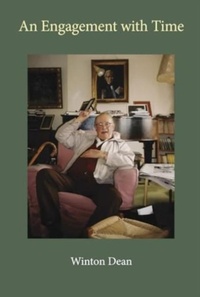
An Engagement With Time
Published on 13. August 2024
Book
Hardback
645 pages
978-1-8380418-1-6 (ISBN)
Description
Winton Dean (1916-2013), the renowned musical scholar and
critic, gives a sparkling account of his early life - and of his disparate set
of forbears. He writes of his controversial father, Basil Dean, the theatrical
and film producer and founder of ENSA, his great uncle Rufus Isaacs (supplying
new information about his first marriage) and Daisy, Countess of Warwick,
mistress of Edward, Prince of Wales. A
deeply divided personality, Winton hoped to pursue a career as a creative
artist rather than as a scholar and critic. To this extent he considered his
life at least in part a failure. But he
was a brilliant and witty writer, as these memoirs repeatedly demonstrate.
He records
his grim years at Elstree and Harrow Schools, where however he was
outstandingly successful academically, and the titanic family rows that
followed. King's, Cambridge, where he read Classics, then English, brought an
immense release of emotions and inhibitions. There are sharp pen portraits of
the dons, including Edward Dent. Alan
Turing was his tennis partner. A trip to Greece in 1936 is described in
luminous detail. Though not a performer,
he became increasingly interested in music, encouraged by a young don, Philip
Radcliffe, who became a life-long friend.
On two visits to the Salzburg Festival he was bowled over by the
conducting of Arturo Toscanini, especially in opera. He gives highly
entertaining accounts of the chaotic rehearsals of The Frogs of
Aristophanes (in Greek) and the stage production of Handel's Saul (in
both of which he played minor roles). The overwhelming dramatic power of Handel's
music impelled him, after the war, to devote ten years of his life to the study
of Handel's oratorios. Among his many interests, which encompassed trams, steam
trains, stamp collecting, old churches and naval history, Winton had a passion
for cricket (though he was an indifferent performer with the bat) and later for
shooting pheasants and grouse.
His first
book, Bizet, was published in 1948; his second, the classic Handel's
Dramatic Oratorios and Masques (1959), established him as a musicologist of
world renown. Winton worked independently and held no university appointments,
apart from a visiting professorship at the University of California, Berkeley,
in 1965-6, which gave rise to his third book, Handel and the Opera Seria. The last of the gentleman scholars, he played
a leading role in astonishing revival of Handel's operas and dramatic oratorios
in recent years.
Winton began
his memoirs at the age of 72 but never finished them, breaking off at the
beginning of 1946, when his career as scholar and critic had barely begun. His early life and young manhood were what
mattered to him. The later chapters, provided by his son Stephen, follow his
career as scholar and sportsman up to 1966.
critic, gives a sparkling account of his early life - and of his disparate set
of forbears. He writes of his controversial father, Basil Dean, the theatrical
and film producer and founder of ENSA, his great uncle Rufus Isaacs (supplying
new information about his first marriage) and Daisy, Countess of Warwick,
mistress of Edward, Prince of Wales. A
deeply divided personality, Winton hoped to pursue a career as a creative
artist rather than as a scholar and critic. To this extent he considered his
life at least in part a failure. But he
was a brilliant and witty writer, as these memoirs repeatedly demonstrate.
He records
his grim years at Elstree and Harrow Schools, where however he was
outstandingly successful academically, and the titanic family rows that
followed. King's, Cambridge, where he read Classics, then English, brought an
immense release of emotions and inhibitions. There are sharp pen portraits of
the dons, including Edward Dent. Alan
Turing was his tennis partner. A trip to Greece in 1936 is described in
luminous detail. Though not a performer,
he became increasingly interested in music, encouraged by a young don, Philip
Radcliffe, who became a life-long friend.
On two visits to the Salzburg Festival he was bowled over by the
conducting of Arturo Toscanini, especially in opera. He gives highly
entertaining accounts of the chaotic rehearsals of The Frogs of
Aristophanes (in Greek) and the stage production of Handel's Saul (in
both of which he played minor roles). The overwhelming dramatic power of Handel's
music impelled him, after the war, to devote ten years of his life to the study
of Handel's oratorios. Among his many interests, which encompassed trams, steam
trains, stamp collecting, old churches and naval history, Winton had a passion
for cricket (though he was an indifferent performer with the bat) and later for
shooting pheasants and grouse.
His first
book, Bizet, was published in 1948; his second, the classic Handel's
Dramatic Oratorios and Masques (1959), established him as a musicologist of
world renown. Winton worked independently and held no university appointments,
apart from a visiting professorship at the University of California, Berkeley,
in 1965-6, which gave rise to his third book, Handel and the Opera Seria. The last of the gentleman scholars, he played
a leading role in astonishing revival of Handel's operas and dramatic oratorios
in recent years.
Winton began
his memoirs at the age of 72 but never finished them, breaking off at the
beginning of 1946, when his career as scholar and critic had barely begun. His early life and young manhood were what
mattered to him. The later chapters, provided by his son Stephen, follow his
career as scholar and sportsman up to 1966.
More details
Language
English
Place of publication
London
United Kingdom
Illustrations
64 images /plates: B&W and colour across 40 pages
Dimensions
Height: 241 mm
Width: 166 mm
Thickness: 57 mm
Weight
1298 gr
ISBN-13
978-1-8380418-1-6 (9781838041816)
Copyright in bibliographic data and cover images is held by Nielsen Book Services Limited or by the publishers or by their respective licensors: all rights reserved.
Schweitzer Classification
Person
Winton
Dean (1916-2013), renowned as a musical scholar and a
trenchant and witty critic, had the temperament of a creative artist, which in
youth he hoped he might become. If in the end his critical-intellectual side
won the day, it was not a bloodless victory.
He felt that the better half had lost. Instead, he became the leading
Handel scholar of his era - fired by a stage production of Saul at Cambridge
before the war. The finest scholars and critics, he believed, harbour a failed
or potential artist within; it is the understanding derived from this that
exalts them above the common run.
Winton began his Memoirs at the
age of 72 but never finished them, breaking off at the beginning of 1946, when
his career as scholar and critic had barely begun. His early life and young
manhood were what mattered to him. In the later chapters his son Stephen takes
up the story.
Dean (1916-2013), renowned as a musical scholar and a
trenchant and witty critic, had the temperament of a creative artist, which in
youth he hoped he might become. If in the end his critical-intellectual side
won the day, it was not a bloodless victory.
He felt that the better half had lost. Instead, he became the leading
Handel scholar of his era - fired by a stage production of Saul at Cambridge
before the war. The finest scholars and critics, he believed, harbour a failed
or potential artist within; it is the understanding derived from this that
exalts them above the common run.
Winton began his Memoirs at the
age of 72 but never finished them, breaking off at the beginning of 1946, when
his career as scholar and critic had barely begun. His early life and young
manhood were what mattered to him. In the later chapters his son Stephen takes
up the story.