

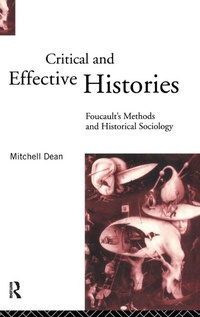
Critical And Effective Histories
Foucault's Methods and Historical Sociology
1st Edition
Published on 2. September 2016
Book
Hardback
248 pages
978-1-138-15218-2 (ISBN)
Description
First Published in 2004. This work places Foucault's methodologies against social theory and philosophy in order to provide a guide to social sciences, particularly historical sociology. Written to clarify Foucault's contribution for professional and non-professional readers, the text demonstrates the originality and usefulness of Foucault's work and embodies a conviction that Foucault's approaches could transform sociology into an effective, multi-focused, relevant discipline. Finally, the book illustrates that his methods provide the necessary condition for any state-of-the-art social research today, addressing his methodological position and establishing its relationship to Nietzsche, Kant, Weber, Elias, Habermas, Giddens, and the Annales and Frankfurt Schools.
Reviews / Votes
'... a thoughtful critique of sociology, history and philosophy which thankfully avoids the more obvious and repetitive lines of Foucauldian commentary.' - Radical PhilosophyMore details
Language
English
Place of publication
London
United Kingdom
Publishing group
Taylor & Francis Ltd
Target group
College/higher education
Dimensions
Height: 240 mm
Width: 161 mm
Thickness: 18 mm
Weight
540 gr
ISBN-13
978-1-138-15218-2 (9781138152182)
Copyright in bibliographic data and cover images is held by Nielsen Book Services Limited or by the publishers or by their respective licensors: all rights reserved.
Schweitzer Classification
Other editions
Additional editions
E-Book
11/2002
Routledge
€69.99
Available for download
E-Book
11/2002
Routledge
€69.99
Available for download
Book
03/1994
1st Edition
Routledge
€76.50
Shipment within 15-20 days
Person
Content
Acknowledgements Introduction 1. Sociology, Foucault, and the uses of history 2. Presentist perspectives Excursus: Foucault and Annales 3. Questions of enlightenment 4. Weber, rationality, and the subject 5. A 'specific and peculiar rationalism'? Beyond the rationalisation thesis 6. Absent history and enlightenment dialectics Postscript: the problem with critique 7. Habermas modernist translations 8. Thematics of state and power Excursus: Time, space, and power 9. Governmentality 10. ....and practices of the self Conclusion