

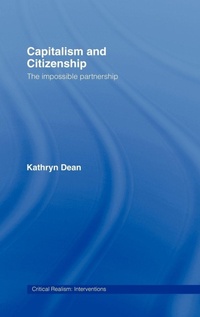
Capitalism and Citizenship
The Impossible Partnership
1st Edition
Published on 17. July 2003
Book
Hardback
248 pages
978-0-415-27273-5 (ISBN)
Description
Can capitalism and citizenship co-exist? In recent years advocates of the Third Way have championed the idea of public-spirited capitalism as the antidote to the many problems confronting the modern world. This book develops a multi-disciplinary theory of citizenship, exploring the human abilities needed for its practice. It then argues that capitalism impedes the nurturing of these abilities. In advancing these arguments, Kathryn Dean draws on the work of a wide range of thinkers including Freud, Marx, Lacan, Habermas and Castells.
More details
Series
Language
English
Place of publication
London
United Kingdom
Publishing group
Taylor & Francis Ltd
Target group
College/higher education
Dimensions
Height: 240 mm
Width: 161 mm
Thickness: 18 mm
Weight
540 gr
ISBN-13
978-0-415-27273-5 (9780415272735)
Copyright in bibliographic data and cover images is held by Nielsen Book Services Limited or by the publishers or by their respective licensors: all rights reserved.
Schweitzer Classification
Other editions
Additional editions
E-Book
11/2012
Routledge
€78.99
Available for download
E-Book
11/2012
Routledge
€78.99
Available for download
Book
07/2003
1st Edition
Routledge
€85.60
Shipment within 15-20 days
Person
Kathryn Dean is a member of the School of Oriental and African Studies, University of London
Content
Part 1: Theoretical Foundations 1. Human Nature: Indeterminate and Indeterminable 2. Capitalism: Culture of Worldlessness Part 2: The Wordly World of the Bourgeois Subject 3. The Wordly World of Bourgeois Subject 4. Parenting and the Consitution of Bougeois Part 3: From Place to Space: the Death of Worldliness 5. The Institution of Commodity Fetishism 6. Abstract labour and the Network Society 7. Abstract Consumption and the Dissolution of the Ego 8. Abstract Knowledge: Disorganized Capitalism and the Vicissitudes of Science Conclusion: Citizenship and the Recovery of Worldliness