

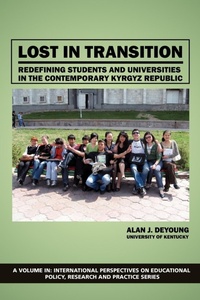
Lost in Transition
Redefining Students and Universities in the Contemporary Kyrgyz Republic
Will be published approx. on 27. January 2011
Book
Paperback/Softback
186 pages
978-1-61735-230-0 (ISBN)
Description
Being a "student" has been and remains a highly desirable status for young people and their families in Kyrgyzstan. "Giving their children education" (dat detyam obrazovaniye) - meaning "higher education" - has become an imperative for many parents, even in a time of serious economic and social decline. The numbers of universities and university enrollments have increased dramatically - in fact quadrupled - since Kyrgyz independence from the former USSR in 1991. All this is happening just as the overall system of secondary education has basically collapsed. School quality and outcomes of learning for most Kyrgyz youth have become increasingly marginal - even as those who run universities widely proclaim quality improvements and desires/intentions to join international higher education space. The book thus seeks to explain the manifest versus the latent functions of higher education in Kyrgyzstan. Relying on explanations of lived experience, the research attempts to explain how the seeming contradiction of a declining resource and intellectual base of universities yet appeals to parents and students as the system continues to expand with easily compromised accountability measures. The study approaches these topics by seeking to define what it now means to be a university student in Kyrgyzstan, as well as what many state universities have turned into" in contrast in contrast to how they were remembered by those who attended and taught within them two decades ago. The work also considers a number of private and inter-governmental universities which are allowed to operate in Kyrgyzstan and award both state and international diplomas. I portray the different organizational and ideological pursuits of these universities as they contrast with those of the state universities.
Lost in Transition is an empirical look at higher education reform in Kyrgyzstan, employing several methodological strategies. These include a student survey given to over 200 students at five different universities; surveys and interviews with senior instructors and administrators at these same institutions; and a two-year case study of a student and faculty cultures and subcultures at one particular national university particular university faculty in one of the larger state universities. The case study utilized participant observation, ethnographic interviews, document analysis, and social media.
Lost in Transition is an empirical look at higher education reform in Kyrgyzstan, employing several methodological strategies. These include a student survey given to over 200 students at five different universities; surveys and interviews with senior instructors and administrators at these same institutions; and a two-year case study of a student and faculty cultures and subcultures at one particular national university particular university faculty in one of the larger state universities. The case study utilized participant observation, ethnographic interviews, document analysis, and social media.
More details
Series
Language
English
Place of publication
Charlotte
United States
Publishing group
Emerald Publishing Inc
Target group
Professional and scholarly
Dimensions
Height: 234 mm
Width: 156 mm
Thickness: 10 mm
Weight
292 gr
ISBN-13
978-1-61735-230-0 (9781617352300)
Copyright in bibliographic data and cover images is held by Nielsen Book Services Limited or by the publishers or by their respective licensors: all rights reserved.
Schweitzer Classification
Other editions
Additional editions
Alan J. DeYoung
Lost in Transition
Redefining Students and Universities in the Contemporary Kyrgyz Republic
E-Book
03/2011
1st Edition
Information Age Publishing
from
€62.33
Available for download
Content
Introduction.
Chapter 1. Education and Socialization: Deconstructing the Soviet Imperative.
Chapter 2. Students Making Decisions about the University.
Chapter 3. On Being a Student at Bishkek New University: Social Scenes and Situations.
Chapter 4. On Being a Student at Bishkek New University: Students, Student Groups, and Classes.
Chapter 5. University Use and University Quality: Then and Now.
Chapter 6. Faculty of Foreign Languages: Academic Culture Compromised.
Chapter 7. Concluding Remarks and International Perspectives on the Kyrgyz Higher Education Scene.
Appendix.
References.
Chapter 1. Education and Socialization: Deconstructing the Soviet Imperative.
Chapter 2. Students Making Decisions about the University.
Chapter 3. On Being a Student at Bishkek New University: Social Scenes and Situations.
Chapter 4. On Being a Student at Bishkek New University: Students, Student Groups, and Classes.
Chapter 5. University Use and University Quality: Then and Now.
Chapter 6. Faculty of Foreign Languages: Academic Culture Compromised.
Chapter 7. Concluding Remarks and International Perspectives on the Kyrgyz Higher Education Scene.
Appendix.
References.