

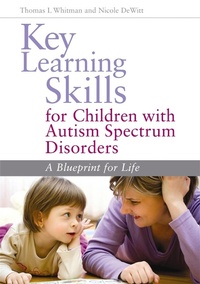
Key Learning Skills for Children with Autism Spectrum Disorders
A Blueprint for Life
Published on 15. July 2011
Book
Paperback/Softback
336 pages
978-1-84905-864-3 (ISBN)
Description
Finding a way of simultaneously addressing the sensory, motor, emotional, communicative, cognitive and social needs of children on the autism spectrum can be a real challenge, and choosing from the vast array of options available is a daunting task. This book provides a blueprint for an educational intervention program that is evidence-based, comprehensive in scope and integrative in its approach.
Grouping techniques into five categories for discussion, the book examines autism spectrum disorders within a developmental context, and shows that interventions with autistic individuals are not only possible, but can be really successful. Specific intervention strategies and program examples for developing competencies in areas such as joint attention, sensory integration, motor functioning, impulse control, memory, self-awareness, theory of mind and empathy, abstract thinking, problem-solving, social skills and community engagement, are presented. Techniques for dealing with specific behavior problems are also examined, including toileting delays, temper-tantrums, and eating and sleeping problems, amongst many others.
This book will be essential reading for families, teachers, and other professionals working with children with autism.
Grouping techniques into five categories for discussion, the book examines autism spectrum disorders within a developmental context, and shows that interventions with autistic individuals are not only possible, but can be really successful. Specific intervention strategies and program examples for developing competencies in areas such as joint attention, sensory integration, motor functioning, impulse control, memory, self-awareness, theory of mind and empathy, abstract thinking, problem-solving, social skills and community engagement, are presented. Techniques for dealing with specific behavior problems are also examined, including toileting delays, temper-tantrums, and eating and sleeping problems, amongst many others.
This book will be essential reading for families, teachers, and other professionals working with children with autism.
Reviews / Votes
Educators and parents alike will find it extremely helpful as they navigate the often perplexing world of ASD. Addressing topics which include empathy, social engagement, communication, and attention, Whitman and DeWitt outline strategies that will enable caregivers to teach autistic children the skills they need to survive and thrive in a world that can be unforgiving in its demand for conformity.Whitman and DeWitt manage to strike the perfect balance between theory and practical advice... those who've gone past the overwhelmed stage and entered the determined stage will find enormous support. The authors are refreshingly matter-of-fact in their approach to autism and based solidly in the scientific camp. With their help, parents, educators, and children can all make great strides. -- Foreword Magazine Dr. Whitman and Nicole DeWitt have produced a practical, evidence-based, 'must-have' resource for parents, providers and educators who work with children with autism. Key Learning Skills for Children with Autism Spectrum Disorders cuts through the confusion of the myriad of options of interventions available. It distils everything down to those that are proven most effective. The specific program examples included are 'where the rubber meets the road' activities that can be readily implemented in the school, office and home. Use of the information presented in this book will lead to the development of a comprehensive, customized and powerful intervention program that meets the specific needs of any child on the autism spectrum. This book is truly a gift to the autism community and to all who endeavor to help children reach their full potential! -- Laura McGuire, M.D., family physician and mother of a child with autism, Indiana, USA Having had the privilege of working with both Dr. Whitman and Nicole DeWitt, my son has experienced firsthand the benefit of the therapies discussed in this book. These therapies allowed me to chart my son's progress and not just 'guess' how he was doing week to week. We were able to build on skills he had already mastered and keep moving forward. I was able to see what skills to work on and train my tutors how to work with my son. Matching the program to the family, whatever the dynamic, will only ensure success to the individual. I feel besides early intervention, parent training is key to any successful program for an individual struggling with ASD. -- Myra Sweeny, parent of a child with autism, Indiana, USA Within each chapter the authors offer step-by-step lesson plans that describe practical applications of these interventions to the specific problem area being addressed. Materials lists, action plans, and troubleshooting strategies are included in each program example, which grant the parent or teacher the best possible chances for a successful outcome. The plans are issued in clear directives and include props that are easy to find or make - no shopping trip necessary. Especially helpful are the troubleshooting sections; if readers run into a problem during a session, they have immediate suggestions on what to do differently. -- ForeWord Magazine
More details
Language
English
Place of publication
London
United Kingdom
Target group
Professional and scholarly
Product notice
Paperback (UK-trade)
Dimensions
Height: 246 mm
Width: 176 mm
Thickness: 21 mm
Weight
680 gr
ISBN-13
978-1-84905-864-3 (9781849058643)
Copyright in bibliographic data and cover images is held by Nielsen Book Services Limited or by the publishers or by their respective licensors: all rights reserved.
Schweitzer Classification
Other editions
Additional editions
Nicole DeWitt | Thomas L. Whitman
Key Learning Skills for Children with Autism Spectrum Disorders
A Blueprint for Life
E-Book
08/2011
Jessica Kingsley Publishers
€29.99
Available for download
Persons
Thomas L. Whitman is a Professor of Psychology at the University of Notre Dame, Indiana. His research and scholarship have centered on the investigation of biological and social factors that place children at risk for physical, cognitive and socioemotional problems. He is the author of over a hundred research articles and chapters, and five previous books. His current research and publications focus on stress and coping in mothers of children with autism spectrum disorders. He is the co-director of the Notre Dame Research Training Program on Intellectual and Developmental Disabilities, has been the recipient of numerous federal research and training grants, and has taught courses in the area of developmental disabilities and autism for most of his professional career.
Nicole DeWitt's educational background is in the area of psychology. She has a Masters Degree in psychology and behavior analysis from Western Michigan University. She is a board certified behavior analyst who has trained graduate and undergraduate college students in the principles and application of learning-based education programs for children with disabilities. She has served as a director of home-based services for children with autism and their families. In her current position at the Sonya Ansari Regional Center for Autism she is involved in developing and evaluating intervention and education programs for children with autism in family, school and other community settings.
Nicole DeWitt's educational background is in the area of psychology. She has a Masters Degree in psychology and behavior analysis from Western Michigan University. She is a board certified behavior analyst who has trained graduate and undergraduate college students in the principles and application of learning-based education programs for children with disabilities. She has served as a director of home-based services for children with autism and their families. In her current position at the Sonya Ansari Regional Center for Autism she is involved in developing and evaluating intervention and education programs for children with autism in family, school and other community settings.
Content
Preface. 1. Selection of Appropriate Interventions. 2. Interventions. 3. Core Learning Skills. 4. Emotion-related Problems. 5. Sensory Problems. 6. Sensorimotor Deficiencies. 7. Language and Communication Problems. 8. Cognitive Deficiencies. 9. Social Interaction Problems. 10. Self-regulation Deficiencies. 11. Behavior Problems, Developmental Challenges and Medical Issues. Index.