

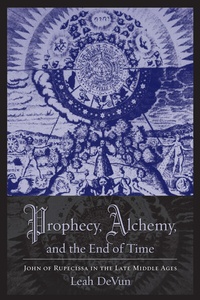
Prophecy, Alchemy, and the End of Time
John of Rupescissa in the Late Middle Ages
Will be published approx. on 3. March 2009
Book
Hardback
272 pages
978-0-231-14538-1 (ISBN)
Description
In the middle of the fourteenth century, the Franciscan friar John of Rupescissa sent a dramatic warning to his followers: the last days were coming; the apocalypse was near. Deemed insane by the Christian church, Rupescissa had spent more than a decade confined to prisons--in one case wrapped in chains and locked under a staircase--yet ill treatment could not silence the friar's apocalyptic message. Religious figures who preached the end times were hardly rare in the late Middle Ages, but Rupescissa's teachings were unique. He claimed that knowledge of the natural world, and alchemy in particular, could act as a defense against the plagues and wars of the last days. His melding of apocalyptic prophecy and quasi-scientific inquiry gave rise to a new genre of alchemical writing and a novel cosmology of heaven and earth. Most important, the friar's research represented a remarkable convergence between science and religion. In order to understand scientific knowledge today, Leah DeVun asks that we revisit Rupescissa's life and the critical events of his age--the Black Death, the Hundred Years' War, the Avignon Papacy--through his eyes.
Rupescissa treated alchemy as medicine (his work was the conceptual forerunner of pharmacology) and represented the emerging technologies and views that sought to combat famine, plague, religious persecution, and war. The advances he pioneered, along with the exciting strides made by his contemporaries, shed critical light on later developments in medicine, pharmacology, and chemistry.
Rupescissa treated alchemy as medicine (his work was the conceptual forerunner of pharmacology) and represented the emerging technologies and views that sought to combat famine, plague, religious persecution, and war. The advances he pioneered, along with the exciting strides made by his contemporaries, shed critical light on later developments in medicine, pharmacology, and chemistry.
Reviews / Votes
DeVun's book is well-constructed, thoroughly documented, instructive, and very useful. -- Chara Crisciani American Historical Review [H]ighly readable text, amply supported by some fifty pages of endnotes, a bibliography, and a usefully compiled index, Leah DeVun has produced an original and valuable book. -- Stanton J. Linden, Washington State University SPECULUM This book offers the reader a tour of one of the more peculiar corners of medieval thought, a corner defined by the intersection of three enterprises: Spiritual Franciscanism, Joachite apocalypticism, and alchemical speculation. -- David E. Timmer Church History DeVun has written a splendid book about medieval alchemy and apocalyptic prophecy that is truly a pleasure to read. Prophecy, Alchemy, and the End of Time will be an essential item for anyone hoping to understand the history of science and religion in the later Middle Ages. -- Laura Ackerman Smoller Medievalia et Humanistica An excellent study... not only for its careful description of an underappreciated figure, but also because of the important theoretical contributions [DeVun] makes to a more holistic approach to our understanding of the history of science and to late medieval culture. -- Gregory J. Miller H-GermanMore details
Language
English
Place of publication
New York
United States
Target group
Professional and scholarly
Product notice
Trade binding
Illustrations
4 illus.
Dimensions
Height: 229 mm
Width: 152 mm
Weight
482 gr
ISBN-13
978-0-231-14538-1 (9780231145381)
Copyright in bibliographic data and cover images is held by Nielsen Book Services Limited or by the publishers or by their respective licensors: all rights reserved.
Schweitzer Classification
Other editions
Additional editions
E-Book
09/2015
1st Edition
De Gruyter
from
€29.95
Available for download
Book
01/2014
Columbia University Press
€34.72
Article not available at the moment
Person
Leah DeVun is associate professor of history at Rutgers University. Her research focuses on the history of the human body in premodern Europe and the legacy of that history in the modern world. Her published work centers on issues of gender and technology.
Content
List of Illustrations Acknowledgments 1. Introduction 2. The Proving of Christendom 3. John of Rupescissa's Vision of the End 4. Alchemy in Theory and Practice 5. Artists and the Art 6. Metaphor and Alchemy 7. The End of Nature 8. Conclusion Bibliography Notes Index