

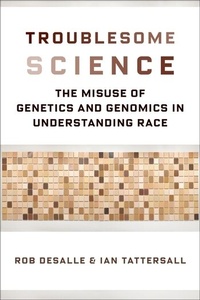
Troublesome Science
The Misuse of Genetics and Genomics in Understanding Race
Will be published approx. on 19. June 2018
Book
Hardback
216 pages
978-0-231-18572-1 (ISBN)
Description
It is well established that all humans today, wherever they live, belong to one single species. Yet even many people who claim to abhor racism take for granted that human "races" have a biological reality. In Troublesome Science, Rob DeSalle and Ian Tattersall provide a lucid and forceful critique of how scientific tools have been misused to uphold misguided racial categorizations.
DeSalle and Tattersall argue that taxonomy, the scientific classification of organisms, provides an antidote to the myth of race's biological basis. They explain how taxonomists do their science-how to identify a species and to understand the relationships among different species and the variants within them. DeSalle and Tattersall also detail the use of genetic data to trace human origins and look at how scientists have attempted to recognize discrete populations within Homo sapiens. Troublesome Science demonstrates conclusively that modern genetic tools, when applied correctly to the study of human variety, fail to find genuine differences. While the diversity that exists within our species is a real phenomenon, it nevertheless defeats any systematic attempt to recognize discrete units within it. The stark lines that humans insist on drawing between their own groups and others are nothing but a mixture of imagination and ideology. Troublesome Science is an important call for researchers, journalists, and citizens to cast aside the belief that race has a biological meaning, for the sake of social justice and sound science alike.
DeSalle and Tattersall argue that taxonomy, the scientific classification of organisms, provides an antidote to the myth of race's biological basis. They explain how taxonomists do their science-how to identify a species and to understand the relationships among different species and the variants within them. DeSalle and Tattersall also detail the use of genetic data to trace human origins and look at how scientists have attempted to recognize discrete populations within Homo sapiens. Troublesome Science demonstrates conclusively that modern genetic tools, when applied correctly to the study of human variety, fail to find genuine differences. While the diversity that exists within our species is a real phenomenon, it nevertheless defeats any systematic attempt to recognize discrete units within it. The stark lines that humans insist on drawing between their own groups and others are nothing but a mixture of imagination and ideology. Troublesome Science is an important call for researchers, journalists, and citizens to cast aside the belief that race has a biological meaning, for the sake of social justice and sound science alike.
Reviews / Votes
Why do we need another book on the refuted belief that human beings are naturally divided into biological races? Because this myth is recirculating in prestigious scientific journals and popular media, as well as on white nationalist websites, threatening to rationalize and reinforce persistent social inequities. By revealing the unscientific basis for contemporary racial claims, DeSalle and Tattersall leave no excuse for letting this dangerous fallacy continue to masquerade as science. Troublesome Science is an urgent and important defense against the modern resurgence of racial science. -- Dorothy Roberts, author of <i>Fatal Invention: How Science, Politics, and Big Business Re-create Race in the Twenty-First Century</i> Troublesome Science provides one of the most lucid expositions in the scientific literature of how taxonomies of human populations have developed-and most important, the authors use this explication to take us on a fascinating 200,000-year journey to demonstrate the flaws in any attempt to use a genetic boundary for racial categories. -- Troy Duster, Chancellor's Professor at the Institute for the Study of Societal Issues, University of California, Berkeley, and author of <i>Backdoor to Eugenics</i> In Troublesome Science, DeSalle and Tattersall tackle the contentious and important subject of human genetic diversity and its relationship to the definition of human groups. This bold, beautiful, thorough, and up-to-date demolition of the biological concept of race is based on excellent history and the latest science. Think of this clearly written and approachable book as a user's guide to your own DNA and ancestry. -- Nina G. Jablonski, Evan Pugh University Professor of Anthropology, associate director of the Huck Institutes of the Life Sciences, Pennsylvania State University In the current atmosphere denigrating truth and wisdom, the resurgence of racism is the worst case of rejection of both morality and science. It is a profound relief and pleasure to read this masterful synthesis of data on human biological variation and evolution, melding results on everything from genomics to the anatomical features of living and ancient populations. The result is a powerful and compelling picture of the generation of diversity, the historical migrations of populations, and the continual mixing of human beings that decisively refutes the notion that our species is compartmentalized into rigidly separate racial subdivisions. It is unscientific, and thus racist, to maintain that there are separate human races! -- Niles Eldredge, curator emeritus, Division of Paleontology at the American Museum of Natural History This timely book sheds a good deal of scholarly light on genetic studies of human variation, which are widely misrepresented in popular science venues. Geneticist Rob DeSalle and anthropologist Ian Tattersall bring some helpfully critical eyes to the research in this biopolitical minefield, and to what genomics really says about the patterns in the human gene pool. This is very important book for anyone interested in race, and why it is not the same as human biodiversity! -- Jonathan Marks, professor of anthropology, University of North Carolina at Charlotte Troublesome Science provides a deeper analysis than one usually finds in discussions of racial classifications. It brings clarity to the field of systematics and in so doing reveals the hollowness of claims to the scientific legitimacy of race. Clear, assertive, and well argued, it demonstrates that scientific taxonomy cannot draw racial boundaries in human populations from genetic-clustering studies. More than a takedown of a popular journalistic account, it is an important contribution to our understanding of the science behind the classification of species and subspecies. -- Sheldon Krimsky, author of <i>Stem Cell Dialogues: A Philosophical and Scientific Inquiry Into Medical Frontiers</i> A masterclass in taxonomy and its methods, evolutionary theory, population and molecular genetics, ancient DNA sequencing, palaeoanthropology and patterns of human migration. -- Steven Rose * Times Higher Education * Genetically, race is a meaningless concept, yet our society seems far from ready to stop dividing people into racial categories. Evolutionary biologist DeSalle and paleoanthropologist Tattersall debunk the idea as a useful scientific classification, explaining how the technique of taxonomy-the grouping of organisms based on shared characteristics-fails to find significant genetic differences among the groups we commonly call races. -- Clara Moskowitz * Scientific American * A necessary response to recently published misguided and troublesome books on the topic of biological race in our species. * American Journal of Human Biology * [Troublesome Science] should be widely read by evolutionary biologists, geneticists, and biomedical researchers. -- Joseph L. Graves Jr. * Evolution: Education & Outreach * The book does an excellent job of describing the approaches to our understanding of how our species has moved out of Africa in waves to fill the continents over a 200,000-year span. * Quarterly Review of Biology *More details
Series
Language
English
Place of publication
New York
United States
Product notice
Trade binding
Illustrations
45 b&w and color images
Dimensions
Height: 229 mm
Width: 152 mm
ISBN-13
978-0-231-18572-1 (9780231185721)
Copyright in bibliographic data and cover images is held by Nielsen Book Services Limited or by the publishers or by their respective licensors: all rights reserved.
Schweitzer Classification
Persons
Rob DeSalle is a curator in the Sackler Institute for Comparative Genomics and professor at the Richard Gilder Graduate School at the American Museum of Natural History. He is the author of The Science of Jurassic Park and the Lost World: Or How to Build a Dinosaur (with David Lindley, 1997) and the coauthor of Welcome to the Microbiome: Getting to Know the Trillions of Bacteria and Other Microbes In, On, and Around You (2015), among others.
Ian Tattersall is curator emeritus in the Division of Anthropology at the American Museum of Natural History. His many books include Masters of the Planet: The Search for Our Human Origins (2012) and The Strange Case of the Rickety Cossack and Other Cautionary Tales from Human Evolution (2015).
DeSalle and Tattersall's previous books together include Human Origins: What Bones and Genomes Tell Us About Ourselves (2007); Race? Debunking a Scientific Myth (2011); and A Natural History of Wine (2015).
Ian Tattersall is curator emeritus in the Division of Anthropology at the American Museum of Natural History. His many books include Masters of the Planet: The Search for Our Human Origins (2012) and The Strange Case of the Rickety Cossack and Other Cautionary Tales from Human Evolution (2015).
DeSalle and Tattersall's previous books together include Human Origins: What Bones and Genomes Tell Us About Ourselves (2007); Race? Debunking a Scientific Myth (2011); and A Natural History of Wine (2015).
Content
Preface
Acknowledgments
1. Evolutionary Lessons
2. Species and How to Recognize Them
3. Phylogenetic Trees
4. The Name Game: Modern Zoological Nomenclature and the Rules of Naming Things
5. DNA Fingerprinting and Barcoding
6. Early Biological Notions of Human Divergence
7. Mitochondrial Eve and Y-Chromosome Adam
8. The Other 99 Percent of the Genome
9. ABBA/BABA and the Genomes of Our Ancient Relatives
10. Human Migration and Neolithic Genomes
11. Gene Genealogies and Species Trees
12. Clustering Humans?
13. STRUCTUREing Humans?
14. Mr. Murray Loses His Bet
Epilogue: Race and Society
Notes and Bibliography
Index
Acknowledgments
1. Evolutionary Lessons
2. Species and How to Recognize Them
3. Phylogenetic Trees
4. The Name Game: Modern Zoological Nomenclature and the Rules of Naming Things
5. DNA Fingerprinting and Barcoding
6. Early Biological Notions of Human Divergence
7. Mitochondrial Eve and Y-Chromosome Adam
8. The Other 99 Percent of the Genome
9. ABBA/BABA and the Genomes of Our Ancient Relatives
10. Human Migration and Neolithic Genomes
11. Gene Genealogies and Species Trees
12. Clustering Humans?
13. STRUCTUREing Humans?
14. Mr. Murray Loses His Bet
Epilogue: Race and Society
Notes and Bibliography
Index