

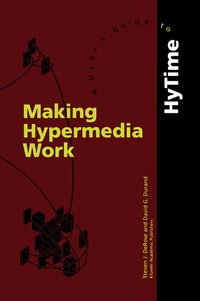
Making Hypermedia Work
A User's Guide to HyTime
Published on 27. September 2012
Book
Paperback/Softback
XXII, 384 pages
978-1-4613-6188-6 (ISBN)
Description
Making Hypermedia Work: A User's Guide to HyTime
discusses how the HyTime standard can be applied to real world problems of navigating from here to there in collections of documents. The HyTime standard itself provides enabling method and templates for various information structures such as links and various kinds of location indicators. A HyTime application specifies how a group applies those templates to their particular requirements. This involves choosing which HyTime structures are needed, setting up conventions for how they are to be used and setting up management and processes for creation, conversion and update of hypermedia documents. A HyTime engine is the last ingredient: actually using an application typically involves choosing software to support one's use of HyTime and customizing it as needed. This may be as simple as setting up hypertextual style sheets that determine how links and other things look and act. More specialized applications may require full-scale design and programming.
Making Hypermedia Work: A User's Guide to HyTime presents the first in-depth guide to the HyTime specifications, both describing its key features and providing guidelines on how it is used. The book begins with the more familiar structures of books, graphics and cross-references, detailing the HyTime constructs and models used to identify, locate, and link data. It goes on to introduce some of HyTime's mechanisms for linking multidimensional, multimedia data, and for scheduling it in space and time. The authors help the reader become fluent in HyTime as it applies to the simpler and most widely understood data types. After mastering this level of HyTime, readers will be ready and able to explore the exciting potential of HyTime for more sophisticated multimedia applications.
Making Hypermedia Work: A User's Guide to HyTime presents the first in-depth guide to the HyTime specifications, both describing its key features and providing guidelines on how it is used. The book begins with the more familiar structures of books, graphics and cross-references, detailing the HyTime constructs and models used to identify, locate, and link data. It goes on to introduce some of HyTime's mechanisms for linking multidimensional, multimedia data, and for scheduling it in space and time. The authors help the reader become fluent in HyTime as it applies to the simpler and most widely understood data types. After mastering this level of HyTime, readers will be ready and able to explore the exciting potential of HyTime for more sophisticated multimedia applications.
More details
Edition
Softcover reprint of the original 1st ed. 1994
Language
English
Place of publication
New York
United States
Target group
Professional and scholarly
Research
Product notice
Paperback (trade)
Unsewn / adhesive bound
Illustrations
XXII, 384 p.
Dimensions
Height: 240 mm
Width: 160 mm
Thickness: 23 mm
Weight
655 gr
ISBN-13
978-1-4613-6188-6 (9781461361886)
DOI
10.1007/978-1-4615-2754-1
Schweitzer Classification
Other editions
Additional editions
E-Book
06/2011
Springer
€149.79
Available for download
Book
06/1994
Kluwer Academic Publishers
€160.49
Shipment within 15-20 days
Content
I.- 1 Introduction.- 2 Hypermedia Concepts.- 3 Overview of SGML.- 4 HyTime Quick start.- 5 The Structure of HyTime.- II.- 6 Basic Measurement.- 7 Hyperlinks.- 8 Locating Data Objects.- 9 The HyTime Query Language.- 10 Modifying a DTD for HyTime.- III.- 11 Lexical Types and Properties.- 12 Extending HyTime.- 13 Advanced Measurement and Scheduling.- 14 The HyTime Base Module.