

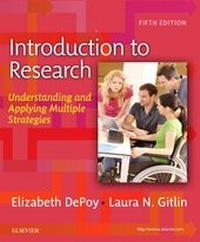
Introduction to Research
Understanding and Applying Multiple Strategies
5th Edition
Published on 19. May 2015
Book
Paperback/Softback
416 pages
978-0-323-26171-5 (ISBN)
Description
Bridge the gap between research and practice with DePoy and Gitlin's Introduction to Research: Understanding and Applying Multiple Strategies, 4th Edition. This completely updated, user-friendly text helps you better understand not only the research process, but also research designs and their applications to the real world of clinical practice. Covering multiple research strategies (including both qualitative and quantitative research), it gives you a balanced approach to various research traditions, addressing the key issues that are emerging in today's health care environment.
Case examples provide real-life snapshots of what it is like to participate in different types of research processes, identify research dilemmas relevant to chapter subjects, and alert you to problems you might encounter.
Authors make the topics more accessible, so research becomes more relevant - and topics come to life.
Covers experimental-type, naturalistic, and mixed method design strategies to improve your ability to compare, contrast, and integrate different methods.
Presents complex information clearly in a highly readable, and easy-to-understand, manner.
Includes detailed discussions of qualitative and quantitative methodologies, a unique and balanced focus that makes this text more comprehensive than others in its field.
NEW! Up-to-date research methods, strategies, and references, like digital sources, visual methods, and geographical analysis, give you the latest information on research in diverse areas of health and human services.
Case examples provide real-life snapshots of what it is like to participate in different types of research processes, identify research dilemmas relevant to chapter subjects, and alert you to problems you might encounter.
Authors make the topics more accessible, so research becomes more relevant - and topics come to life.
Covers experimental-type, naturalistic, and mixed method design strategies to improve your ability to compare, contrast, and integrate different methods.
Presents complex information clearly in a highly readable, and easy-to-understand, manner.
Includes detailed discussions of qualitative and quantitative methodologies, a unique and balanced focus that makes this text more comprehensive than others in its field.
NEW! Up-to-date research methods, strategies, and references, like digital sources, visual methods, and geographical analysis, give you the latest information on research in diverse areas of health and human services.
More details
Edition
5th Revised edition
Language
English
Place of publication
St Louis
United States
Publishing group
Elsevier - Health Sciences Division
Target group
College/higher education
Edition type
Revised edition
Illustrations
Illustrated
Dimensions
Height: 235 mm
Width: 191 mm
ISBN-13
978-0-323-26171-5 (9780323261715)
Copyright in bibliographic data and cover images is held by Nielsen Book Services Limited or by the publishers or by their respective licensors: all rights reserved.
Schweitzer Classification
Other editions
New editions
Elizabeth DePoy | Laura N. Gitlin
Introduction to Research
Understanding and Applying Multiple Strategies
Book
12/2019
6th Edition
Mosby
€76.00
Article exhausted; check for reprint
Additional editions
Msw DePoy | Fgsa Gitlin
Introduction to Research - E-Book
Understanding and Applying Multiple Strategies
E-Book
03/2015
5th Edition
Mosby
€46.99
Available for download
Previous edition
Elizabeth DePoy | Laura N. Gitlin
Introduction to Research
Understanding and Applying Multiple Strategies
Book
10/2010
4th Edition
Mosby
€56.94
Article exhausted; check for reprint
Content
Part 1: Introduction
1. Research as an Important Way of Knowing
2. Essentials
3. Research Ethics
Part II: Thinking Processes
4. Philosophical Foundations
5. Framing the Problem
6. Developing a Knowledge Base Through Literature and Resources
7. Theory in Research
8. Asking Questions and Posing Queries
9. Language and Thinking Processes
Part III: Design Approaches
10. Experimental-Type Designs
11. Naturalistic Designs
12. Mixed Method Designs
Part V: Action Processes
13. Setting Boundaries
14. Boundary Setting in Experimental-Type Design
15. Boundary Setting in Naturalistic Analysis
16. Boundary Setting in Mixed Methods
17. Collecting Information
18. Collecting Data Through Measurement in Experimental-Type Design
19. Gathering Information in Naturalistic Analysis
20. Preparing and Organizing Data
21. Statistical Analysis for Experimental-Type Research
22. Analysis in Naturalistic Inquiry
23. Sharing Research Knowledge Before the Study
24. Sharing Research Knowledge During and After the Study
Part V: Improving Practice Through Inquiry
25. Reciprocal Roles of Research, Knowledge Development, and Practice
26. Stories from the Field
Appendices
Glossary
1. Research as an Important Way of Knowing
2. Essentials
3. Research Ethics
Part II: Thinking Processes
4. Philosophical Foundations
5. Framing the Problem
6. Developing a Knowledge Base Through Literature and Resources
7. Theory in Research
8. Asking Questions and Posing Queries
9. Language and Thinking Processes
Part III: Design Approaches
10. Experimental-Type Designs
11. Naturalistic Designs
12. Mixed Method Designs
Part V: Action Processes
13. Setting Boundaries
14. Boundary Setting in Experimental-Type Design
15. Boundary Setting in Naturalistic Analysis
16. Boundary Setting in Mixed Methods
17. Collecting Information
18. Collecting Data Through Measurement in Experimental-Type Design
19. Gathering Information in Naturalistic Analysis
20. Preparing and Organizing Data
21. Statistical Analysis for Experimental-Type Research
22. Analysis in Naturalistic Inquiry
23. Sharing Research Knowledge Before the Study
24. Sharing Research Knowledge During and After the Study
Part V: Improving Practice Through Inquiry
25. Reciprocal Roles of Research, Knowledge Development, and Practice
26. Stories from the Field
Appendices
Glossary