

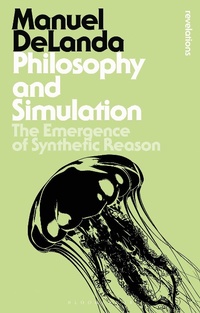
Philosophy and Simulation
The Emergence of Synthetic Reason
Published on 18. April 2019
Book
Paperback/Softback
216 pages
978-1-350-09678-3 (ISBN)
Description
In this groundbreaking book, Manuel DeLanda analyzes different genres of simulation, from cellular automata and generic algorithms to neural nets and multi-agent systems, as a means to conceptualize the space of possibilities associated with casual and other capacities.
This remarkably clear philosophical discussion of a rapidly growing field, from a thinker at the forefront of research at the interface of science and the humanities, is a must-read for anyone interested in the philosophies of technology, emergence and science at all levels.
This remarkably clear philosophical discussion of a rapidly growing field, from a thinker at the forefront of research at the interface of science and the humanities, is a must-read for anyone interested in the philosophies of technology, emergence and science at all levels.
More details
Series
Language
English
Place of publication
London
United Kingdom
Publishing group
Bloomsbury Publishing PLC
Product notice
Paperback (trade)
Dimensions
Height: 216 mm
Width: 136 mm
Thickness: 20 mm
Weight
281 gr
ISBN-13
978-1-350-09678-3 (9781350096783)
Copyright in bibliographic data and cover images is held by Nielsen Book Services Limited or by the publishers or by their respective licensors: all rights reserved.
Schweitzer Classification
Other editions
Additional editions
E-Book
04/2019
1st Edition
Bloomsbury Academic
€28.49
Available for download
E-Book
04/2019
1st Edition
Bloomsbury Academic
€28.49
Available for download
Person
Manuel DeLanda is a distinguished writer, artist and philosopher. He began his career in experimental film, later becoming a computer artist and programmer. He is Professor of Philosophy in the Architecture departments at Princeton University and University of Pennsylvania, and the Gilles Deleuze Chair and Professor of Philosophy at the European Graduate School.
Content
Introduction: Emergence in History
1. The Storm in the Computer
2. Cellular Automata and Patterns of Flow
3. Artificial Chemistries and the Prebiotic Soup
4. Genetic Algorithms and the Prebiotic Soup
5. Genetic Algorithms and Ancient Organisms
6. Neural Nets and Insect Intelligence
7. Neural Nets and Mammalian Memory
8. Multiagents and Primate Strategies
9. Multiagents and Stone Age Economics
10. Multiagents and Primitive Language
11. Multiagents and Archaic States
Appendix: Links to Assemblage Theory
Index
1. The Storm in the Computer
2. Cellular Automata and Patterns of Flow
3. Artificial Chemistries and the Prebiotic Soup
4. Genetic Algorithms and the Prebiotic Soup
5. Genetic Algorithms and Ancient Organisms
6. Neural Nets and Insect Intelligence
7. Neural Nets and Mammalian Memory
8. Multiagents and Primate Strategies
9. Multiagents and Stone Age Economics
10. Multiagents and Primitive Language
11. Multiagents and Archaic States
Appendix: Links to Assemblage Theory
Index