

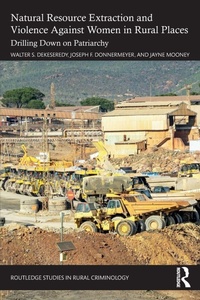
Natural Resource Extraction and Violence Against Women in Rural Places
Drilling Down on the Patriarchy
1st Edition
Will be published approx. on 24. March 2026
Book
Paperback/Softback
190 pages
978-1-032-95383-0 (ISBN)
Description
The phenomenon of boomtowns and of various impacts from resource extraction is global in the sense that it affects many, but certainly not all, rural communities throughout the world. However, it is not a single, homogenous influence, but one with a diversity of effects, including, violence against women (VAW).
Driven by sophisticated theoretical framework, one that integrates three discrete bodies of knowledge (VAW, green criminology, and rural criminology), this book (1) describes the nature, extent, and distribution of VAW in rural boomtowns around the world, (2) critiques what the authors refer to as an anomie/social disorganization model of VAW in rural boomtown communities, and (3) introduces the concept of patriarchal social reorganization and demonstrates that globalization and natural resource extraction did not bring VAW to rural communities, but rather intensified an existing problem.
The authors call upon the criminological community, especially feminist and rural criminologists, to stretch their theoretical imaginations to examine patriarchal linkages between localized expressions of patriarchy, natural resource extraction and VAW. Moreover, heavily informed by a combination of sound research and theoretical work and progressive practices designed and implemented by left realists, human rights activists, Indigenous coalitions, and by feminists, this book recommends forward thinking and timely ways of curbing the types of violence identified throughout it.
This is essential reading for all engaged in rural and feminist criminology, violence against women, and natural resource extraction.
Driven by sophisticated theoretical framework, one that integrates three discrete bodies of knowledge (VAW, green criminology, and rural criminology), this book (1) describes the nature, extent, and distribution of VAW in rural boomtowns around the world, (2) critiques what the authors refer to as an anomie/social disorganization model of VAW in rural boomtown communities, and (3) introduces the concept of patriarchal social reorganization and demonstrates that globalization and natural resource extraction did not bring VAW to rural communities, but rather intensified an existing problem.
The authors call upon the criminological community, especially feminist and rural criminologists, to stretch their theoretical imaginations to examine patriarchal linkages between localized expressions of patriarchy, natural resource extraction and VAW. Moreover, heavily informed by a combination of sound research and theoretical work and progressive practices designed and implemented by left realists, human rights activists, Indigenous coalitions, and by feminists, this book recommends forward thinking and timely ways of curbing the types of violence identified throughout it.
This is essential reading for all engaged in rural and feminist criminology, violence against women, and natural resource extraction.
Reviews / Votes
This remarkable book demand criminologists pay due theoretical attention to the interconnections between natural resource extraction and woman abuse. In making the case for the continua in women's live, binary thinking, rural/urban, past/present, social dis/organisation, is put to the sword. Not before time. An excellent read.Sandra Walklate, Emeritus Professor, University of Liverpool
Natural Resource Extraction and Violence Against Women in Rural Places provides a thought-provoking and well-researched examination of the understudied relationship between natural resource extraction and crime, specifically its impact on male violence against women. Peppered with emotionally evocative testimony conveying the lived experiences of rural people and places, it is a must read for all those interested in the destructive and gendered impact of environmental-based industry.
Victoria Collins, Associate Professor & Director of Criminal Justice Programs, University of Kentucky
DeKeseredy, Donnermeyer and Mooney's call to action must not go unheeded. In their pivotal examination of the link between globalization, environmental degradation and violence against women, they show scholars, practitioners, and communities why and how we must resist systems of oppression and inequality to prevent social and environmental harm. Their innovative theorising and interdisciplinary lens provides a map for future studies and better futures.
Bridget Harris, Associate Professor, Monash University and Director, Monash Gender and Family Violence Prevention Centre
More details
Series
Language
English
Place of publication
London
United Kingdom
Publishing group
Taylor & Francis Ltd
Target group
College/higher education
Postgraduate and Undergraduate Advanced
Illustrations
2 s/w Photographien bzw. Rasterbilder, 6 s/w Abbildungen, 4 s/w Zeichnungen
4 Line drawings, black and white; 2 Halftones, black and white; 6 Illustrations, black and white
Dimensions
Height: 234 mm
Width: 156 mm
Thickness: 10 mm
Weight
266 gr
ISBN-13
978-1-032-95383-0 (9781032953830)
Copyright in bibliographic data and cover images is held by Nielsen Book Services Limited or by the publishers or by their respective licensors: all rights reserved.
Schweitzer Classification
Other editions
Additional editions
Walter S. DeKeseredy | Joseph F. Donnermeyer | Jayne Mooney
Natural Resource Extraction and Violence Against Women in Rural Places
Drilling Down on the Patriarchy
Book
approx. 03/2026
1st Edition
Routledge
€211.70
Not yet published
Walter S. DeKeseredy | Joseph F. Donnermeyer | Jayne Mooney
Natural Resource Extraction and Violence Against Women in Rural Places
Drilling Down on the Patriarchy
E-Book
03/2026
Routledge
€55.49
Available for download
Walter S. DeKeseredy | Joseph F. Donnermeyer | Jayne Mooney
Natural Resource Extraction and Violence Against Women in Rural Places
Drilling Down on the Patriarchy
E-Book
03/2026
Routledge
€55.49
Available for download
Persons
Walter S. DeKeseredy is Anna Deane Carlson Endowed Chair of Social Sciences, Director of the Research Center on Violence, and Professor of Sociology at West Virginia University.
Joseph F. Donnermeyer is a rural criminologist retired from the School of Environment and Natural Resources at the Ohio State University. He is co-founder of the Division of Rural Criminology, American Society of Criminology, and the International Society for the Study of Rural Crime.
Jayne Mooney is Professor of Sociology at John Jay College of Criminal Justice and is on the doctoral faculties of women's studies and sociology at the CUNY Graduate Center, NYC.
Joseph F. Donnermeyer is a rural criminologist retired from the School of Environment and Natural Resources at the Ohio State University. He is co-founder of the Division of Rural Criminology, American Society of Criminology, and the International Society for the Study of Rural Crime.
Jayne Mooney is Professor of Sociology at John Jay College of Criminal Justice and is on the doctoral faculties of women's studies and sociology at the CUNY Graduate Center, NYC.
Content
Introduction 1 Globalization, Natural Resource Extraction, and Boomtowns 2 Violence Against Women and Natural Resource Extraction: The Known and Unknown 3 Theorizing Violence Against Women and Other Crimes in Boomtowns: The Failure of Anomie Theory and Place-Based Perspectives 4 A New Theory of Globalization, Natural Resource Extraction, and Violence Against Women: Toward Solving the Linkage Problem 5 What is to be Done About Violence Against Women in Boomtowns?