

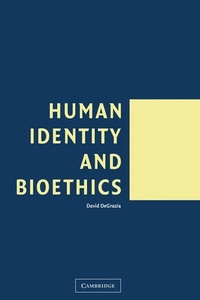
Human Identity and Bioethics
Published on 13. June 2005
Book
Paperback/Softback
316 pages
978-0-521-53268-6 (ISBN)
Description
When philosophers address personal identity, they usually explore numerical identity: what are the criteria for a person's continuing existence? When non-philosophers address personal identity, they often have in mind narrative identity: Which characteristics of a particular person are salient to her self-conception? This book develops accounts of both senses of identity, arguing that both are normatively important, and is unique in its exploration of a range of issues in bioethics through the lens of identity. Defending a biological view of our numerical identity and a framework for understanding narrative identity, DeGrazia investigates various issues for which considerations of identity prove critical: the definition of death; the authority of advance directives in cases of severe dementia; the use of enhancement technologies; prenatal genetic interventions; and certain types of reproductive choices. He demonstrates the power of personal identity theory to illuminate issues in bioethics as they bring philosophical theory to life.
More details
Language
English
Place of publication
Cambridge
United Kingdom
Target group
Professional and scholarly
Product notice
Paperback (trade)
Illustrations
Worked examples or Exercises
Dimensions
Height: 229 mm
Width: 152 mm
Thickness: 19 mm
Weight
515 gr
ISBN-13
978-0-521-53268-6 (9780521532686)
Copyright in bibliographic data and cover images is held by Nielsen Book Services Limited or by the publishers or by their respective licensors: all rights reserved.
Schweitzer Classification
Other editions
Additional editions
David DeGrazia
Human Identity and Bioethics
E-Book
05/2006
1st Edition
Cambridge University Press
€30.99
Available for download
Person
Content
1. Introduction; 2. Human persons: numerical identity and essence; 3. Human persons: narrative identity and self-creation; 4. Identity, what we are, and the definition of death; 5. Advance directives, dementia, and the someone else problem; 6. Enhancement technologies and self-creation; 7. Prenatal identity: genetic interventions, reproductive choices.