

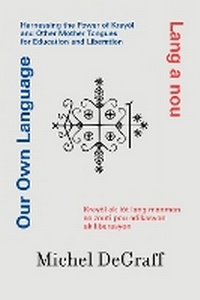
Our Own Language / Lang a nou
Harnessing the Power of Kreyol and Other Mother Tongues for Education and Liberation / Kreyol ak lot lang manman se zo
Will be published approx. on 1. September 2026
Book
Paperback/Softback
360 pages
978-0-262-05322-8 (ISBN)
Description
An exploration of the weaponization of language for neocolonialism, specifically the suppression of Haitian Creole—and why mother tongues are indispensable for universal access to quality education.
Our Own Language addresses the age-old, intricate, and generative relationship between language, power, and education, with a particular focus on the historical and ongoing suppression of Haitian Creole (Kreyòl) in Haiti in favor of French—the language of the former colonizers. It argues that this linguistic oppression is a tool for neocolonialism, mental slavery, and the entrenchment of social-class divides, thus undermining human rights and nation-building.
Michel DeGraff investigates the links between Haiti’s colonial and neocolonial history; the joint evolution of Creole languages and Creole studies; and how French in Haiti became a maker and marker of social hierarchies that exclude from education and governance those who speak Kreyòl only—that is, the majority of Haitians.
DeGraff draws on his own personal experience as a child growing up in Haiti, on historical accounts, and on linguistic analyses. The book extends its scope beyond Haiti, examining similar linguistic injustices in other parts of the world and in other sectors of society, and challenges dominant narratives and practices about language and development, even among agencies such as UNESCO and the World Bank.
Our Own Language addresses the age-old, intricate, and generative relationship between language, power, and education, with a particular focus on the historical and ongoing suppression of Haitian Creole (Kreyòl) in Haiti in favor of French—the language of the former colonizers. It argues that this linguistic oppression is a tool for neocolonialism, mental slavery, and the entrenchment of social-class divides, thus undermining human rights and nation-building.
Michel DeGraff investigates the links between Haiti’s colonial and neocolonial history; the joint evolution of Creole languages and Creole studies; and how French in Haiti became a maker and marker of social hierarchies that exclude from education and governance those who speak Kreyòl only—that is, the majority of Haitians.
DeGraff draws on his own personal experience as a child growing up in Haiti, on historical accounts, and on linguistic analyses. The book extends its scope beyond Haiti, examining similar linguistic injustices in other parts of the world and in other sectors of society, and challenges dominant narratives and practices about language and development, even among agencies such as UNESCO and the World Bank.
More details
Language
English
Place of publication
Cambridge (Massachusetts)
United States
Publishing group
MIT Press Ltd
Dimensions
Height: 229 mm
Width: 152 mm
Weight
369 gr
ISBN-13
978-0-262-05322-8 (9780262053228)
Copyright in bibliographic data and cover images is held by Nielsen Book Services Limited or by the publishers or by their respective licensors: all rights reserved.
Schweitzer Classification
Person
Michel DeGraff