

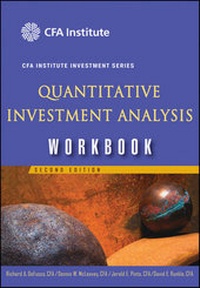
Quantitative Investment Analysis
Workbook
2nd Edition
Published on 2. February 2007
Book
Paperback/Softback
216 pages
978-0-470-06918-9 (ISBN)
Description
In the Second Edition of Quantitative Investment Analysis, financial experts Richard DeFusco, Dennis McLeavey, Jerald Pinto, and David Runkle outline the tools and techniques needed to understand and apply quantitative methods to today's investment process.
Now, in Quantitative Investment Analysis Workbook, Second Edition, they offer you a wealth of practical information and exercises that will further enhance your understanding of this discipline. This essential study guide--which parallels the main book chapter by chapter--contains challenging problems and a complete set of solutions as well as concise learning outcome statements and summary overviews.
If you're looking to successfully navigate today's dynamic investment environment, the lessons found within these pages can show you how. Topics reviewed include:
* The time value of money
* Discounted cash flow
* Probability distributions
* Sampling and estimation
* Hypothesis testing
* Multiple regression
* Time-series analysis
* And much more
Now, in Quantitative Investment Analysis Workbook, Second Edition, they offer you a wealth of practical information and exercises that will further enhance your understanding of this discipline. This essential study guide--which parallels the main book chapter by chapter--contains challenging problems and a complete set of solutions as well as concise learning outcome statements and summary overviews.
If you're looking to successfully navigate today's dynamic investment environment, the lessons found within these pages can show you how. Topics reviewed include:
* The time value of money
* Discounted cash flow
* Probability distributions
* Sampling and estimation
* Hypothesis testing
* Multiple regression
* Time-series analysis
* And much more
More details
Series
Edition
2. Auflage
Language
English
Place of publication
Chichester
United Kingdom
Publishing group
John Wiley and Sons Ltd
Target group
Professional and scholarly
Edition type
Revised edition
Illustrations
Illustrations
Dimensions
Height: 25.3 cm
Width: 18 cm
Thickness: 1.5 cm
Weight
379 gr
ISBN-13
978-0-470-06918-9 (9780470069189)
Schweitzer Classification
Other editions
New editions
Richard A. DeFusco | Dennis W. McLeavey | Jerald E. Pinto
Quantitative Investment Analysis Workbook
Book
11/2015
3rd Edition
Wiley
€47.90
Article exhausted; check for reprint
Persons
RICHARD A. DeFUSCO, CFA, is an Associate Professor of Finance at the University of Nebraska-Lincoln. DeFusco completed his bachelor's degree in management science at the University of Rhode Island and doctoral degree in finance at the University of Tennessee-Knoxville. He earned his CFA charter in 1999.
DENNIS W. McLEAVEY, CFA, is Head of Professional Development Products at CFA Institute. McLeavey completed a doctorate in production management and industrial engineering at Indiana University in 1972, and earned his CFA charter in 1990.
JERALD E. PINTO, CFA, is Director in the CFA and CIPM Programs Division at CFA Institute. Before coming to CFA Institute in 2002, he consulted in investment planning, portfolio analysis, and quantitative analysis. He holds an MBA from Baruch College and a PhD in finance from the Stern School. Pinto earned his CFA charter in 1992.
DAVID E. RUNKLE, CFA, is Vice President and Research Manager at U.S. Bancorp Piper Jaffray. He is an adjunct professor of finance in the Carlson School of Management at the University of Minnesota. Runkle received a BA in economics from Carleton College and a PhD in economics from MIT.
DENNIS W. McLEAVEY, CFA, is Head of Professional Development Products at CFA Institute. McLeavey completed a doctorate in production management and industrial engineering at Indiana University in 1972, and earned his CFA charter in 1990.
JERALD E. PINTO, CFA, is Director in the CFA and CIPM Programs Division at CFA Institute. Before coming to CFA Institute in 2002, he consulted in investment planning, portfolio analysis, and quantitative analysis. He holds an MBA from Baruch College and a PhD in finance from the Stern School. Pinto earned his CFA charter in 1992.
DAVID E. RUNKLE, CFA, is Vice President and Research Manager at U.S. Bancorp Piper Jaffray. He is an adjunct professor of finance in the Carlson School of Management at the University of Minnesota. Runkle received a BA in economics from Carleton College and a PhD in economics from MIT.
Content
PART 1: Learning Outcomes, Summary Overview, and Problems.
Chapter 1. The Time Value of Money.
Chapter 2. Discounted Cash Flow Applications.
Chapter 3. Statistical Concepts and Market Returns.
Chapter 4. Probability Concepts.
Chapter 5. Common Probability Distributions.
Chapter 6. Sampling and Estimation.
Chapter 7. Hypothesis Testing.
Chapter 8. Correlation and Regression.
Chapter 9. Multiple Regression and Issues in Regression Analysis.
Chapter 10. Time-Series Analysis.
Chapter 11. Portfolio Concepts.
PART 2: Solutions.
Chapter 1. The Time Value of Money.
Chapter 2. Discounted Cash Flow Applications.
Chapter 3. Statistical Concepts and Market Returns.
Chapter 4. Probability Concepts.
Chapter 5. Common Probability Distributions.
Chapter 6. Sampling and Estimation.
Chapter 7. Hypothesis Testing.
Chapter 8. Correlation and Regression.
Chapter 9. Multiple Regression and Issues in Regression Analysis.
Chapter 10. Time-Series Analysis.
Chapter 11. Portfolio Concepts.
About the CFA Program.
Chapter 1. The Time Value of Money.
Chapter 2. Discounted Cash Flow Applications.
Chapter 3. Statistical Concepts and Market Returns.
Chapter 4. Probability Concepts.
Chapter 5. Common Probability Distributions.
Chapter 6. Sampling and Estimation.
Chapter 7. Hypothesis Testing.
Chapter 8. Correlation and Regression.
Chapter 9. Multiple Regression and Issues in Regression Analysis.
Chapter 10. Time-Series Analysis.
Chapter 11. Portfolio Concepts.
PART 2: Solutions.
Chapter 1. The Time Value of Money.
Chapter 2. Discounted Cash Flow Applications.
Chapter 3. Statistical Concepts and Market Returns.
Chapter 4. Probability Concepts.
Chapter 5. Common Probability Distributions.
Chapter 6. Sampling and Estimation.
Chapter 7. Hypothesis Testing.
Chapter 8. Correlation and Regression.
Chapter 9. Multiple Regression and Issues in Regression Analysis.
Chapter 10. Time-Series Analysis.
Chapter 11. Portfolio Concepts.
About the CFA Program.