

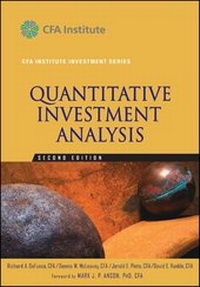
Quantitative Investment Analysis
2nd Edition
Published on 16. February 2007
Book
Hardback
600 pages
978-0-470-05220-4 (ISBN)
Description
Praise for Quantitative Investment Analysis, Second Edition
"Quantitative Investment Analysis is an essential book for any serious investor in today's financial markets. Cogently written, the authors cover a robust array of quantitative methods in a straightforward and digestible style. This book should be on everyone's short list of necessary reading and reference."
-Gary P. Brinson, CFA, President, GP Brinson Investments
"This second Edition of Quantitative Investment Analysis provides a strong foundation for investment practitioners seeking benefit from the rigor and discipline of quantitative tools and analysis. An abundance of examples enhances the value of this essential text for non-classroom pedagogy."
-Brian Singer, CFA, UBS Global Asset Management
"Quantitative Investment Analysis gets to the heart of the matter. Crisp, well-written, and technically thorough, this book provides an excellent foundation for understanding the statistics and economics of portfolio management and asset pricing. It also provides a thorough review of the major asset pricing models widely used today."
-David Blackwell, Head and RepublicBank/James W. Aston Professor of Finance, Mays Business School, Texas A&M University
"Quantitative Investment Analysis is an essential book for any serious investor in today's financial markets. Cogently written, the authors cover a robust array of quantitative methods in a straightforward and digestible style. This book should be on everyone's short list of necessary reading and reference."
-Gary P. Brinson, CFA, President, GP Brinson Investments
"This second Edition of Quantitative Investment Analysis provides a strong foundation for investment practitioners seeking benefit from the rigor and discipline of quantitative tools and analysis. An abundance of examples enhances the value of this essential text for non-classroom pedagogy."
-Brian Singer, CFA, UBS Global Asset Management
"Quantitative Investment Analysis gets to the heart of the matter. Crisp, well-written, and technically thorough, this book provides an excellent foundation for understanding the statistics and economics of portfolio management and asset pricing. It also provides a thorough review of the major asset pricing models widely used today."
-David Blackwell, Head and RepublicBank/James W. Aston Professor of Finance, Mays Business School, Texas A&M University
More details
Series
Edition
2. Auflage
Language
English
Place of publication
Chichester
United Kingdom
Publishing group
John Wiley and Sons Ltd
Target group
Professional and scholarly
Edition type
Revised edition
Illustrations
Illustrations
Dimensions
Height: 25.5 cm
Width: 18.8 cm
Thickness: 3.4 cm
Weight
1168 gr
ISBN-13
978-0-470-05220-4 (9780470052204)
Schweitzer Classification
Other editions
New editions
Richard A. DeFusco | Dennis W. McLeavey | Jerald E. Pinto
Quantitative Investment Analysis
Book
11/2015
3rd Edition
Wiley
€105.00
Article exhausted; check for reprint
Persons
RICHARD A. DEFUSCO, CFA, is an Associate Professor of Finance at the University of Nebraska-Lincoln (UNL). He earned his CFA charter in 1999. DeFusco is a member of the Omaha-Lincoln Society of Financial Analysts, and completed his bachelor's degree in management science at the University of Rhode Island and doctoral degree in finance at the University of Tennessee-Knoxville.
DENNIS W. MCLEAVEY, CFA, is Head of Professional Development Products at CFA Institute. During his twenty-five year academic career, he has taught at The University of Western Ontario, the University of Connecticut, the University of Rhode Island (where he founded a student-managed fund), and Babson College. McLeavey completed a doctorate in production management and industrial engineering at Indiana University in 1972, and earned his CFA charter in 1990.
JERALD E. PINTO, CFA, is Director in the CFA and CIPM Programs Division at CFA Institute. Before coming to CFA Institute in 2002, he consulted to corporations, foundations, and partnerships in investment planning, portfolio analysis, and quantitative analysis. He has also worked in the investment and banking industries in New York City and taught finance at New York University's Stern School of Business. He holds an MBA from Baruch College, a PhD in finance from the Stern School, and earned his CFA charter in 1992.
DAVID E. RUNKLE, CFA, is Vice President and Research Manager at U.S. Bancorp Piper Jaffray. He has been an adjunct professor of finance in the Carlson School of Management at the University of Minnesota since 1989. Runkle received a BA in economics from Carleton College and a PhD in economics from MIT.
DENNIS W. MCLEAVEY, CFA, is Head of Professional Development Products at CFA Institute. During his twenty-five year academic career, he has taught at The University of Western Ontario, the University of Connecticut, the University of Rhode Island (where he founded a student-managed fund), and Babson College. McLeavey completed a doctorate in production management and industrial engineering at Indiana University in 1972, and earned his CFA charter in 1990.
JERALD E. PINTO, CFA, is Director in the CFA and CIPM Programs Division at CFA Institute. Before coming to CFA Institute in 2002, he consulted to corporations, foundations, and partnerships in investment planning, portfolio analysis, and quantitative analysis. He has also worked in the investment and banking industries in New York City and taught finance at New York University's Stern School of Business. He holds an MBA from Baruch College, a PhD in finance from the Stern School, and earned his CFA charter in 1992.
DAVID E. RUNKLE, CFA, is Vice President and Research Manager at U.S. Bancorp Piper Jaffray. He has been an adjunct professor of finance in the Carlson School of Management at the University of Minnesota since 1989. Runkle received a BA in economics from Carleton College and a PhD in economics from MIT.
Content
Preface.
Acknowledgements.
Introduction.
Chapter 1. The Time Value of Money.
Chapter 2. Discounted Cash Flow Applications.
Chapter 3. Statistical Concepts and Market Returns.
Chapter 4. Probability Concepts.
Chapter 5. Common Probability Distributions.
Chapter 6. Sampling and Estimation.
Chapter 7. Hypothesis Testing.
Chapter 8. Correlation and Regression.
Chapter 9. Multiple Regression and Issues in Regression Analysis.
Chapter 10. Time-Series Analysis.
Chapter 11. Portfolio Concepts.
Appendices.
References.
Glossary.
About the CFA Program.
About the Authors.
Index.
Acknowledgements.
Introduction.
Chapter 1. The Time Value of Money.
Chapter 2. Discounted Cash Flow Applications.
Chapter 3. Statistical Concepts and Market Returns.
Chapter 4. Probability Concepts.
Chapter 5. Common Probability Distributions.
Chapter 6. Sampling and Estimation.
Chapter 7. Hypothesis Testing.
Chapter 8. Correlation and Regression.
Chapter 9. Multiple Regression and Issues in Regression Analysis.
Chapter 10. Time-Series Analysis.
Chapter 11. Portfolio Concepts.
Appendices.
References.
Glossary.
About the CFA Program.
About the Authors.
Index.