

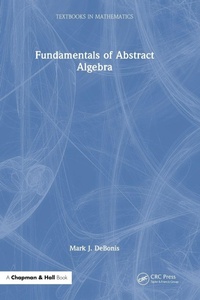
Fundamentals of Abstract Algebra
1st Edition
Published on 11. April 2024
Book
Hardback
290 pages
978-1-032-36701-9 (ISBN)
Description
Fundamentals of Abstract Algebra is a primary textbook for a one year first course in Abstract Algebra, but it has much more to offer besides this. The book is full of opportunities for further, deeper reading, including explorations of interesting applications and more advanced topics, such as Galois theory. Replete with exercises and examples, the book is geared towards careful pedagogy and accessibility, and requires only minimal prerequisites. The book includes a primer on some basic mathematical concepts that will be useful for readers to understand, and in this sense the book is self-contained.
Features
Self-contained treatments of all topics
Everything required for a one-year first course in Abstract Algebra, and could also be used as supplementary reading for a second course
Copious exercises and examples
Mark DeBonis received his PhD in Mathematics from the University of California, Irvine, USA. He began his career as a theoretical mathematician in the field of group theory and model theory, but in later years switched to applied mathematics, in particular to machine learning. He spent some time working for the US Department of Energy at Los Alamos National Lab as well as the US Department of Defense at the Defense Intelligence Agency, both as an applied mathematician of machine learning. He held a position as Associate Professor of Mathematics at Manhattan College in New York City, but later left to pursue research working for the US Department of Energy at Sandia National Laboratory as a Principal Data Analyst. His research interests include machine learning, statistics and computational algebra.
Features
Self-contained treatments of all topics
Everything required for a one-year first course in Abstract Algebra, and could also be used as supplementary reading for a second course
Copious exercises and examples
Mark DeBonis received his PhD in Mathematics from the University of California, Irvine, USA. He began his career as a theoretical mathematician in the field of group theory and model theory, but in later years switched to applied mathematics, in particular to machine learning. He spent some time working for the US Department of Energy at Los Alamos National Lab as well as the US Department of Defense at the Defense Intelligence Agency, both as an applied mathematician of machine learning. He held a position as Associate Professor of Mathematics at Manhattan College in New York City, but later left to pursue research working for the US Department of Energy at Sandia National Laboratory as a Principal Data Analyst. His research interests include machine learning, statistics and computational algebra.
More details
Series
Language
English
Place of publication
United Kingdom
Publishing group
Taylor & Francis Ltd
Target group
College/higher education
Primary & secondary/elementary & high school
Undergraduate Core
Illustrations
38 s/w Abbildungen, 38 s/w Zeichnungen
38 Line drawings, black and white; 38 Illustrations, black and white
Dimensions
Height: 260 mm
Width: 183 mm
Thickness: 21 mm
Weight
770 gr
ISBN-13
978-1-032-36701-9 (9781032367019)
Copyright in bibliographic data and cover images is held by Nielsen Book Services Limited or by the publishers or by their respective licensors: all rights reserved.
Schweitzer Classification
Other editions
Additional editions
Mark J. DeBonis
Fundamentals of Abstract Algebra
Book
04/2024
1st Edition
Chapman & Hall/CRC
€93.90
Shipment within 10-20 days
Mark J. DeBonis
Fundamentals of Abstract Algebra
E-Book
04/2024
1st Edition
Chapman and Hall
€89.99
Available for download
Mark J. DeBonis
Fundamentals of Abstract Algebra
E-Book
04/2024
1st Edition
Chapman and Hall
€89.99
Available for download
Person
Mark DeBonis received his PhD in Mathematics from University of California, Irvine, USA. He began his career as a theoretical mathematician in the field of group theory and model theory, but in later years switched to applied mathematics, in particular to machine learning. He spent some time working for the US Department of Energy at Los Alamos National Lab as well as the US Department of Defense at the Defense Intelligence Agency both as an applied mathematician of machine learning. He held a position as Associate Professor of Mathematics at Manhattan College in New York City, but later left to pursue research working for the US Department of Energy at Sandia National Laboratory as a Principal Data Analyst. His research interests include machine learning, statistics and computational algebra.
Content
Section I. Groups. 1. Background Material. 2. Basic Group Theory. 3. Simple Groups. 4. Group Action. Group Presentation and Representations. 5. Solvable and Nilpotent Groups. Section II. Rings and Fields. Chapter 7. Ring Theory. 8. Integral Domain Theory. 9. Field Theory. 10. Galois Theory.