

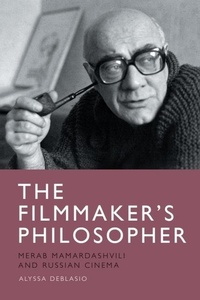
The Filmmaker's Philosopher
Merab Mamardashvili and Russian Cinema
Published on 31. August 2021
Book
Paperback/Softback
216 pages
978-1-4744-4449-1 (ISBN)
Description
Known as the 'Georgian Socrates' of Soviet philosophy, Merab Mamardashvili was a defining personality of the late-Soviet intelligentsia. In the 1970s and 1980s, he taught required courses in philosophy at Russia's two leading film schools, helping to educate a generation of internationally prolific directors.
Exploring Mamardashvili's extensive philosophical output, as well as a range of recent Russian films, Alyssa DeBlasio reveals the intellectual affinities amongst directors of the Mamardashvili generation - including Alexander Sokurov, Andrey Zvyagintsev and Alexei Balabanov. This multidisciplinary study offers an innovative way to think about film, philosophy and the philosophical potential of the moving image.
Exploring Mamardashvili's extensive philosophical output, as well as a range of recent Russian films, Alyssa DeBlasio reveals the intellectual affinities amongst directors of the Mamardashvili generation - including Alexander Sokurov, Andrey Zvyagintsev and Alexei Balabanov. This multidisciplinary study offers an innovative way to think about film, philosophy and the philosophical potential of the moving image.
Reviews / Votes
The Filmmaker's Philosopher is a highly effective text that handles complex, ever-elusive philosophical thinking with great confidence and clarity. It will undoubtedly be useful to a great variety of researchers, from Mamardashvili scholars to film-philosophers who are yet to discover his invigorating ideas. -- Ilia Ryzhenko * Film-Philosophy * The Filmmaker's Philosopher is a deep, sustained study that reads with great interest to the end. In addition to its rigorous philosophical explorations and insightful new readings of particular films, DeBlasio crafts a vivid portrait of Mamardashvili himself, with his sartorial elegance, the smoky lecture halls of late socialism, and the exhilaration of free thought. The book is a must-read for Russian film studies, but will also greatly interest students and specialists of late Soviet culture and philosophy. -- Justin Wilmes, East Carolina University * Slavic Review Vol. 79, Issue 4 * The Filmmaker's Philosopher is a deep, sustained study that reads with great interest to the end. In addition to its rigorous philosophical explorations and insightful new readings of particular films, DeBlasio crafts a vivid portrait of Mamardashvili himself, with his sartorial elegance, the smoky lecture halls of late socialism, and the exhilaration of free thought. The book is a must-read for Russian film studies, but will also greatly interest students and specialists of late Soviet culture and philosophy. -- Justin Wilmes, East Carolina University * Slavic Review Vol. 79, Issue 4 * DeBlasio's book has the merit of introducing Merab Mamardashvili to scholars who do not read Russian and it does so from an interesting angle. [...] two hundred pages of pleasant and clear narrative [...] -- Elisa Pontini, Radboud University * Studies in East European Thought (2020) 72 * [A] fascinating and original book [...] DeBlasio is a reliable guide to both the cinema and the philosophy. -- Anthony Anemone, The New School * The Russian Review, Vol. 80, No. 2 * We have been missing this book. Merab Mamardashvili was force of freedom in the Soviet academy, not for what he said, but how. His life spanned the cold-war divide, influencing an entire generation of filmmakers and intellectuals. He showed the crowds in his lecture halls that thinking out loud can itself be a political act. DeBlasio's book moves back and forth between the man and the films he inspired, providing a fresh understanding of his times. -- Professor Susan Buck-Morss, CUNY Graduate CenterMore details
Language
English
Place of publication
Edinburgh
United Kingdom
Target group
Professional and scholarly
Illustrations
14 black and white illustrations
Dimensions
Height: 153 mm
Width: 233 mm
Thickness: 17 mm
Weight
338 gr
ISBN-13
978-1-4744-4449-1 (9781474444491)
Copyright in bibliographic data and cover images is held by Nielsen Book Services Limited or by the publishers or by their respective licensors: all rights reserved.
Schweitzer Classification
Other editions
Additional editions
E-Book
09/2019
Edinburgh University Press
€26.49
Available for download
Person
Alyssa DeBlasio is Associate Professor of Russian at Dickinson College, where she also contributes to the Film Studies and Philosophy programs.
Content
Acknowledgements
Notes on Transliteration
Introduction: The Freest Man in the USSR
Chapter One: Alexander Sokurov's Demoted (1980): Consciousness as Celebration
Chapter Two: Ivan Dykhovichnyi's The Black Monk (1988): Madness, Chekhov, and the Chimera of Idleness
Chapter Three: Dmitry Mamuliya's Another Sky (2010): The Language of Consciousness
Chapter Four: Alexei Balabanov's The Castle (1994) and Me Too (2012): Kafka, the Absurd, and the Death of Form
Chapter Five: Alexander Zeldovich's Target (2011): Tolstoy and Mamardashvili on the Infinite and the Earthly
Chapter Six: Vadim Abdrashitov and Alexander Mindadze's The Train Stopped (1982): Film as a Metaphor for Consciousness
Conclusion: Andrey Zvyagintsev's Loveless (2017): The Philosophical Image and the Possibilities of Film
Bibliography
Appendix
Notes on Transliteration
Introduction: The Freest Man in the USSR
Chapter One: Alexander Sokurov's Demoted (1980): Consciousness as Celebration
Chapter Two: Ivan Dykhovichnyi's The Black Monk (1988): Madness, Chekhov, and the Chimera of Idleness
Chapter Three: Dmitry Mamuliya's Another Sky (2010): The Language of Consciousness
Chapter Four: Alexei Balabanov's The Castle (1994) and Me Too (2012): Kafka, the Absurd, and the Death of Form
Chapter Five: Alexander Zeldovich's Target (2011): Tolstoy and Mamardashvili on the Infinite and the Earthly
Chapter Six: Vadim Abdrashitov and Alexander Mindadze's The Train Stopped (1982): Film as a Metaphor for Consciousness
Conclusion: Andrey Zvyagintsev's Loveless (2017): The Philosophical Image and the Possibilities of Film
Bibliography
Appendix