

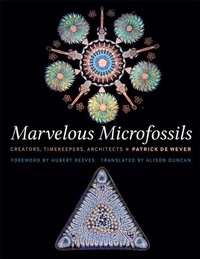
Marvelous Microfossils
Creators, Timekeepers, Architects
Published on 28. April 2020
Book
Hardback
256 pages
978-1-4214-3673-9 (ISBN)
Description
Training a powerful lens on the microscopic wonders of the universe, hundreds of photos, both exquisite and strange, accompany this startling expose of a secret world invisibly evolving around us for billions of years.
Silver Winner of the 2021 IBPA Benjamin Franklin Award for Nature & Environment
Microfossils-the most abundant, ancient, and easily accessible of Earth's fossils-are also the most important. Their ubiquity is such that every person on the planet touches or uses them every single day, and yet few of us even realize they exist. Despite being the sole witnesses of 3 billion years of evolutionary history, these diminutive fungi, plants, and animals are themselves invisible to the eye. In this microscopic bestiary, prominent geologist, paleontologist, and scholar Patrick De Wever lifts the veil on their mysterious world.
Marvelous Microfossils lays out the basics of what microfossils are before moving on to the history, tools, and methods of investigating them. The author describes the applications of their study, both practical and sublime. Microfossils, he explains, are indispensable in age-dating and paleoenvironmental reconstruction, which guide enormous investments in the oil, gas, and mining industries. De Wever shares surprising stories of how microfossils made the Chunnel possible and have unmasked perpetrators in jewel heists and murder investigations. He also reveals that microfossils created the stunning white cliffs on the north coast of France, graced the tables of the Medici family, and represent our best hope for discovering life on the exoplanets at the outer edges of our solar system.
Describing the many strange and beautiful groups of known microfossils in detail, De Wever combines lyrical prose with hundreds of arresting color images, from delicate nineteenth-century drawings of phytoplankton drafted by Ernst Haeckel, the "father of ecology," to cutting-edge scanning electron microscope photographs of billion-year-old acritarchs. De Wever's ode to the invisible world around us allows readers to peer directly into a minute microcosm with massive implications, even traversing eons to show us how life arose on Earth.
Silver Winner of the 2021 IBPA Benjamin Franklin Award for Nature & Environment
Microfossils-the most abundant, ancient, and easily accessible of Earth's fossils-are also the most important. Their ubiquity is such that every person on the planet touches or uses them every single day, and yet few of us even realize they exist. Despite being the sole witnesses of 3 billion years of evolutionary history, these diminutive fungi, plants, and animals are themselves invisible to the eye. In this microscopic bestiary, prominent geologist, paleontologist, and scholar Patrick De Wever lifts the veil on their mysterious world.
Marvelous Microfossils lays out the basics of what microfossils are before moving on to the history, tools, and methods of investigating them. The author describes the applications of their study, both practical and sublime. Microfossils, he explains, are indispensable in age-dating and paleoenvironmental reconstruction, which guide enormous investments in the oil, gas, and mining industries. De Wever shares surprising stories of how microfossils made the Chunnel possible and have unmasked perpetrators in jewel heists and murder investigations. He also reveals that microfossils created the stunning white cliffs on the north coast of France, graced the tables of the Medici family, and represent our best hope for discovering life on the exoplanets at the outer edges of our solar system.
Describing the many strange and beautiful groups of known microfossils in detail, De Wever combines lyrical prose with hundreds of arresting color images, from delicate nineteenth-century drawings of phytoplankton drafted by Ernst Haeckel, the "father of ecology," to cutting-edge scanning electron microscope photographs of billion-year-old acritarchs. De Wever's ode to the invisible world around us allows readers to peer directly into a minute microcosm with massive implications, even traversing eons to show us how life arose on Earth.
Reviews / Votes
Enhanced by sumptuous images, Marvelous Microfossils reveals microfossils' amazing forms and fascinating architecture. Readers will be easily hypnotized by their patterns, their rhythms, their symmetries . . . a delight for the eyes, this book is also notable for its scientific intelligibility. The author is able to render his interest and the complexity of an invisible and inert world with a sharp literary pen, clear text, and simple and effective examples and organization.-Remi Luglia, President, Societe Nationale de Protection de la Nature Initially an emotional thunderbolt for geologist and micropaleontologist Patrick De Wever, microfossils became the object of his research for decades. Sharing this feeling was his motivation to devote a book to the topic. To say the least, this book perfectly fulfills that function!
-La Recherche This book will make history! It is the fruit of a whole life's work dedicated to the study of microfossils. The author combines his qualities as a scientist with a great knowledge of the literature. His wish, to inspire us to look for the beauties hidden in stone, is fully realized in this beautiful and successful work!
-A Fond la Science
More details
Language
English
Place of publication
Baltimore, MD
United States
Target group
Professional and scholarly
Product notice
sewn/stitched
Cloth over boards
Illustrations
200 farbige Abbildungen, 100 s/w Abbildungen
100 Illustrations, black and white; 200 Illustrations, color
Dimensions
Height: 282 mm
Width: 218 mm
Thickness: 25 mm
Weight
1202 gr
ISBN-13
978-1-4214-3673-9 (9781421436739)
DOI
10.1353/book.74018
Copyright in bibliographic data and cover images is held by Nielsen Book Services Limited or by the publishers or by their respective licensors: all rights reserved.
Schweitzer Classification
Other editions
Additional editions
E-Book
04/2020
Johns Hopkins University Press
€45.49
Available for download
Persons
Patrick De Wever is a professor of geology and micropaleontology at the Museum national d'Histoire naturelle. He is the author of Temps de la Terre, temps de l'Homme and Carnet de curiosites d'un geologue. Alison Duncan is a translator and book editor. She earned her master of science in translation from New York University and her bachelor of arts in French and Francophone studies from Vassar College.
Content
Preface
Introduction
A Marvelous Microscopic World
What Is a Microfossil?
Why Study Microfossils
Part A: The Study of Microfossils
Part B: Microfossils through the Geologic Ages
Part C: The Diversity of Microfossils
Part D: Architects, Builders, and Markers of Time
Introduction
A Marvelous Microscopic World
What Is a Microfossil?
Why Study Microfossils
Part A: The Study of Microfossils
Part B: Microfossils through the Geologic Ages
Part C: The Diversity of Microfossils
Part D: Architects, Builders, and Markers of Time