

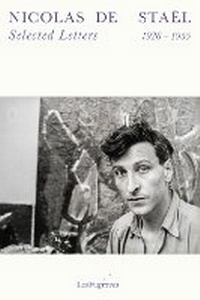
Selected Letters
1926-1955
Will be published approx. on 1. October 2026
Book
Paperback/Softback
250 pages
978-1-0684338-9-4 (ISBN)
Description
Available in English for the first time, these letters are taken from the several hundred letters anthologised by French art historian Germain Viatte, published in 2014 by Le bruit du temps. As well as an intriguing investigation of one of the great 20th-century painters, these are also the letters of a writer. From his adolescence onwards, Nicolas de Stael developed an incisive style of his own, capturing - as in his paintings - the reality of what he saw with the intensity of pure simplicity.
'Nicolas de Stael's letters are imbued with that mixture of absolute certitude and profound doubt which is the mark of a great artist. His belief in his destiny - which arises from faith - places the bar so high that it will always be impossible to clear. ... He had the premonition that the path would be long and winding before it ever broke onto a clearing. Stael is not, like Raphael, Gericault or Seurat, a precocious genius. If he must be compared to one of his predecessors, it is impossible not to think of Van Gogh.' - Jean Fremon
'This selection of letters begins in 1926 when de Stael was 12 years old and ends with the last letter he wrote on the day he died. De Stael wrote thousands of letters - to his adoptive parents, his wives and lovers, his children, gallery owners and dealers, poets, fellow painters and those who bought his work. They describe the course of his life from young man eagerly awaiting a cheque from a family member at a post office in Cadiz so he can buy his daily kilo of tomatoes, his wine, his newspaper, paints, canvases and sketchbooks, to the final months, when black gulls began to gather on his canvasses, bringing a darker, inky sense of foreboding to work that until then had been characterised by a boundless sense of colour and light. The letters also show the evolution of his understanding of painting, of what painting actually is, of the human cost - what part of the self must be sacrificed to it. And always he is aware of the complementary roles of language and painting. De Stael's work, though it bears traces of figuration, is never illustrative; the writing is his illustrative tool, and his own words provide a dazzling commentary on the paintings.' - Helen Stevenson
'Nicolas de Stael's letters are imbued with that mixture of absolute certitude and profound doubt which is the mark of a great artist. His belief in his destiny - which arises from faith - places the bar so high that it will always be impossible to clear. ... He had the premonition that the path would be long and winding before it ever broke onto a clearing. Stael is not, like Raphael, Gericault or Seurat, a precocious genius. If he must be compared to one of his predecessors, it is impossible not to think of Van Gogh.' - Jean Fremon
'This selection of letters begins in 1926 when de Stael was 12 years old and ends with the last letter he wrote on the day he died. De Stael wrote thousands of letters - to his adoptive parents, his wives and lovers, his children, gallery owners and dealers, poets, fellow painters and those who bought his work. They describe the course of his life from young man eagerly awaiting a cheque from a family member at a post office in Cadiz so he can buy his daily kilo of tomatoes, his wine, his newspaper, paints, canvases and sketchbooks, to the final months, when black gulls began to gather on his canvasses, bringing a darker, inky sense of foreboding to work that until then had been characterised by a boundless sense of colour and light. The letters also show the evolution of his understanding of painting, of what painting actually is, of the human cost - what part of the self must be sacrificed to it. And always he is aware of the complementary roles of language and painting. De Stael's work, though it bears traces of figuration, is never illustrative; the writing is his illustrative tool, and his own words provide a dazzling commentary on the paintings.' - Helen Stevenson
Reviews / Votes
As absorbing and fascinating as the letters of Van Gogh.' - Richard Blin, Le Matricule des anges'He puts his entire being into every sentence he writes, as though each one were an irrevocable act. He will do this until the very end.' - Philippe Lancon, Liberation
'A rapid, ecstatic, at times violent but resolutely poetic rhythm. The writing of Nicolas de Stael is that of urgency, of creation, emotion, and doubt.' - Daphne Betard, Beaux-Arts Magazine
'After having read these letters, so full are they with belief and life and tragedy, we see the colours, the skies, the rooftops painted by this hand which almost seems to move and tremble before us. A life in words and in painting.' - Lisbeth Koutchoumoff, Le Temps
'In reading these letters, one has the feeling of being as close as possible to the creative act, through its day to day struggles, the fondness and generosity felt for loved ones, through its vertigo, nobility and its disdain for everything commercial, through its incessant desire for renewal and its "inevitable need to break everything when the machine runs too smoothly".' - Edith de La Heronniere, Revue des deux mondes
'To immerse yourself in [de Stael's] letters is to follow the thread of his biography: his formative years, his travels to Spain and Morocco, the visits he made to museums and to the masters (Velasquez, Rembrandt, Delacroix, Van Gogh, Courbet) and gradually learning from them the rules of drawing, composition, colour; but also his intensely passionate relationships, his family life, his friendship with Braque and Rene Char, his chronic financial difficulties and later, right at the end of the 1940s, the recognition, the first exhibitions and the beginning of a more comfortable material existence - this just a few years before his death aged 41. For Nicolas de Stael more than anyone else, the biography is inseparable from the work. It is as though it were in constant evolution, in search of itself.' - Nathalie Crom, Telerama
More details
Language
English
Place of publication
London
United Kingdom
Dimensions
Height: 180 mm
Width: 135 mm
ISBN-13
978-1-0684338-9-4 (9781068433894)
Copyright in bibliographic data and cover images is held by Nielsen Book Services Limited or by the publishers or by their respective licensors: all rights reserved.
Schweitzer Classification
Persons
Nicolas de Stael was an abstract painter best known for his luminous landscapes using
thick impasto. Born in St Petersburg in 1914, he was five years old when
his family fled the Russian Revolution to Poland, where both his
parents subsequently died of cancer. Rescued by a couple living in
Brussels, de Stael went on to study fine arts, architecture and
decorative arts at the Beaux-Arts and the Royal Academy of Belgium. He
lived in France for most of his adult life, but also spent several years
travelling in Morocco in the 1930s, and was mobilised in 1940 in the
French Foreign Legion in Tunisia, where he drew maps. From the late
1940s to the late 1950s, his paintings were exhibited in London, Paris,
Montevideo, New York and Washington. De Stael moved to a studio in
Antibes in 1954 to live closer to Jeanne Polge, his lover, who refused
to leave her marriage and family. On 16 March 1955, at the height of his
fame but depressed and exhausted by the intensity of his work, de Stael
took his own life, aged forty-one. He was survived by his second wife,
Francoise, their three young children, and the daughter from his first
marriage - his first wife, the painter Jeannine Guillou, having died
during her second pregnancy.
thick impasto. Born in St Petersburg in 1914, he was five years old when
his family fled the Russian Revolution to Poland, where both his
parents subsequently died of cancer. Rescued by a couple living in
Brussels, de Stael went on to study fine arts, architecture and
decorative arts at the Beaux-Arts and the Royal Academy of Belgium. He
lived in France for most of his adult life, but also spent several years
travelling in Morocco in the 1930s, and was mobilised in 1940 in the
French Foreign Legion in Tunisia, where he drew maps. From the late
1940s to the late 1950s, his paintings were exhibited in London, Paris,
Montevideo, New York and Washington. De Stael moved to a studio in
Antibes in 1954 to live closer to Jeanne Polge, his lover, who refused
to leave her marriage and family. On 16 March 1955, at the height of his
fame but depressed and exhausted by the intensity of his work, de Stael
took his own life, aged forty-one. He was survived by his second wife,
Francoise, their three young children, and the daughter from his first
marriage - his first wife, the painter Jeannine Guillou, having died
during her second pregnancy.