

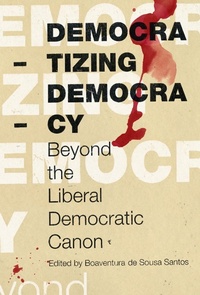
Democratizing Democracy
Beyond the Liberal Democratic Canon
Published on 17. August 2007
Book
Paperback/Softback
562 pages
978-1-84467-147-2 (ISBN)
Description
The majorconflicts between the Global North and the South can be expected toresult from the confrontation of alternative conceptions of democracy,mainly between liberal or representative democracy and participatorydemocracy.
The hegemonic model of democracy, while prevailing on aglobal scale, guarantees no more than low-intensity democracy. Inrecent times, participatory democracy has exhibited a new dynamic,engaging mainly subaltern communities and social groups that fightagainst social exclusion and the suppression of citizenship.
In thiscollection of reports from the Global South-India, South Africa,Mozambique, Colombia, and Brazil-De Sousa Santos and his colleaguesshow how, in some cases, the deepening of democracy results from thedevelopment of dual forms of participatory and representativedemocracy, and points to the emergence of transnational networks ofparticipatory democracy initiatives. Such networks pave one of the waysto the reinvention of social emancipation.
This is volume 1 of the Reinventing Social Emancipation project, edited by Boaventura de Sousa Santos.
The hegemonic model of democracy, while prevailing on aglobal scale, guarantees no more than low-intensity democracy. Inrecent times, participatory democracy has exhibited a new dynamic,engaging mainly subaltern communities and social groups that fightagainst social exclusion and the suppression of citizenship.
In thiscollection of reports from the Global South-India, South Africa,Mozambique, Colombia, and Brazil-De Sousa Santos and his colleaguesshow how, in some cases, the deepening of democracy results from thedevelopment of dual forms of participatory and representativedemocracy, and points to the emergence of transnational networks ofparticipatory democracy initiatives. Such networks pave one of the waysto the reinvention of social emancipation.
This is volume 1 of the Reinventing Social Emancipation project, edited by Boaventura de Sousa Santos.
Reviews / Votes
At last, someone is putting concrete analysis on 'counter-hegemonic globalization from the bottom up.' Boaventura de Sousa Santos has assembled social scientists from Latin America, Africa, and Asia to describe another kind of democracy, full of lessons for the benighted countries of the North, where it should be mandatory reading for serious people. -- Immanuel Wallerstein In the 1980s Margaret Thatcher declared 'There is no alternative.' At the beginning of the 21st century the World Social Forum replied, 'Another World is Possible.' The project, Reinventing Social Emancipation, is a passionate and wide-ranging effort enriching our vision of that other world. -- Erik Olin WrightMore details
Series
Language
English
Place of publication
London
United Kingdom
Target group
College/higher education
Product notice
Paperback (trade)
Unsewn / adhesive bound
Dimensions
Height: 234 mm
Width: 161 mm
Thickness: 39 mm
Weight
780 gr
ISBN-13
978-1-84467-147-2 (9781844671472)
Copyright in bibliographic data and cover images is held by Nielsen Book Services Limited or by the publishers or by their respective licensors: all rights reserved.
Schweitzer Classification
Other editions
Additional editions
E-Book
05/2020
Verso Books
€34.49
Available for download
Previous edition
Book
01/2006
Verso Books
€69.60
Article exhausted; check for reprint
Persons
Boaventura de Sousa Santos is Professor of Sociology at the University of Coimbra (Portugal) and ILS Distinguished Scholar at the University of Wisconsin-Madison. He has been an active participant in the World Social Forum. His books include Toward a New Legal Common Sense: Law, Globalization and Emancipation.
Emir Sader is Emeritus Professor of Political Science at the University of Sao Paolo and Director of the Latin American Social Science Research Council (CLACSO).
Emir Sader is Emeritus Professor of Political Science at the University of Sao Paolo and Director of the Latin American Social Science Research Council (CLACSO).