

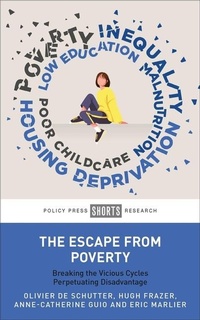
The Escape from Poverty
Breaking the Vicious Cycles Perpetuating Disadvantage
1st Edition
Published on 17. October 2023
Book
Hardback
216 pages
978-1-4473-7060-4 (ISBN)
Description
ePDF and ePUB available Open Access under CC-BY-NC-ND license.
The perpetuation of poverty across generations damages lives. It weakens social cohesion and the economy and undermines environmental sustainability. This book examines why poverty is carried on from one generation to the next and what needs to be done to eradicate it.
This book draws on a wide variety of sources and academic disciplines (social sciences, economics, law, community development, neuroscience and developmental psychology) along with the lived experience of people in poverty. Challenging the myths and prejudices about poverty that hinder progress, it calls for a comprehensive approach based on ensuring real equality of opportunity for all. It stresses the need to intervene early to combat child poverty and break the vicious cycles that perpetuate poverty and disadvantage.
The perpetuation of poverty across generations damages lives. It weakens social cohesion and the economy and undermines environmental sustainability. This book examines why poverty is carried on from one generation to the next and what needs to be done to eradicate it.
This book draws on a wide variety of sources and academic disciplines (social sciences, economics, law, community development, neuroscience and developmental psychology) along with the lived experience of people in poverty. Challenging the myths and prejudices about poverty that hinder progress, it calls for a comprehensive approach based on ensuring real equality of opportunity for all. It stresses the need to intervene early to combat child poverty and break the vicious cycles that perpetuate poverty and disadvantage.
Reviews / Votes
"This book provides various pathways towards 'Good Living' (Buen Vivir), as an alternative to development: a call to move beyond the fetishism of progress, which, far from alleviating poverty and slowing down the destruction of Nature, steadily increases them both." Alberto Acosta, Former President of the Constituent Assembly of Ecuador [2007-2008]"This book is an informed and impassioned call to action to end (monetary) poverty and its concatenation of effects on children's lives. It distils the vast and dispersed literature on inter-generational perpetuation of poverty accurately in a readable and concise fashion - which itself is no minor feat. Its analysis is a springboard to articulate actions that would uproot poverty feasibly and permanently. The authors' intellectual rigour and ethical energy permeates the narrative, making this a book to be read seriously and to be used." Sabina Alkire, Professor, Oxford Poverty and Human Development Initiative, University of Oxford, United Kingdom
"In this book a talented group of researchers give us direction on how to build on the world progress in reducing extreme poverty and break the circle of poverty. As so clearly presented in this book, with excellent academic basis, this is the ultimate goal in advancing the lives of so many children and families around the world." Asher Ben-Arieh, Professor, Hebrew University of Jerusalem, Israel "A cry for action on child poverty from four distinguished scholars, drawing on worldwide evidence to back their case and proposing cogent policy remedies within the grasp of national governments. The most important issue of our time. Act." Jonathan Bradshaw, Emeritus Professor, University of York, United Kingdom
"The time to consign mass poverty to the dustbin of history is long overdue. This requires freeing children from the chains that bound their parents. Here is an essential guide to this escape." Jean Dreze, Honorary Professor, Delhi School of Economics, India
"This book vividly traces the pathways through which poverty transmits across generations, generating deep patterns of intergenerational disadvantage. It demonstrates the critical role of social rights and programmes giving effect to these rights in disrupting these patterns and improving outcomes for future generations. It is essential reading for all who are interested in the role of law and policy in improving the life chances of those living in poverty, particularly children and generations still to come." Sandra Liebenberg, Distinguished Professor and HF Oppenheimer Chair in Human Rights Law, University of Stellenbosch, South Africa "A must-read for anyone concerned about the persistence of poverty, this seminal book argues that to break the intergenerational perpetuation of poverty, it is necessary to intervene early on, addressing the vicious circles that constrain poor children's life chances." Chiara Saraceno, Honorary Fellow, Collegio Carlo Alberto, Italy
"This book's solutions are actionable and holistic thanks to a human-rights framework and deep respect for knowledge that is forged by lived experience of poverty." Diana Skelton, National Coordination Team at All Together in Dignity, ATD Fourth World, United Kingdom
"[The book's] combination of thoughtful critique and practical advice makes it a valuable resource for those seeking to address poverty at its roots." The Journal of Economic Inequality
More details
Edition
First Edition
Language
English
Place of publication
United Kingdom
Publishing group
Bristol University Press
Target group
Professional and scholarly
Product notice
Unsewn / adhesive bound
Cloth over boards
Illustrations
1 Illustrations, black and white
Dimensions
Height: 203 mm
Width: 127 mm
Thickness: 14 mm
Weight
340 gr
ISBN-13
978-1-4473-7060-4 (9781447370604)
Copyright in bibliographic data and cover images is held by Nielsen Book Services Limited or by the publishers or by their respective licensors: all rights reserved.
Schweitzer Classification
Other editions
Additional editions
Olivier De Schutter | Hugh Frazer | Anne-Catherine Guio
The Escape from Poverty
Breaking the Vicious Cycles Perpetuating Disadvantage
E-Book
10/2023
1st Edition
Policy Press
€0.00
Available for download
Persons
Olivier De Schutter is Professor at the Universite catholique de Louvain, Belgium and the UN Special Rapporteur on extreme poverty and human rights.
Hugh Frazer is Adjunct Professor at Maynooth University, Ireland, a former Director of the Irish Government's Combat Poverty Agency and an expert on child poverty and European Union (EU) social policy.
Anne-Catherine Guio is Senior Researcher at the Luxembourg Institute of Socio-Economic Research (LISER) and ensured the scientific coordination of the first two EU's Feasibility Studies for a 'European Child Guarantee'.
Eric Marlier is International Scientific Coordinator at the Luxembourg Institute of Socio-Economic Research (LISER) and manages the 38-country 'European Social Policy Analysis Network' funded by the EU.
Hugh Frazer is Adjunct Professor at Maynooth University, Ireland, a former Director of the Irish Government's Combat Poverty Agency and an expert on child poverty and European Union (EU) social policy.
Anne-Catherine Guio is Senior Researcher at the Luxembourg Institute of Socio-Economic Research (LISER) and ensured the scientific coordination of the first two EU's Feasibility Studies for a 'European Child Guarantee'.
Eric Marlier is International Scientific Coordinator at the Luxembourg Institute of Socio-Economic Research (LISER) and manages the 38-country 'European Social Policy Analysis Network' funded by the EU.
Content
Introduction
Part 1: What Is IGPP About?
1. Setting the Stage
2. How Poverty Is Perpetuated Across Generations
Part 2: Why Should We Care?
3. Why IGPP Is Bad For All
Part 3: What Can Be Done?
4. Post-market Redistribution
5. Towards An Inclusive Economy
6. Making it Happen
Conclusion
Part 1: What Is IGPP About?
1. Setting the Stage
2. How Poverty Is Perpetuated Across Generations
Part 2: Why Should We Care?
3. Why IGPP Is Bad For All
Part 3: What Can Be Done?
4. Post-market Redistribution
5. Towards An Inclusive Economy
6. Making it Happen
Conclusion