

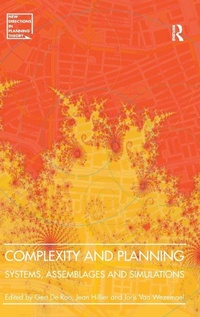
Complexity and Planning
Systems, Assemblages and Simulations
1st Edition
Published on 28. July 2012
Book
Hardback
462 pages
978-1-4094-0347-0 (ISBN)
Description
Complexity, complex systems and complexity theories are becoming increasingly important within a variety disciplines. While these issues are less well known within the discipline of spatial planning, there has been a recent growing awareness and interest. As planners grapple with how to consider the vagaries of the real world when putting together proposals for future development, they question how complexity, complex systems and complexity theories might prove useful with regard to spatial planning and the physical environment. This book provides a readable overview, presenting and relating a range of understandings and characteristics of complexity and complex systems as they are relevant to planning. It recognizes multiple, relational approaches of dynamic complexity which enhance understandings of, and facilitate working with, contingencies of place, time and the various participants' behaviours. In doing so, it should contribute to a better understanding of processes with regard to our physical and social worlds.
Reviews / Votes
'Complexity theory is the wave of the future in planning thought. It helps us to see how things really work in cities and regions and provides a basis for rethinking the practice of planning for the 21st century. This collection of articles, each of which explores complexity in planning from a different perspective, advances the journey toward more insightful theory and more effective practice.' Judith Innes, University of California, Berkeley, USA, co-author of Planning with Complexity: An Introduction to Collaborative Rationality for the 21st Century 'Complex adaptive systems are the stuff of life and culture. But it is a long way from such general statements to how things play out on the ground. This book provides the best guide yet to planning for that complexity.' Nigel Thrift, University of Warwick, UK 'Important reading for anyone interested in complexity theory, planning, and city systems.' Journal of Regional ScienceMore details
Language
English
Place of publication
London
United Kingdom
Publishing group
Taylor & Francis Ltd
Target group
Professional and scholarly
Dimensions
Height: 240 mm
Width: 161 mm
Thickness: 29 mm
Weight
857 gr
ISBN-13
978-1-4094-0347-0 (9781409403470)
Copyright in bibliographic data and cover images is held by Nielsen Book Services Limited or by the publishers or by their respective licensors: all rights reserved.
Schweitzer Classification
Other editions
Additional editions
Book
05/2017
1st Edition
Routledge
€73.30
Shipment within 10-20 days

E-Book
05/2016
Routledge
€64.49
Available for download

E-Book
05/2016
Routledge
€64.49
Available for download
Persons
Gert De Roo, Faculty of Spatial Sciences, University of Groningen, The Netherlands; Jean Hillier, Associate Dean, School of Global Studies, Social Science and Planning, Editor Planning Theory, RMIT University, Australia and Joris Van Wezemael, Department of Geosciences, University of Fribourg, Switzerland
Content
1: Complexity and Spatial Planning; I: Theoretical Reflections Bridging Complexity and Planning; 2: Baroque Complexity; 3: Planning in Complexity; 4: Transformative Practice as an Exploration of Possibility Spaces; II: Complex Systems and Planning, in between the Real and the Relative; 5: Complexity Theories of Cities; 6: Spatial Planning, Complexity and a World 'Out of Equilibrium'; 7: Complexity and Transition Management; 8: Coevolutionary Planning Processes; 9: Climate Adaptation in Complex Governance Systems; 10: Beyond Blueprints? Complexity Theory as a Prospective Influence for Metropolitan Governance; 11: Considering Complex Systems; III: Assemblage and a Relational Attitude to Planning; 12: A Different View of Relational Complexity. Imagining Places through the Deleuzean Social Cartography; 13: On the Emergence of Agency in Participatory Strategic Planning; 14: Population Thinking in Architecture; 15: Coevolving Adaptive and Power Networks; IV: Simulating in between the Real and the Ideal; 16: The Metaverse as Lab to Experiment with Problems of Organized Complexity; 17: The Use of Agent-Based Modeling for Studying the Social and Physical Environment of Cities; 18: Building Mega-Models for Megacities