

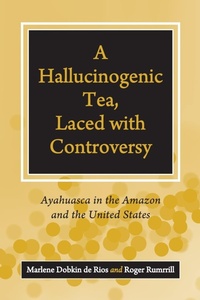
A Hallucinogenic Tea, Laced with Controversy
Ayahuasca in the Amazon and the United States
Published on 30. August 2008
Book
Paperback/Softback
168 pages
978-1-4408-3616-9 (ISBN)
Description
One country's sacrament is another's illicit drug, as officials in South America and the United States are well aware. For centuries, a hallucinogenic tea made from a giant vine native to the Amazonian rainforest has been taken as a religious sacrament across several cultures in South America. Many spiritual leaders, shamans, and their followers consider the tea and its main component - ayahuasca - to be both enlightening and healing. In fact, ayahuasca (pronounced a-ja-was-ka) loosely translated means spirit vine. In this book, de Rios and Rumrrill take us inside the history and realm of, as well as the raging arguments about, the substance that seems a sacrament to some and a scourge to others. Their book includes text from the United Nations Convention on Psychotropic Substances and interviews with shamans in the Amazon.
One country's sacrament is another's illicit drug, as officials in South America and the United States are well aware. For centuries, a hallucinogenic tea made from a giant vine native to the Amazonian rainforest has been taken as a religious sacrament across several cultures in South America. Many spiritual leaders, shamans, and their followers consider the tea and its main component - ayahuasca - to be both enlightening and healing. In fact, ayahuasca (pronounced a-ja-was-ka) loosely translated means spirit vine. Ayahuasca has moved into the United States, causing legal battles in the Supreme Court and rulings from the United Nations. Some U.S. church groups are using the hallucinogen in their ceremonies and have fought for government approval to do so. The sacrament has also drawn American drug tourists to South America to partake, say authors de Rios and Rumrrill. But they warn that these tourists are being put at risk by charlatans who are not true shamans or religious figures, just profiteers.
In this book, de Rios and Rumrrill take us inside the history and realm of, as well as the raging arguments about, the substance that seems a sacrament to some and a scourge to others. Opponents fight its use even as U.S. scientists and psychologists continue investigations of whether ayahuasca has healing properties that might be put to conventional use for physical and mental health. This book includes text from the United Nations Convention on Psychotropic Substances and interviews with shamans in the Amazon.
One country's sacrament is another's illicit drug, as officials in South America and the United States are well aware. For centuries, a hallucinogenic tea made from a giant vine native to the Amazonian rainforest has been taken as a religious sacrament across several cultures in South America. Many spiritual leaders, shamans, and their followers consider the tea and its main component - ayahuasca - to be both enlightening and healing. In fact, ayahuasca (pronounced a-ja-was-ka) loosely translated means spirit vine. Ayahuasca has moved into the United States, causing legal battles in the Supreme Court and rulings from the United Nations. Some U.S. church groups are using the hallucinogen in their ceremonies and have fought for government approval to do so. The sacrament has also drawn American drug tourists to South America to partake, say authors de Rios and Rumrrill. But they warn that these tourists are being put at risk by charlatans who are not true shamans or religious figures, just profiteers.
In this book, de Rios and Rumrrill take us inside the history and realm of, as well as the raging arguments about, the substance that seems a sacrament to some and a scourge to others. Opponents fight its use even as U.S. scientists and psychologists continue investigations of whether ayahuasca has healing properties that might be put to conventional use for physical and mental health. This book includes text from the United Nations Convention on Psychotropic Substances and interviews with shamans in the Amazon.
More details
Language
English
Place of publication
United States
Publishing group
Bloomsbury Publishing Plc
Target group
College/higher education
Interest Age: From 7 to 17 years
Dimensions
Height: 234 mm
Width: 156 mm
Thickness: 9 mm
Weight
266 gr
ISBN-13
978-1-4408-3616-9 (9781440836169)
Copyright in bibliographic data and cover images is held by Nielsen Book Services Limited or by the publishers or by their respective licensors: all rights reserved.
Schweitzer Classification
Persons
MARLENE DOBKIN DE RIOS is a medical anthropologist who has conducted fieldwork in the Peruvian Amazon and the coast on plant hallucinogens and healing. She is Associate Clinical Professor of Psychiatry and Human Behavior at the University of California, Irvine, and Professor Emerita of Anthropology at California State University, Fullerton. De Rios has spearheaded research on the plant hallucinogen, ayahuasca in Peru, Brazil, and the United States. The author of six books and several hundred articles on hallucinogens and culture, she resides in Southern California.
ROGER RUMRRILL is a well-known Peruvian journalist and author of 25 books. He is a recognized expert on Amazon themes, including narco-trafficking, biological wealth of the Amazon, and social and cultural issues of indigenous peoples in Peru and other regions of Latin America.
ROGER RUMRRILL is a well-known Peruvian journalist and author of 25 books. He is a recognized expert on Amazon themes, including narco-trafficking, biological wealth of the Amazon, and social and cultural issues of indigenous peoples in Peru and other regions of Latin America.
Content
Ch 1: Introduction
Ch 2: Native Use of Ayahuasca
Ch 3: Drug Tourism
Ch 4: Shamanic Power and Hallucinogens
Ch 5: The New Shamans
Ch 6: The UDV and the U.S. Supreme Court
Ch 7: Globalization and the Future of Ayahuasca
Endnotes
Glossary
References
Ch 2: Native Use of Ayahuasca
Ch 3: Drug Tourism
Ch 4: Shamanic Power and Hallucinogens
Ch 5: The New Shamans
Ch 6: The UDV and the U.S. Supreme Court
Ch 7: Globalization and the Future of Ayahuasca
Endnotes
Glossary
References