

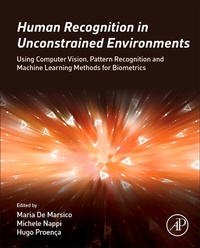
Human Recognition in Unconstrained Environments
Using Computer Vision, Pattern Recognition and Machine Learning Methods for Biometrics
Published on 13. January 2017
Book
Hardback
248 pages
978-0-08-100705-1 (ISBN)
Description
Human Recognition in Unconstrained Environments provides a unique picture of the complete 'in-the-wild' biometric recognition processing chain; from data acquisition through to detection, segmentation, encoding, and matching reactions against security incidents.
Coverage includes:
Data hardware architecture fundamentals
Background subtraction of humans in outdoor scenes
Camera synchronization
Biometric traits: Real-time detection and data segmentation
Biometric traits: Feature encoding / matching
Fusion at different levels
Reaction against security incidents
Ethical issues in non-cooperative biometric recognition in public spaces
With this book readers will learn how to:
Use computer vision, pattern recognition and machine learning methods for biometric recognition in real-world, real-time settings, especially those related to forensics and security
Choose the most suited biometric traits and recognition methods for uncontrolled settings
Evaluate the performance of a biometric system on real world data
Coverage includes:
Data hardware architecture fundamentals
Background subtraction of humans in outdoor scenes
Camera synchronization
Biometric traits: Real-time detection and data segmentation
Biometric traits: Feature encoding / matching
Fusion at different levels
Reaction against security incidents
Ethical issues in non-cooperative biometric recognition in public spaces
With this book readers will learn how to:
Use computer vision, pattern recognition and machine learning methods for biometric recognition in real-world, real-time settings, especially those related to forensics and security
Choose the most suited biometric traits and recognition methods for uncontrolled settings
Evaluate the performance of a biometric system on real world data
More details
Language
English
Place of publication
London
United Kingdom
Publishing group
Elsevier Science & Technology
Target group
Professional and scholarly
University and industry R&D Engineers researching into pattern recognition, computer vision and machine learning methods applied to biometric system development.
Dimensions
Height: 235 mm
Width: 191 mm
Weight
670 gr
ISBN-13
978-0-08-100705-1 (9780081007051)
Copyright in bibliographic data and cover images is held by Nielsen Book Services Limited or by the publishers or by their respective licensors: all rights reserved.
Schweitzer Classification
Other editions
Additional editions
Maria De Marsico | Michele Nappi | Hugo Pedro Proença
Human Recognition in Unconstrained Environments
Using Computer Vision, Pattern Recognition and Machine Learning Methods for Biometrics
E-Book
01/2017
Academic Press
€104.00
Available for download
Persons
Maria De Marsico is Associate Professor at Sapienza University of Rome, Department of Computes Science. She got her Master degree in Computer science from University of Salerno. Her scientific interests focus on Image Processing and Human Computer Interaction. Regarding the first one, she works on biometric recognition, including face, iris, gate, and multimodal recognition. Regarding the second one, she is especially interested in multimodal interaction, accessibility for users with special needs, and advanced techniques for personalized distance learning. She is Associate Editor of Pattern Recognition Letters, and Area Editor of the IEEE Biometrics Compendium. She published about 100 scientific works in international journals, conferences, and book chapters. She has been member of many Technical program Committees and is referee for several top journals, and Program Chair for the International Conference on Pattern Recognition Applications and Methods since 2013. Michele Nappi received the laurea degree (cum laude) in computer science from the University of Salerno, Salerno, Italy, in 1991, the M.Sc. degree in information and communication technology from I.I.A.S.S. "E.R. Caianiello", Vietri sul Mare, Salerno, and the Ph.D. degree in applied mathematics and computer science from the University of Padova, Padova, Italy. He is currently an Associate Professor of computer science at the University of Salerno.His research interests include Multibiometric Systems, Pattern Recognition, Image Processing, Compression and Indexing, Multimedia Databases, Human-Computer Interaction, VR/AR. He co-authored over 120 papers in international conference, peer review journals and book chapters in these fields (see http://www.informatik.uni-trier.de/~ley/pers/hd/n/Nappi:Michele.html). He also served as Guest Editor for several international journals and as Editor for International Books. In 2014 He was one of the founders of the spin off BS3 (Biometric System for Security and Safety). President of the Italian Chapter of the IEEE Biometrics Council (2015-2017), member of IAPR and IEEE, He is team leader of the Biometric and Image Processing Lab (BIPLAB). Dr. Nappi received several international awards for scientific and research activities. Hugo Proenca B.Sc. (2001), M.Sc. (2004), Ph.D. (2007) and Habilitation (Agregado, 2016) is an Associate Professor and the current Head of the Department (2015-2017) of Computer Science, University of Beira Interior. He has been researching mainly about biometrics and visual-surveillance, particularly in developing human recognition solutions able to work in degraded data, resulting from unconstrained data acquisition protocols. He is an associate editor of the Image and Vision Computing Journal, the coordinating editor of the IEEE Biometrics Council Newsletter and the area editor (ocular biometrics) of the IEEE Biometrics Compendium Journal. Also, he is a member of the Editorial Board of the International Journal of Biometrics and served as Guest Editor of special issues of the Pattern Recognition Letters, Image and Vision Computing and Signal, Image and Video Processing journals.
Content
1. Iris Recognition on Mobile Devices Using Near-Infrared Images
2. Face recognition using dictionary learning and domain adaptation
3. Periocular Recognition in Non-ideal Images
4. Real Time 3D Face-Ear Recognition on Mobile Devices: New Scenarios for 3D Biometricks "in-the-Wild?
5. Fingerphoto Recognition in Outdoor Environment using Smartphones
6. Soft biometric labels in the wild. Case study on gender classification
7. Unconstrained data acquisition frameworks and protocols
8. Biometric Authentication to Access Controlled Areas through Eye Tracking
9. Non-cooperative biometrics: Cross-Jurisdictional concerns
10. Pattern Recognition and Machine Learning Methods for assessing the quality of fingerprints
2. Face recognition using dictionary learning and domain adaptation
3. Periocular Recognition in Non-ideal Images
4. Real Time 3D Face-Ear Recognition on Mobile Devices: New Scenarios for 3D Biometricks "in-the-Wild?
5. Fingerphoto Recognition in Outdoor Environment using Smartphones
6. Soft biometric labels in the wild. Case study on gender classification
7. Unconstrained data acquisition frameworks and protocols
8. Biometric Authentication to Access Controlled Areas through Eye Tracking
9. Non-cooperative biometrics: Cross-Jurisdictional concerns
10. Pattern Recognition and Machine Learning Methods for assessing the quality of fingerprints