

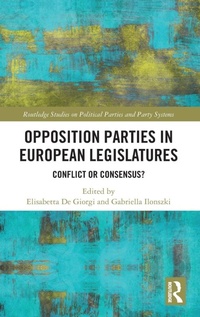
Opposition Parties in European Legislatures
Conflict or Consensus?
1st Edition
Published on 20. March 2018
Book
Hardback
270 pages
978-1-138-67487-5 (ISBN)
Description
Democratic theory considers it fundamental for parties in government to be both responsive to their electorate and responsible to internal and international constraints. But recently these two roles have become more and more incompatible with Mair's growing divide in European party systems between parties which claim to represent, but don't deliver, and those which deliver, but are no longer seen to represent truer than ever.
This book contains a qualitative and quantitative analysis of the behaviour of the opposition parties in eleven European democracies across Western and East Central Europe. Specifically, it investigates the parliamentary behaviour of the opposition parties, and shows that the party context is increasingly diverse. It demonstrates the emergence of two distinct types of opposition: one more cooperative, carried out by the mainstream parties (those with government aspirations), and one more adversarial focusing on government scrutiny rather than on policy alternatives (parties permanently excluded from power). It systematically and analytically explores the sources of their behaviour, whilst acknowledging that opposition is broader than its mere parliamentary behaviour. Finally, it considers the European agenda and the economic crisis as two possible intervening variables that might have an impact on the opposition parties' behaviour and the government-opposition relations. As such, it responds to questions that are major concerns for the European democracies of the new millennium.
This text will be of key interest to students and scholars of political parties, European politics, comparative politics and democracy.
This book contains a qualitative and quantitative analysis of the behaviour of the opposition parties in eleven European democracies across Western and East Central Europe. Specifically, it investigates the parliamentary behaviour of the opposition parties, and shows that the party context is increasingly diverse. It demonstrates the emergence of two distinct types of opposition: one more cooperative, carried out by the mainstream parties (those with government aspirations), and one more adversarial focusing on government scrutiny rather than on policy alternatives (parties permanently excluded from power). It systematically and analytically explores the sources of their behaviour, whilst acknowledging that opposition is broader than its mere parliamentary behaviour. Finally, it considers the European agenda and the economic crisis as two possible intervening variables that might have an impact on the opposition parties' behaviour and the government-opposition relations. As such, it responds to questions that are major concerns for the European democracies of the new millennium.
This text will be of key interest to students and scholars of political parties, European politics, comparative politics and democracy.
More details
Series
Language
English
Place of publication
London
United Kingdom
Publishing group
Taylor & Francis Ltd
Target group
College/higher education
Illustrations
6 s/w Abbildungen, 6 s/w Zeichnungen, 51 s/w Tabellen
51 Tables, black and white; 6 Line drawings, black and white; 6 Illustrations, black and white
Dimensions
Height: 240 mm
Width: 161 mm
Thickness: 19 mm
Weight
573 gr
ISBN-13
978-1-138-67487-5 (9781138674875)
Copyright in bibliographic data and cover images is held by Nielsen Book Services Limited or by the publishers or by their respective licensors: all rights reserved.
Schweitzer Classification
Other editions
Additional editions
Elisabetta De Giorgi | Gabriella Ilonszki
Opposition Parties in European Legislatures
Conflict or Consensus?
Book
06/2020
1st Edition
Routledge
€51.98
Shipment within 15-20 days
Elisabetta De Giorgi | Gabriella Ilonszki
Opposition Parties in European Legislatures
Conflict or Consensus?
E-Book
03/2018
1st Edition
Routledge
€59.49
Available for download
Elisabetta De Giorgi | Gabriella Ilonszki
Opposition Parties in European Legislatures
Conflict or Consensus?
E-Book
03/2018
Routledge
€59.49
Available for download
Persons
Elisabetta De Giorgi is a Researcher at the Portuguese Institute of International Relations (IPRI) of the NOVA University of Lisbon, Portugal.
Gabriella Ilonszki is Professor of Political Science at Corvinus University of Budapest, Hungary, and Doctor of the Hungarian Academy of Sciences.
Gabriella Ilonszki is Professor of Political Science at Corvinus University of Budapest, Hungary, and Doctor of the Hungarian Academy of Sciences.
Content
1. Introduction [Gabriella Ilonszki and Elisabetta De Giorgi] 2. Denmark: Strengthened opposition, yet high levels of cooperation [Flemming Juul Christiansen] 3. Germany: Heated debates but cooperative behaviour [Christian Stecker] 4. The Netherlands: The Reinvention of Consensus Democracy [Simon Otjes, Tom Louwerse and Arco Timmermans] 5. Italy: When responsibility fails. Parliamentary opposition in times of crisis [Francesco Marangoni and Luca Verzichelli] 6. Portugal: The unexpected path of far left parties, from permanent opposition to government support [Elisabetta De Giorgi and Federico Russo] 7. Spain: Government and opposition cooperation in a multi-level context [Ana Palau and Luz Munoz] 8. Czech Republic: Weak Governments and Divided Opposition in Times of crisis [Petra Guasti and Zdenka Mansfeldova] 9. Hungary: The De(con)struction of Parliamentary Opposition [Reka Varnagy and Gabriella Ilonszki] 10. Poland: Opposition in the Making [Agnieszka Dudzinska and Witold Betkiewicz] 11. Romania: An Ambivalent Parliamentary Opposition [Sergiu Gherghina and Mihail Chiru] 12. Switzerland: When Opposition is in Government [Jan Rosset, Andrea Pilotti and Yannis Papadopoulos] 13. Conclusions [Elisabetta De Giorgi and Gabriella Ilonszki]