

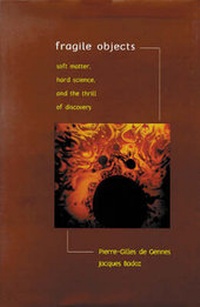
Fragile Objects
Soft Matter, Hard Science, and the Thrill of Discovery
Published on 29. August 1996
Book
Hardback
XVI, 189 pages
978-0-387-94774-7 (ISBN)
Description
Written by 1991 Nobel laureate Pierre Gilles de Gennes, this fascinating book addresses topics ranging from soft-matter physics to the activities of science: the role of individual or team work, the relation of discovery to correction, and the interplay of conscience and knowledge.
"Reading this book can be compared to strolling through a magnificent garden of fragile objects...I highly recommend it to any reader who is interested in condensed matter physics and science at large."-PHYSICS TODAY
"Reading this book can be compared to strolling through a magnificent garden of fragile objects...I highly recommend it to any reader who is interested in condensed matter physics and science at large."-PHYSICS TODAY
More details
Other editions
Additional editions
Pierre-gilles De Gennes | Jacques Badoz
Fragile Objects
Soft Matter, Hard Science, and the Thrill of Discovery
Book
09/2011
Springer
€80.24
Shipment within 15-20 days
Persons
Content
I Soft Matter.- 1 The Indian boot and Mr. Goodyear.- Small cause, large effects.- 2 The noodle soup.- Applied research and fundamental research.- Kuhn's example: Knowing when to switch.- 3 The tubeless siphon and the runaway boat.- A construction set.- The tubeless siphon.- The runaway boat.- The limitations of theory.- Four equations of diamondlike purity.- The true birth of ideas.- 4 The Egyptian scribe, arabic gum, and Chinese ink.- Carbon black.- Impossible loves.- The additive that makes a difference.- Paint, the magic potion.- 5 Liquid crystals and the school of fish.- The three states (of matter).- Judiciously chosen molecules.- The nematic state.- The smectic state.- How to recognize a liquid crystal?.- How to issue commands to a liquid crystal?.- 6 On the surface of things: Wetting and dewetting.- On a duck feather.- The family rug.- A pearl necklace.- Cannibalistic drops.- The Benjamin Franklin spirit.- The bilayer and the red blood cell.- 7 Bubbles and foams.- Every color of the rainbow.- Water's skin.- Surfactants decrease the surface energy.- The birth of a film.- A self-repairing bandage.- And so goes life.- A turbulent bubble.- Newton and the Babylonian sage.- Rose, she lived the way roses do.- Drowning by numbers-or one bubble, two bubbles. foam.- Foam and the edges of the universe.- 8 Fragile objects.- II Research.- 1 Profession: Research scientist.- Teamwork.- Publish or perish.- The two halves of the sky.- A promising formula: Mixed laboratories.- The high-wire dancer.- One length ahead.- A tennis game.- 2 Discovery.- Edison and Feynman.- Memories of a trip.- Half-way across the ford.- The nanonewton.- Blunders.- Know when to stop, know when to switch.- Explosions and Bengal lights.- 3 A positive science.- The duty to inform, not the power to decide.- One danger can hide another.- Physics and metaphysics.- Measure before you judge.- 4 The Environment.- Making science heard.- A cultural deficit.- Ecology and ignorance.- More conscience calls for more science.- III Education.- 1 A pedagogy for the real world.- Good teachers.- Too much ignorance.- Manual work.- The sailor's bar.- Experimental common sense.- Ekman and the drift of ice floes.- Leonardo da Vinci, engineer.- The "Auguste Comte" prejudice.- 2 The imperialism of mathematics.- The entrance examination theorem.- A system working in a vacuum.- Lifelong rights.- The "limp" education in universities.- 2 A little oxygen.- Some pedagogical experiments.- Giving universities some "muscle".- Travel does make one young, but in later years.- 4 New banners.- Ethics and solidarity.- "We, civilizations, now know that we are mortal".- Epilog.