

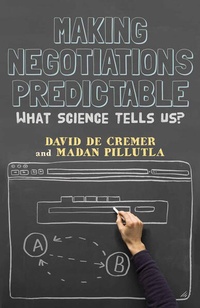
Making Negotiations Predictable
What Science Tells Us
Published on 11. December 2012
Book
Paperback/Softback
V, 178 pages
978-1-349-43865-5 (ISBN)
Description
Everybody in business is involved in negotiating internally and externally. The impact of this can have consequences for revenue and profitability, so it is more important than ever to be an effective negotiator for business success. In Making Negotiations Predictable, two global experts give crucial insights into getting it right.
More details
Edition
1st ed. 2012
Language
English
Place of publication
London
United Kingdom
Target group
Professional and scholarly
Illustrations
V, 178 p.
Dimensions
Height: 235 mm
Width: 155 mm
Thickness: 11 mm
Weight
295 gr
ISBN-13
978-1-349-43865-5 (9781349438655)
DOI
10.1057/9781137024794
Schweitzer Classification
Other editions
Additional editions
Book
12/2012
Palgrave Macmillan
€58.84
Shipment within 10-20 days
Persons
DAVID DE CREMER is Professor of Management at China Europe International Business School (CEIBS), Shanghai, and visiting Professor of Organisational Behaviour at London Business School. He has held visiting appointments at other leading universities, including Harvard University and New York University, and has received many outstanding international awards for his research.
MADAN PILLUTLA is the Mike Salamon term Professor of Organisational Behaviour at London Business School and he is recognized as an expert in the field of negotiation and has taught classes on this topic to various audiences, including senior leaders of multinational corporations in different countries, for over 15 years. He is the director of the Negotiation and Influencing Skills Senior Manager programme at the London Business School, where his negotiation classes are among the most sought-after courses.
MADAN PILLUTLA is the Mike Salamon term Professor of Organisational Behaviour at London Business School and he is recognized as an expert in the field of negotiation and has taught classes on this topic to various audiences, including senior leaders of multinational corporations in different countries, for over 15 years. He is the director of the Negotiation and Influencing Skills Senior Manager programme at the London Business School, where his negotiation classes are among the most sought-after courses.
Content
PART I: INTRODUCTION The Myth of the Rational Negotiator What this Book is About PART II: NEGOTIATION BASICS: STRUCTURE AND PROCESS Best Alternative to a Negotiated Agreement The Bottom Line Zone of Possible Agreement Distributive and Integrative Negotiations Try to Understand the Needs of the Other Party The Negotiator as a Detective But, Their Problems Are Not Your Problems How Do You Want to Come Across Don't be Afraid to Ask Why a Deadline is Often not a Deadline PART III: COGNITIVE ERRORS OF NEGOTIATORS What I Remember is Important - Isn't It? People Tend to Underestimate the Probability of All Other Problems Valuing What We Have More Than We Should Overconfidence Escalation 'Will you or should I?' The Importance of Anchors The Myth of the 'Fixed Pie' Impatience! PART IV: EMOTIONS AND INTUITION To be Angry, or not to be Angry? Intrapersonal Effects Interpersonal Effects If Emotions have Nothing to do with the Negotiations When Intuition Takes Over: System 1 vs. System 2 Thinking PART V: THE IMPACT OF FRAMING ON NEGOTIATIONS Social Frames Negotiating Gains and Losses Concrete Versus Abstract Thought Social Pressure! Where do we Negotiate? If Representatives are Doing the Negotiations PART VI: TRUST AND DISTRUST Giving Trust Creates Trust Repairing Trust The Value of an Apology Compensating People for Financial Losses PART VII: POWER Power and Your Understanding of the Other Party Power and Freedom of Movement Power can Make you Blind Acquiring Other People's Power: Asking for Favours Promises and Threats PART VIII: FAIRNESS Multiple Legitimate Criteria to Determine Fairness in Negotiations Ego-centric Interpretations of Fairness in Negotiations Belief that One is Fair Leads to Inflexibility in Negotiations What Would We Recommend? PART IX: 'MOVING FORWARD TO AN AGREEMENT - SURVEY'