

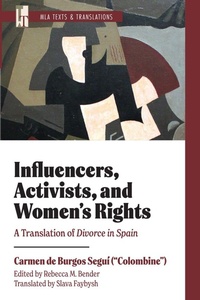
Influencers, Activists, and Women's Rights
A Translation of Divorce in Spain
Published on 16. September 2024
Book
Paperback/Softback
235 pages
978-1-60329-669-4 (ISBN)
Description
Voices from the debate on women's rights in early-twentieth-century Spain
The newspaper columnist Carmen de Burgos Segui caused a sensation in 1903 when she called for a public discussion on divorce, then illegal in Spain. The fierce debate that ensued among Spain's leading thinkers-politicians, academics, feminists, journalists, and others-is collected in Divorce in Spain. This milestone volume ultimately contributed to Spain's legalizing divorce in the 1930s-a victory for women's rights that was subsequently rolled back by the Franco dictatorship and not regained for over fifty years. The opinions showcased here illuminate the uniqueness of feminism in early-twentieth-century Spain: because ideas about marriage and the role of women in society were anchored in Catholic teachings, feminist arguments focused on rights to education, divorce, and employment instead of on suffrage.
This volume contains discussion of Ricardo Beltran y Rozpide's Los pueblos hispanoamericanos en el siglo (The Hispano-American Peoples of the Twentieth Century); Jacinto Benavente y Martinez's Sacrificios (Sacrifices); Emile Bougaud's Histoire de Sainte Monique (Life of Saint Monica); Eugene Brieux's Les avaries (Damaged Lives) and Le berceau (The Cradle); Alfred Capus and Emmanuel Arene's L'adversaire (The Adversary); Gabriele D'Annunzio's The Dead City; Joseph Delboeuf's La matiere brute et la matiere vivant: Etude sur l'origine de la vie et de la mort (Raw Matter and Living Matter: A Study on the Origin of Life and Death); Dionisio Diez Enriquez's Derecho positivo de la mujer (Positive Rights of Women); Johann Wolfgang von Goethe's Elective Affinities; D. Teodoro Guerrero's Pleito del matrimonio (Trial of Marriage); Paul Hervieu's Le dedale; Henrik Ibsen's When We Dead Awaken; Krausism, Life of the Reverend Mother Du Rousier, Founder of the Religious of the Sacred Heart in Chile; Maurice Maeterlinck's Aglavaine and Selysette; Max Nordau's The Conventional Lies of Our Civilization; Sully Prudhomme; Arthur Schopenhauer; and Leo Tolstoy's Anna Karenina.
The newspaper columnist Carmen de Burgos Segui caused a sensation in 1903 when she called for a public discussion on divorce, then illegal in Spain. The fierce debate that ensued among Spain's leading thinkers-politicians, academics, feminists, journalists, and others-is collected in Divorce in Spain. This milestone volume ultimately contributed to Spain's legalizing divorce in the 1930s-a victory for women's rights that was subsequently rolled back by the Franco dictatorship and not regained for over fifty years. The opinions showcased here illuminate the uniqueness of feminism in early-twentieth-century Spain: because ideas about marriage and the role of women in society were anchored in Catholic teachings, feminist arguments focused on rights to education, divorce, and employment instead of on suffrage.
This volume contains discussion of Ricardo Beltran y Rozpide's Los pueblos hispanoamericanos en el siglo (The Hispano-American Peoples of the Twentieth Century); Jacinto Benavente y Martinez's Sacrificios (Sacrifices); Emile Bougaud's Histoire de Sainte Monique (Life of Saint Monica); Eugene Brieux's Les avaries (Damaged Lives) and Le berceau (The Cradle); Alfred Capus and Emmanuel Arene's L'adversaire (The Adversary); Gabriele D'Annunzio's The Dead City; Joseph Delboeuf's La matiere brute et la matiere vivant: Etude sur l'origine de la vie et de la mort (Raw Matter and Living Matter: A Study on the Origin of Life and Death); Dionisio Diez Enriquez's Derecho positivo de la mujer (Positive Rights of Women); Johann Wolfgang von Goethe's Elective Affinities; D. Teodoro Guerrero's Pleito del matrimonio (Trial of Marriage); Paul Hervieu's Le dedale; Henrik Ibsen's When We Dead Awaken; Krausism, Life of the Reverend Mother Du Rousier, Founder of the Religious of the Sacred Heart in Chile; Maurice Maeterlinck's Aglavaine and Selysette; Max Nordau's The Conventional Lies of Our Civilization; Sully Prudhomme; Arthur Schopenhauer; and Leo Tolstoy's Anna Karenina.
More details
Series
Edition
Critical Edition
Language
English
Place of publication
New York
United States
Product notice
Paperback (trade)
Dimensions
Height: 216 mm
Width: 140 mm
ISBN-13
978-1-60329-669-4 (9781603296694)
Copyright in bibliographic data and cover images is held by Nielsen Book Services Limited or by the publishers or by their respective licensors: all rights reserved.
Schweitzer Classification
Persons
Carmen de Burgos Segui, also known as Colombine (1867-1932), was a key figure in Spanish feminist thought and activism at the beginning of the twentieth century. She was a teacher, translator, editor, novelist, short story writer, and journalist. Her work includes feminist treatises, travelogues, and editorials on issues such as prison reform, maternal and infant mortality rates, and divorce.