

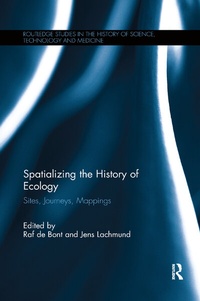
Spatializing the History of Ecology
Sites, Journeys, Mappings
1st Edition
Published on 7. May 2019
Book
Paperback/Softback
238 pages
978-0-367-34856-4 (ISBN)
Description
Throughout its history, the discipline of ecology has always been profoundly entangled with the history of space and place. On the one hand, ecology is a field science that has thrived on the study of concrete spatial entities, such as islands, forests or rivers. These spaces are the workplaces in which ecological phenomena are identified, observed and experimented on. They provide both epistemic opportunities and constraints that structure the agenda and the analytical sensibilities of ecological researchers. On the other hand, ecological knowledge and practices have become important resources through which spaces and places are classified, delineated, explained, experienced and managed. The impact of these activities reaches far beyond the realms of the ecological discipline. Many ecological concepts such as "biotopes," "ecosystems" and "the biosphere" have become entities that widely resonate in public life and policy making.
This book explores the mutual entanglement between space and knowledge-making in the history of ecology. Its first goal is to explore to which extent a spatial perspective can shed new light on the history of ecological science. Second, it uses ecology as a critical site to gain broader insights into the history of the environment in the nineteenth and twentieth centuries. Via a series of case studies - discussing topics that range from ecological field stations in the early-twentieth century Caribbean over wisent breeding in Nazi Germany to computer modelling in North American deserts - the book offers a tour through the changing landscapes of modern ecology.
This book explores the mutual entanglement between space and knowledge-making in the history of ecology. Its first goal is to explore to which extent a spatial perspective can shed new light on the history of ecological science. Second, it uses ecology as a critical site to gain broader insights into the history of the environment in the nineteenth and twentieth centuries. Via a series of case studies - discussing topics that range from ecological field stations in the early-twentieth century Caribbean over wisent breeding in Nazi Germany to computer modelling in North American deserts - the book offers a tour through the changing landscapes of modern ecology.
More details
Series
Language
English
Place of publication
London
United Kingdom
Publishing group
Taylor & Francis Ltd
Target group
College/higher education
Illustrations
8 s/w Photographien bzw. Rasterbilder, 9 s/w Zeichnungen
9 Line drawings, black and white; 8 Halftones, black and white
Dimensions
Height: 234 mm
Width: 156 mm
Weight
460 gr
ISBN-13
978-0-367-34856-4 (9780367348564)
Copyright in bibliographic data and cover images is held by Nielsen Book Services Limited or by the publishers or by their respective licensors: all rights reserved.
Schweitzer Classification
Other editions
Additional editions
Book
06/2017
1st Edition
Routledge
€238.09
Shipment within 10-20 days
E-Book
06/2017
Routledge
€78.99
Available for download
E-Book
06/2017
Routledge
€78.99
Available for download
Persons
Raf de Bont is a Lecturer in the History Department at Maastricht University.
Jens Lachmund is a Lecturer in Science and Technology Studies at Maastricht University.
Jens Lachmund is a Lecturer in Science and Technology Studies at Maastricht University.
Content
1. Introduction: Knowing Nature, Making Space
Raf De Bont and Jens Lachmund
Part I: Crafting Zones and Regions
2. Mapping Heimat: Amateur Natural History and Plant Ecology in Imperial Germany
Nils Guettler
3. Life Zones: The Rise and Decline of a Theory of the Geographic Distribution of Species
Roderick P. Neumann
4. A Laboratory for Tropical Ecology: Colonial Models and American Science at Cinchona, Jamaica
Megan Raby
5. Field Stations and the Problem of Scale: Local, Regional, and Global at the Desert Lab
Jeremy Vetter
6. Ecology and Rehabilitation: The West Highland Survey
Mark Toogood
Part II: Modelling Systems
7. Ecosystem Simulation as a Practice of Emplacement: The Desert Biome Project, 1970-1974
Etienne S. Benson
8. The City as an Ecosystem: Paul Duvigneaud and the Ecological Study of Brussels
Jens Lachmund
Part III: Fashioning Objects of Conservation
9. Extinct in the Wild: Finding a Place for the European Bison, 1919-1952
Raf De Bont
10. Islands and Bioregions: Global Reserve Design Models and the Making of National Parks, 1960-2000
Simone Schleper and Hans Schouwenburg
11. Space, Place, Land, and Sea: The "Ecological Discovery" of the Global Wadden Sea
Anna-Katharina Woebse
Epilogue
Raf De Bont and Jens Lachmund
Raf De Bont and Jens Lachmund
Part I: Crafting Zones and Regions
2. Mapping Heimat: Amateur Natural History and Plant Ecology in Imperial Germany
Nils Guettler
3. Life Zones: The Rise and Decline of a Theory of the Geographic Distribution of Species
Roderick P. Neumann
4. A Laboratory for Tropical Ecology: Colonial Models and American Science at Cinchona, Jamaica
Megan Raby
5. Field Stations and the Problem of Scale: Local, Regional, and Global at the Desert Lab
Jeremy Vetter
6. Ecology and Rehabilitation: The West Highland Survey
Mark Toogood
Part II: Modelling Systems
7. Ecosystem Simulation as a Practice of Emplacement: The Desert Biome Project, 1970-1974
Etienne S. Benson
8. The City as an Ecosystem: Paul Duvigneaud and the Ecological Study of Brussels
Jens Lachmund
Part III: Fashioning Objects of Conservation
9. Extinct in the Wild: Finding a Place for the European Bison, 1919-1952
Raf De Bont
10. Islands and Bioregions: Global Reserve Design Models and the Making of National Parks, 1960-2000
Simone Schleper and Hans Schouwenburg
11. Space, Place, Land, and Sea: The "Ecological Discovery" of the Global Wadden Sea
Anna-Katharina Woebse
Epilogue
Raf De Bont and Jens Lachmund