

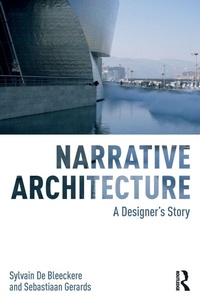
Narrative Architecture
A Designer's Story
1st Edition
Published on 23. January 2017
Book
Paperback/Softback
190 pages
978-1-138-89942-1 (ISBN)
Description
Narrative Architecture explores the postmodern concept of narrative architecture from four perspectives: thinking, imagining, educating, and designing, to give you an original view on our postmodern era and architectural culture. Authors Sylvain De Bleeckere and Sebastiaan Gerards outline the ideas of thinkers, such as Edmund Husserl, Paul Ricoeur, Emmanuel Levinas, and Peter Sloterdijk, and explore important work of famous architects, such as Daniel Libeskind and Frank Gehry, as well as rather underestimated architects like Guenter Behnisch and Sep Ruf. With more than 100 black and white images this book will help you to adopt the design method in your own work.
More details
Language
English
Place of publication
London
United Kingdom
Publishing group
Taylor & Francis Ltd
Target group
College/higher education
Illustrations
131 s/w Photographien bzw. Rasterbilder, 11 s/w Zeichnungen
11 Line drawings, black and white; 131 Halftones, black and white
Dimensions
Height: 234 mm
Width: 156 mm
Thickness: 11 mm
Weight
313 gr
ISBN-13
978-1-138-89942-1 (9781138899421)
Copyright in bibliographic data and cover images is held by Nielsen Book Services Limited or by the publishers or by their respective licensors: all rights reserved.
Schweitzer Classification
Other editions
Additional editions
E-Book
02/2017
Routledge
€86.99
Available for download
E-Book
02/2017
Routledge
€86.99
Available for download
Book
01/2017
1st Edition
Routledge
€261.80
Shipment within 10-20 days
Persons
Sylvain De Bleeckere, prof. em. dr. phil., worked as assistant professor at the Faculty of Architecture and Arts at Hasselt University in Flanders (Belgium). He was responsible for the graduate seminar Culture and was a leading member of the research group ArcK. Cross-fertilization between the design studio and research activities is central to his work. Since 1977, Sylvain De Bleeckere has continuously published about the postmodern philosophy of culture in relation to democracy, architecture, and cinematography.
Sebastiaan Gerards holds a Master's degree in Architecture (Hasselt University, 2010) and Arts and Heritage (Maastricht University, 2012). Since the end of 2012 he has been working as a PhD student at the Faculty of Architecture and Arts at Hasselt University, Belgium. The main focus of his research is the social and architectural design of multigenerational dwelling as a renewed housing concept for Flanders. A key element in his work is the design assignment 'multigenerational dwelling', which he organizes with Sylvain De Bleeckere at Hasselt University. Together they have developed a new collaborative educational strategy to respond to growing social and cultural complexity (in residential Flanders).
Sebastiaan Gerards holds a Master's degree in Architecture (Hasselt University, 2010) and Arts and Heritage (Maastricht University, 2012). Since the end of 2012 he has been working as a PhD student at the Faculty of Architecture and Arts at Hasselt University, Belgium. The main focus of his research is the social and architectural design of multigenerational dwelling as a renewed housing concept for Flanders. A key element in his work is the design assignment 'multigenerational dwelling', which he organizes with Sylvain De Bleeckere at Hasselt University. Together they have developed a new collaborative educational strategy to respond to growing social and cultural complexity (in residential Flanders).
Content
Setting The Scene. 1. Thinking. 1.1. The Narrative of Architecture. 1.2. Phenomenology and the Crisis of European Sciences. 1.3. The Phenomenon. 1.4. In the School of Time. 2. Imagining. 2.1. In the Beginning There Was Imagination, But In the End it Was Lost. 2.2. Reimagining Imagination. 2.3. The Heart of Storytelling. 2.4. Metaphor's Story. 2.5. The Designer's Dionysian Imagination. 2.6. Moral Imagination. 2.7. A Personal Way of Life. 3. Educating. 3.1. The Narrative of Education. 3.2. Architecture as Educator. 3.3. Educating the Architect. 3.4. Reconnecting with Life in the Design Studio. 3.5. The Ultimate Question. 4. Designing. 4.1. Scope. 4.2. Skills and Methods. Open-Ended Stories. Index.