

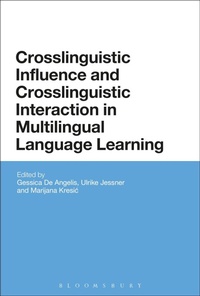
Crosslinguistic Influence and Crosslinguistic Interaction in Multilingual Language Learning
Published on 22. October 2015
Book
Hardback
272 pages
978-1-4742-3585-3 (ISBN)
Description
Which strategies do multilingual learners use when confronted with languages they don't yet know? Which factors are involved in activating prior linguistic knowledge in multilingual learning? This volume offers valuable insights into recent research in multilingualism, crosslinguistic influence and crosslinguistic interaction. Experts in the field examine the role of background languages in multilingual learning. All the chapters point to the heart of the question of what the <<multilingual mind>> is. Does learning one language actually help you learn another, and if so, why?
This volume looks at languages and scenarios beyond English as a second language - Italian, Gaelic, Dutch and German, amongst others, are covered, as well as instances of third and additional language learning. Research into crosslinguistic influence and crosslinguistic interaction essentially contributes to our understanding of how language learning works when there are three or more languages in contact.
This volume looks at languages and scenarios beyond English as a second language - Italian, Gaelic, Dutch and German, amongst others, are covered, as well as instances of third and additional language learning. Research into crosslinguistic influence and crosslinguistic interaction essentially contributes to our understanding of how language learning works when there are three or more languages in contact.
Reviews / Votes
The strength is that the information of the book applies not only to teaching and learning English as is traditionally the case, but to other languages which are taught in many countries in addition to English. This makes the volume very important practically. Dealing with different languages, including languages as different as Dutch, Spanish, Scottish and Italian, rather than only English, it is of value to many places in the world. The collection deepens the topic, focusing on how speakers perceive the closeness between languages. -- Larissa Aronin, Associate Professor, Oranim Academic College, Israel This volume, while remaining all the time true to its theme of crosslinguistic influence and interaction in multilingual learning, offers a quite breathtaking array of engaging perspectives on this theme. The fascinating range of theoretical and methodological treatments and the variety of results and interpretations it presents demonstrate yet again the rich diversity of multilingualism studies, and the way in which a topic like crosslinguistic impact, which was once regarded as straightforward (!), takes on an infinity of complexities in a multilingual context. -- David Singleton, Fellow Emeritus, Trinity College Dublin, Ireland and Professor of Applied Linguistics, University of Pannonia, Veszprem, HungaryMore details
Language
English
Place of publication
London
United Kingdom
Publishing group
Bloomsbury Publishing PLC
Target group
College/higher education
Dimensions
Height: 240 mm
Width: 161 mm
Thickness: 19 mm
Weight
578 gr
ISBN-13
978-1-4742-3585-3 (9781474235853)
Copyright in bibliographic data and cover images is held by Nielsen Book Services Limited or by the publishers or by their respective licensors: all rights reserved.
Schweitzer Classification
Other editions
Additional editions
Gessica De Angelis | Ulrike Jessner | Marijana Kresic
Crosslinguistic Influence and Crosslinguistic Interaction in Multilingual Language Learning
E-Book
11/2015
1st Edition
Bloomsbury Academic
€42.99
Available for download
Persons
Gessica De Angelis is Assistant Professor at Trinity College Dublin, Ireland.
Urlike Jessner is Associate Professor at University of Innsbruck, Austria.
Marijana Kresic is Associate Professor at University of Zadar, Croatia.
Urlike Jessner is Associate Professor at University of Innsbruck, Austria.
Marijana Kresic is Associate Professor at University of Zadar, Croatia.
Content
1. Introduction
Gessica De Angelis (Trinity College Dublin, Ireland);
Ulrike Jessner (University of Innsbruck, Austria); Marijana Kresic (University of Zadar, Croatia)
2. Perceptual Training of Novel Speech Contrasts in L3 Acquisition: The Effect of Multilingual Benefit
Divya Verma Gogoi, James D. Harnsberger and Caroline Wiltshire (University of Florida, USA)
3. The Lexicon-Syntax Interfacein 3L1 acquisition: An Experimental Investigation of the Unaccusative/Unergative Distinction
Megan Devlin, Raffaella Folli and Christina Sevdali (University of Ulster, Ireland)
4. Can a Background Language Alter the Path of Acquisition of Verb Placement in a Multilingual Context? Evidence from a Longitudinal Study
Laura Sanchez (University of Barcelona, Spain)
5. Item-related determinants of cognate guessing in multilinguals
Jan Vanhove and Raphael Berthele (University of Fribourg, Switzerland)
6. Developing Cognitive Strategies through Pluralistic approaches
Rebecca Dahm (Universite de Limoges, France)
7. "If you know Amharic you can read this": Emergent literacy in multilingual pre-reading children
Anat Stavans (Beit Berl College and Research Institute for Innovation in Education at Hebrew University in Jerusalem, Israel)
8. Does German help speakers of Dutch to understand written and spoken Danish words? - The role of second language knowledge in decoding an unknown but related language
Femke Swarte, Anja Schueppert and Charlotte Gooskens (University of Groningen, The Netherlands)
9. Is A2 in German better than B2 in French when reading Danish? The role of prior language knowledge when faced with an unknown language
Karolina Mieszkowska and Agnieszka Otwinowska (University of Warsaw, Poland)
10. Do learners transfer from the language they perceive as most closely related to the L3? The role of psychotypology for lexical and grammatical cross-linguistic influence in French L3
Christina Lindqvist (Uppsala University, Sweden)
11. Epilogue
De Angelis, Jessner, Kresic
Bibliography
Index
Gessica De Angelis (Trinity College Dublin, Ireland);
Ulrike Jessner (University of Innsbruck, Austria); Marijana Kresic (University of Zadar, Croatia)
2. Perceptual Training of Novel Speech Contrasts in L3 Acquisition: The Effect of Multilingual Benefit
Divya Verma Gogoi, James D. Harnsberger and Caroline Wiltshire (University of Florida, USA)
3. The Lexicon-Syntax Interfacein 3L1 acquisition: An Experimental Investigation of the Unaccusative/Unergative Distinction
Megan Devlin, Raffaella Folli and Christina Sevdali (University of Ulster, Ireland)
4. Can a Background Language Alter the Path of Acquisition of Verb Placement in a Multilingual Context? Evidence from a Longitudinal Study
Laura Sanchez (University of Barcelona, Spain)
5. Item-related determinants of cognate guessing in multilinguals
Jan Vanhove and Raphael Berthele (University of Fribourg, Switzerland)
6. Developing Cognitive Strategies through Pluralistic approaches
Rebecca Dahm (Universite de Limoges, France)
7. "If you know Amharic you can read this": Emergent literacy in multilingual pre-reading children
Anat Stavans (Beit Berl College and Research Institute for Innovation in Education at Hebrew University in Jerusalem, Israel)
8. Does German help speakers of Dutch to understand written and spoken Danish words? - The role of second language knowledge in decoding an unknown but related language
Femke Swarte, Anja Schueppert and Charlotte Gooskens (University of Groningen, The Netherlands)
9. Is A2 in German better than B2 in French when reading Danish? The role of prior language knowledge when faced with an unknown language
Karolina Mieszkowska and Agnieszka Otwinowska (University of Warsaw, Poland)
10. Do learners transfer from the language they perceive as most closely related to the L3? The role of psychotypology for lexical and grammatical cross-linguistic influence in French L3
Christina Lindqvist (Uppsala University, Sweden)
11. Epilogue
De Angelis, Jessner, Kresic
Bibliography
Index