

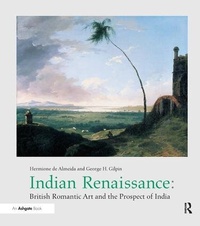
Indian Renaissance
British Romantic Art and the Prospect of India
1st Edition
Published on 7. December 2016
Book
Paperback/Softback
352 pages
978-1-138-26636-0 (ISBN)
Description
Indian Renaissance: British Romantic Art and the Prospect of India is the first comprehensive examination of British artists whose first-hand impressions and prospects of the Indian subcontinent became a stimulus for the Romantic Movement in England; it is also a survey of the transformation of the images brought home by these artists into the cultural imperatives of imperial, Victorian Britain. The book proposes a second - Indian - Renaissance for British (and European) art and culture and an undeniable connection between English Romanticism and British Imperialism. Artists treated in-depth include James Forbes, James Wales, Tilly Kettle, William Hodges, Johann Zoffany, Francesco Renaldi, Thomas and William Daniell, Robert Home, Thomas Hickey, Arthur William Devis, R. H. Colebrooke, Alexander Allan, Henry Salt, James Baillie Fraser, Charles Gold, James Moffat, Charles D'Oyly, William Blake, J. M. W. Turner and George Chinnery.
Reviews / Votes
Prize: winner of the The Association of Historians of British Art prize for 2007 in the post-1800 category'.... a welcome addition to the field of British Indian studies. The authors have ... made a significant contribution to the study of the role of art and the development of British imperial identity and ideology ... this book is original, fresh, engaging ... The text is a must for anyone interested in British Romanticism. It stands apart from previous publications on British artists working on the subcontinent in that it avoids the cliche biographical or descriptive approach. Instead de Almedia and Gilpin focus on analysis shedding light on significant questions such as how the desire to dominate another culture influenced the subjects of art works.' New Zealand Journal of Asian Studies
'This important text offers an original and very welcome addition to the literature on the art and aesthetics of British India during the early period of colonization; as such it contributes significantly to the increasing debate over British art's relation to imperial history, as well as forcing a reconsideration of the changing ways in which India was perceived by the British during this period.' Geoff Quilley, National Maritime Museum, London, UK
'This ranging and detailed study seriously complicates our notions of the place of India in the Romantic imagination. Lavishly and intelligently illustrated, Indian Reniassance persuasively argues that images of India were crucial to late-18th and early-19th-century Europe, and to Romanticism itself. This is a book Romanticists will need to read and absorb visually-and to own.' J. Paul Hunter, University of Virginia
More details
Series
Language
English
Place of publication
London
United Kingdom
Publishing group
Taylor & Francis Ltd
Target group
College/higher education
Dimensions
Height: 260 mm
Width: 230 mm
Weight
453 gr
ISBN-13
978-1-138-26636-0 (9781138266360)
Copyright in bibliographic data and cover images is held by Nielsen Book Services Limited or by the publishers or by their respective licensors: all rights reserved.
Schweitzer Classification
Other editions
Additional editions
Hermione De Almeida | George H. Gilpin
Indian Renaissance
British Romantic Art and the Prospect of India
Book
02/2006
1st Edition
Routledge
€222.84
Shipment within 10-20 days
Persons
Hermione de Almeida is Walter Professor of English and Comparative Literature at the University of Tulsa, USA. She is author of Romantic Medicine and John Keats (1991), Byron and Joyce Through Homer (1981), and other works on Romanticism.
George H. Gilpin is Professor of English at the University of Tulsa and Scholar-in-Residence in Special Collections at McFarlin Library. He is the author of The Art of Contemporary English Culture (1991) and other works on Romanticism and British art.
George H. Gilpin is Professor of English at the University of Tulsa and Scholar-in-Residence in Special Collections at McFarlin Library. He is the author of The Art of Contemporary English Culture (1991) and other works on Romanticism and British art.
Content
Contents: Foreword; Part I The idea of India: tiger, tree and cave: Tigers of all stripes; The great Banyan tree of India; The Cave Temple of Elephanta: eroticism and art; The Indian prospect in English Romantic art and literature; Sanskrit translations for an Indian Renaissance; The ideal of India: ancient India as the uroffenbarung of the Romantic era; Part II Oriental fantasies and Indian prospects: Tilly Kettle's theater of India; The dancing girl of Faizabad; Artists and traders at Oudh; Edenic nights and everyday living; The paradise of the Nayars; Natural paradise and natural history; Part III English Romantic art and the Indian prospect: The Royal Academy and the prospect of India; Patronage of learning - by a Governor General; Hodges' Indian sublime; Temple gloom and rural complexity; Conversations in Calcutta abd Oudh; The legacy of Clive and Hastings; Part IV Storming Seringapatam: The drama and romance of empire: Little boys lost; Romantic, revolutionary Mysore; Storming Seringapatam; Imperial vision: the progress from Cornwallis to Wellesley; The view from the hill-forts; Part V Thomas Daniell and the picturesque possession of India: 'Times are changed': early and late views of Calcutta; Travel and picturesque possession; Oriental Scenery: from Bengal to Madras, 1795-97; Twelve 'singular' Antiquities of India, 1799-1800; Objects and scenes of conquest, 1801-1803; Twenty-Four Landscapes composed too perfectly, 1804-1805; Singular India, 1808; Part VI Dark prospects in the light of empire: 'Something new' - the freaks of gold; Devolution of an Indian prospect; Missionaries of empire; The imperial sublime of James Baillie Fraser; Savage forms and natural landscapes for the imperial traveler; Charles D'Oyly - the view from an elephant's back; Part VII Elegies to an Indian Renaissance: Empire follows art: the retrospections of Hodges and Zoffany; Blake's prophecies against empire; Blake's 'Indian' epic; Turner and the dragons of empire; George Chinnery