

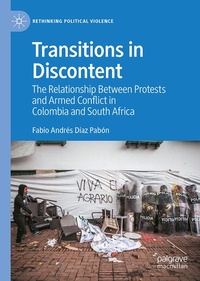
Transitions in Discontent
Description
This book presents a new framework for understanding the dynamics that connect protests, protest campaigns and armed conflict. Through a comparative study of conflicts in Colombia and South Africa, it shows the processes of collective action and their escalation to protest campaigns and civil wars, as well as the de-escalation of conflict away from armed conflict. The book moves past the traditional division between studies of collective action and the literature on civil wars to present a tool to help us understand why growing socio-political tensions, inequality and global tensions across the world could lead to a sharp rise in organised violence.
It is a vital resource for scholars and practitioners focused on sociology, political science, conflict and peace studies, and international relations. Dr. Díaz Pabón explores how shifts in political freedoms, equality, state strength and legitimacy, and provision of public services can help us to understand the processes of escalation, de-escalation and recurrence of conflict. In doing so, he provides new insights into the dynamics of protests, riots and violence emerging across the world.
More details
Person
Fabio Andrés Díaz Pabón is a Senior Researcher at the Southern Centre for Inequality Studies (SCIS) of the University of Witwatersrand, and an Honorary Research Associate at the Department of Politics and International Studies of Rhodes University. Specializing in conflict, politics, governance and development, he applies systems thinking and interdisciplinary approaches to the study of comparative politics, development, conflict and governance across Africa and Latin America.
Content
1. Introduction: Connecting expressions of conflict-The relationship between protests and armed conflict.- 2. Understanding transisions in discontent.- 3. Colombia: Continous conflict and fragmented peaces.- 4. South Africa: Expressions of conflict during and after apartheid.- 5. The relation between protests, protest campaigns and armed conflict in Colombia and South Africa.- 6. Conclusions.