

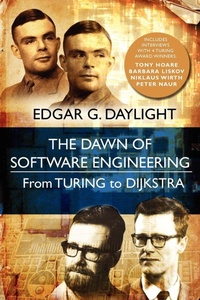
The Dawn of Software Engineering
From Turing to Dijkstra
Published on 5. April 2012
Book
Paperback/Softback
250 pages
978-94-91386-02-2 (ISBN)
Description
Contrary to what many believe, Alan Turing is not the father of the all-purpose computer. Engineers were, independently of Turing, already building such machines during World War II. Turing's influence was felt more in programming after his death than in computer building during his lifetime. The first person to receive a Turing award was a programmer, not a computer builder.
Logicians and programmers recast Turing's notions of machine and universality. Gradually, these recast notions helped programmers to see the bigger picture of what they were accomplishing. Later, problems unsolvable with a computer influenced experienced programmers, including Edsger W. Dijkstra.
Dijkstra's pioneering work shows that both unsolvability and aesthetics have practical relevance in software engineering. But to what extent did Dijkstra and others depend on Turing's accomplishments? This book presents a revealing synthesis for the modern software engineer and, by doing so, deromanticizes Turing's role in the history of computing.
More details
Language
English
Product notice
Paperback (trade)
Unsewn / adhesive bound
Dimensions
Height: 229 mm
Width: 152 mm
Thickness: 14 mm
Weight
368 gr
ISBN-13
978-94-91386-02-2 (9789491386022)
Copyright in bibliographic data and cover images is held by Nielsen Book Services Limited or by the publishers or by their respective licensors: all rights reserved.
Schweitzer Classification