

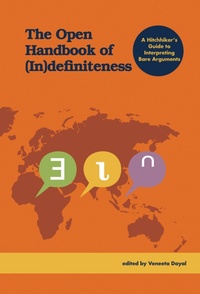
The Open Handbook of (In)definiteness
A Hitchhiker's Guide to Interpreting Bare Arguments
Published on 2. June 2026
Book
Hardback
464 pages
978-0-262-05279-5 (ISBN)
Description
A hands-on, accessible guide for investigating the meaning of noun phrases.
Why do many languages have definite and indefinite articles, while many others do not? What principles govern the use of articles? Do these principles apply to article-less languages? These are some of the questions that confront anyone who engages seriously with language, from theoretical linguists and cognitive scientists to language learners and language teachers. In The Open Handbook of (In)definiteness, Veneeta Dayal clarifies how morpho-syntactic signals related to (in)definiteness can be distinguished from interpretation.
Dayal provides a path for scholars to describe how (in)definiteness plays out in any language by identifying different aspects of definiteness and indefiniteness, providing short introductions to relevant concepts in formal semantics. Explicit diagnostics are collated in the form of a questionnaire. The volume includes case studies that work in tandem with the questionnaire to probe the interpretive profile of seven typologically unrelated languages, revealing new facets of their grammar. The result is both empirically rich and theoretically intriguing, as Dayal elaborates in her discussion of cross-linguistic variation in the domain of nominal semantics. . Contributions by experts of the seven languages investigated showcase some of the avenues that the volume opens for future explorations.
Why do many languages have definite and indefinite articles, while many others do not? What principles govern the use of articles? Do these principles apply to article-less languages? These are some of the questions that confront anyone who engages seriously with language, from theoretical linguists and cognitive scientists to language learners and language teachers. In The Open Handbook of (In)definiteness, Veneeta Dayal clarifies how morpho-syntactic signals related to (in)definiteness can be distinguished from interpretation.
Dayal provides a path for scholars to describe how (in)definiteness plays out in any language by identifying different aspects of definiteness and indefiniteness, providing short introductions to relevant concepts in formal semantics. Explicit diagnostics are collated in the form of a questionnaire. The volume includes case studies that work in tandem with the questionnaire to probe the interpretive profile of seven typologically unrelated languages, revealing new facets of their grammar. The result is both empirically rich and theoretically intriguing, as Dayal elaborates in her discussion of cross-linguistic variation in the domain of nominal semantics. . Contributions by experts of the seven languages investigated showcase some of the avenues that the volume opens for future explorations.
More details
Language
English
Place of publication
Cambridge (Massachusetts)
United States
Publishing group
MIT Press Ltd
Product notice
sewn/stitched
Cloth over boards
Illustrations
20 FIGURES
Dimensions
Height: 260 mm
Width: 184 mm
Thickness: 32 mm
Weight
567 gr
ISBN-13
978-0-262-05279-5 (9780262052795)
Copyright in bibliographic data and cover images is held by Nielsen Book Services Limited or by the publishers or by their respective licensors: all rights reserved.
Schweitzer Classification
Other editions
Additional editions

Veneeta Dayal
The Open Handbook of (In)definiteness
A Hitchhiker's Guide to Interpreting Bare Arguments
E-Book
06/2026
MIT Press
€191.99
Available for download
Person
Veneeta Dayal is Dorothy R. Diebold Professor & Chair of Linguistics at Yale University. In addition to articles on a wide range of topics in semantics and its interfaces with pragmatics and syntax, she is the author of Locality in Wh Quantification and Questions and coeditor of Clause Structure in South Asian Languages.
Content
Table of Contents
Preface
Foreword
Foreword
Part I: Contextualizing Indefiniteness
Chapter 1: Introducing the Hitchhiker’s Guide to (In)Definiteness
Chapter 2: A Guide to Some Semantic Concepts
Chapter 3: The (In)Definiteness Questionnaire
Part II: Seven Case Studies on (In)Definiteness
Chapter 4: A Case Study on (In)definiteness in Cabo Verdean Creole
Chapter 5: A Case Study on (In)definiteness in Cuzco Quechua
Chapter 6: A Case Study on (In)definiteness in Hiaki
Chapter 7: A Case Study on (In)definiteness in Indonesian
Chapter 8: A Case Study on (In)definiteness in Korean
Chapter 9: A Case Study on (In)definiteness in Russian
Chapter 10: A Case Study on (In)definiteness in Xhosa
Part III: (In)Definiteness through the Lens of the Questionnaire
Chapter 11: A New Emerging Picture of (In)definiteness
Chapter 12: A Textured Approach to (In)definiteness Across Languages
PART IV: (In)Definiteness beyond the (In)Definiteness Questionnaire
Chapter 13: Cabo Verdean Creole and Mandinka DPs: A Comparative Analysis
Chapter 14: Is the Cuzco Quechua plural marker -kuna optional?
Chapter 15: Reflections on probing (in)definiteness in an endangered language
Chapter 16: Definiteness marking in Austronesian: an overview
Chapter 17: Factors that influence the use of plural marker tul in Korean
Chapter 18: Split-scope definites in Russian
Chapter 19: Extraction and the syntax of Xhosa nominal expressions
PART V: Last Words on (In)Definiteness – for now!
Chapter 20: The End of this Journey Index
Preface
Foreword
Foreword
Part I: Contextualizing Indefiniteness
Chapter 1: Introducing the Hitchhiker’s Guide to (In)Definiteness
Chapter 2: A Guide to Some Semantic Concepts
Chapter 3: The (In)Definiteness Questionnaire
Part II: Seven Case Studies on (In)Definiteness
Chapter 4: A Case Study on (In)definiteness in Cabo Verdean Creole
Chapter 5: A Case Study on (In)definiteness in Cuzco Quechua
Chapter 6: A Case Study on (In)definiteness in Hiaki
Chapter 7: A Case Study on (In)definiteness in Indonesian
Chapter 8: A Case Study on (In)definiteness in Korean
Chapter 9: A Case Study on (In)definiteness in Russian
Chapter 10: A Case Study on (In)definiteness in Xhosa
Part III: (In)Definiteness through the Lens of the Questionnaire
Chapter 11: A New Emerging Picture of (In)definiteness
Chapter 12: A Textured Approach to (In)definiteness Across Languages
PART IV: (In)Definiteness beyond the (In)Definiteness Questionnaire
Chapter 13: Cabo Verdean Creole and Mandinka DPs: A Comparative Analysis
Chapter 14: Is the Cuzco Quechua plural marker -kuna optional?
Chapter 15: Reflections on probing (in)definiteness in an endangered language
Chapter 16: Definiteness marking in Austronesian: an overview
Chapter 17: Factors that influence the use of plural marker tul in Korean
Chapter 18: Split-scope definites in Russian
Chapter 19: Extraction and the syntax of Xhosa nominal expressions
PART V: Last Words on (In)Definiteness – for now!
Chapter 20: The End of this Journey Index