

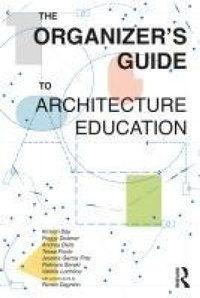
The Organizer's Guide to Architecture Education
1st Edition
Published on 24. July 2024
Book
Paperback/Softback
232 pages
978-1-032-53281-3 (ISBN)
Description
The Organizer's Guide to Architecture Education serves as a timely call-to-action for transforming architecture education to meet the monumental environmental and social challenges of our time.
Written by a collective of eight educators, practitioners, and organizers and structured in three parts, the book considers organizing across four scales of architecture education and reorients architecture toward stewarding the planetary commons. It speaks to students, faculty, and administrators in architecture schools, as well as professional architects and built environment practitioners, who recognize the need to expand and decenter the discipline. Readers will gain critical understandings and skills for reimagining architectural pedagogy, practice, and relations to power structures. Empowered by this knowledge, readers will be motivated to contribute actively to and drive systemic change within the field.
Illuminated with how-to methods-from power mapping to conversation tactics-and case study precedents, the book catalyzes a collective redefinition of architecture as a vital player in building a socially just and ecologically regenerative future.
Written by a collective of eight educators, practitioners, and organizers and structured in three parts, the book considers organizing across four scales of architecture education and reorients architecture toward stewarding the planetary commons. It speaks to students, faculty, and administrators in architecture schools, as well as professional architects and built environment practitioners, who recognize the need to expand and decenter the discipline. Readers will gain critical understandings and skills for reimagining architectural pedagogy, practice, and relations to power structures. Empowered by this knowledge, readers will be motivated to contribute actively to and drive systemic change within the field.
Illuminated with how-to methods-from power mapping to conversation tactics-and case study precedents, the book catalyzes a collective redefinition of architecture as a vital player in building a socially just and ecologically regenerative future.
More details
Language
English
Place of publication
London
United Kingdom
Publishing group
Taylor & Francis Ltd
Target group
College/higher education
Professional and scholarly
Postgraduate and Undergraduate Advanced
Illustrations
40 s/w Abbildungen, 32 s/w Photographien bzw. Rasterbilder, 8 s/w Zeichnungen
8 Line drawings, black and white; 32 Halftones, black and white; 40 Illustrations, black and white
Dimensions
Height: 228 mm
Width: 152 mm
Thickness: 17 mm
Weight
514 gr
ISBN-13
978-1-032-53281-3 (9781032532813)
Copyright in bibliographic data and cover images is held by Nielsen Book Services Limited or by the publishers or by their respective licensors: all rights reserved.
Schweitzer Classification
Other editions
Additional editions
Kirsten Day | Peggy Deamer | Andrea Dietz
The Organizer's Guide to Architecture Education
Book
07/2024
1st Edition
Routledge
€215.41
Shipment within 10-20 days
Kirsten Day | Peggy Deamer | Andrea Dietz
The Organizer's Guide to Architecture Education
E-Book
07/2024
1st Edition
Routledge
€41.99
Available for download
Kirsten Day | Peggy Deamer | Andrea Dietz
The Organizer's Guide to Architecture Education
E-Book
07/2024
1st Edition
Routledge
€41.99
Available for download
Persons
Kirsten Day (she/her) is an architect and lecturer in Architecture (Technology and Practice) at the University of Melbourne, Australia.
Peggy Deamer (she/her) is Professor Emerita, Yale School of Architecture and a founding member of the Architecture Lobby.
Andrea Dietz (she/her) is an architect-educator whose research-based practice focuses on the culture and politics of space and its representations.
Tessa Forde (she/they) is an architecture researcher, teacher, and practitioner in Aotearoa New Zealand, interested in the redeployment of architecture's tools.
Jessica Garcia Fritz (she/her) is an Assistant Professor of Architecture at the University of Minnesota, and a citizen of the Cheyenne River Sioux Tribe (Itazipco).
Palmyra Geraki (she/her) is an interdisciplinary architect, educator, and editor, interested in the tensions and opportunities present in the relationship between the individual and the collective.
Valerie (Val) Lechene (she/they) is a systems change agent, technologist, and a trained-architect based in Brooklyn, NY, USA.
Peggy Deamer (she/her) is Professor Emerita, Yale School of Architecture and a founding member of the Architecture Lobby.
Andrea Dietz (she/her) is an architect-educator whose research-based practice focuses on the culture and politics of space and its representations.
Tessa Forde (she/they) is an architecture researcher, teacher, and practitioner in Aotearoa New Zealand, interested in the redeployment of architecture's tools.
Jessica Garcia Fritz (she/her) is an Assistant Professor of Architecture at the University of Minnesota, and a citizen of the Cheyenne River Sioux Tribe (Itazipco).
Palmyra Geraki (she/her) is an interdisciplinary architect, educator, and editor, interested in the tensions and opportunities present in the relationship between the individual and the collective.
Valerie (Val) Lechene (she/they) is a systems change agent, technologist, and a trained-architect based in Brooklyn, NY, USA.
Content
Part 1: Organizing Part 2: The Scales of Organizing Architecture Education Part 3: Toward the Planetary CODA - Coauthoring: An Experimental Endeavor