

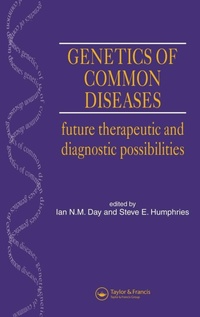
Genetics of Common Diseases
Future Therapeutic and Diagnostic Possibilities
1st Edition
Published on 15. June 1997
Book
Hardback
344 pages
978-1-85996-041-7 (ISBN)
Description
Many common diseases are partly attributable to the genes which an individual inherits. Early steps have now been made in developing ways to determine which genetic variations are important, with some recent successes. In parallel, ways to improve healt
Reviews / Votes
"I recommend this book as a good introduction to this exciting area." BMJ; ; "In summary, this book is an interesting and very informative attempt to bring together aspects of our rapidly increasing knowledge of the genetics of common diseases, with possMore details
Language
English
Place of publication
London
United Kingdom
Publishing group
Taylor & Francis Ltd
Target group
College/higher education
Professional and scholarly
Dimensions
Height: 240 mm
Width: 161 mm
Thickness: 23 mm
Weight
690 gr
ISBN-13
978-1-85996-041-7 (9781859960417)
Copyright in bibliographic data and cover images is held by Nielsen Book Services Limited or by the publishers or by their respective licensors: all rights reserved.
Schweitzer Classification
Other editions
Additional editions
Ian Day | Prof Steve Humphries
Genetics of Common Diseases
Future Therapeutic and Diagnostic Possibilities
E-Book
12/2020
1st Edition
Taylor & Francis
€258.99
Available for download
Ian Day | Prof Steve Humphries
Genetics of Common Diseases
Future Therapeutic and Diagnostic Possibilities
E-Book
12/2020
1st Edition
Taylor & Francis
€258.99
Available for download
Persons
Department of Medicine, University College London Medical School, The Rayne Institute, London, UK (address from October 1997: Wessex Human Genetics Institute, Southampton University Hospital, Southampton, UK). Department of Medicine, University College London Medical School, The Rayne Institute, London, UK.
Content
Contributors -- Abbreviations -- Preface -- 1 Perspectives in human linkage studies. /S. Povey -- Pairwise linkage analysis of Mendelian traits -- Finding the cause of a disease which shows clear Mendelian inheritance -- After a LOO score of +3, what next? -- Narrowing the search by searching for critical recombinants -- Linkage disequilibrium -- Linkage analysis in more complex situations -- Linkage in complex traits -- Why are we doing this? -- References -- 2 Twin research: nature versus nurture in common diseases. /K.O. Kyvik -- Introduction -- History -- Biology of twinning -- Demography -- Twin studies -- Assumptions -- T he concept of concordance rates -- Heritability -- Twin studies and common diseases -- Other types of twin studies -- Conclusion -- References -- 3 The molecular basis of genetic variation: mutation detection methodologies and limitations. /E. Spanakis and I.N.M. Day -- Introduction -- Current theories of mutation -- Parallel development of theory with methodology -- Methods of mutation detection -- Limitations of current methods for mutation detection -- Our approaches -- Conclusions -- References -- 4 Finding susceptibility genes for schizophrenia. /M.J. Owen and M.C. O'Donovan -- Introduction -- Molecular genetic approaches to schizophrenia -- Candidate gene association studies -- Conclusions -- References -- 5 Approaches to determining the genetic basis of noninsulin-dependent diabetes mellitus. /M. McCarthy -- Non-insulin-dependent diabetes mellitus (NIDDM) -- Overview of approaches to dissect NIDDM -- Choosing a candidate gene -- Exploring candidate genes -- Assessing genotype-phenotype correlations -- Understanding the biology of complex traits -- References -- 6 Population-scale genotype assays: APOE gene in Alzheimer's dementia and coronary risk. /I.N.M. Day, D. Palamand and E. Spanakis -- Introduction: availability of population-scale gene testing -- Background -- Some future possibilities -- References -- 7 Genetic tests for corona