

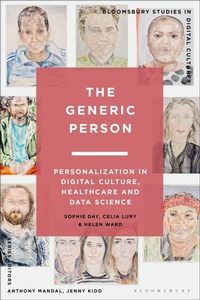
The Generic Person
Personalization in Digital Culture, Healthcare and Data Science
Will be published approx. on 6. August 2026
Book
Hardback
256 pages
978-1-350-34015-2 (ISBN)
Description
We ask who-or what, and how-is the person of personalisation. Exploring practices across the domains of digital culture, healthcare and data science, this open-access book argues that they re-articulate relations between economy, politics and culture.
Contemporary investment in big data, increasing computational power and 'real-time' analytics have made participation in a culture of personalisation almost impossible to avoid. We must declare, measure and share our personal data in order to carry out many activities. 'People Like You' are simultaneously one and many: a group, a category, or a generic emerging from the mapping of publics onto populations.
Focusing in-depth on case studies in digital culture, health care and data science, this book identifies common features of personalising practices to evaluate their significance for conceptions of the person. We explore three features: the use of tracking techniques; the formation of relations of likeness, resemblance or similarity on the basis of practices of liking or preference; and new forms of contextualising persons in what Meta CEO Mark Zuckerberg referred to as the "default social." This book explores the implications of these techniques for the stratification of populations, processes of inclusion, exclusion and belonging, and the assetisation of data, and how they combine to create to create new emphases on the individual, dividual and generic person.
The eBook editions of this book are available open access under a CC BY-NC-ND 4.0 licence on bloomsburycollections.com. Open access was funded by The Wellcome Trust.
Contemporary investment in big data, increasing computational power and 'real-time' analytics have made participation in a culture of personalisation almost impossible to avoid. We must declare, measure and share our personal data in order to carry out many activities. 'People Like You' are simultaneously one and many: a group, a category, or a generic emerging from the mapping of publics onto populations.
Focusing in-depth on case studies in digital culture, health care and data science, this book identifies common features of personalising practices to evaluate their significance for conceptions of the person. We explore three features: the use of tracking techniques; the formation of relations of likeness, resemblance or similarity on the basis of practices of liking or preference; and new forms of contextualising persons in what Meta CEO Mark Zuckerberg referred to as the "default social." This book explores the implications of these techniques for the stratification of populations, processes of inclusion, exclusion and belonging, and the assetisation of data, and how they combine to create to create new emphases on the individual, dividual and generic person.
The eBook editions of this book are available open access under a CC BY-NC-ND 4.0 licence on bloomsburycollections.com. Open access was funded by The Wellcome Trust.
More details
Series
Language
English
Place of publication
London
United Kingdom
Publishing group
Bloomsbury Publishing PLC
Target group
Professional and scholarly
Product notice
sewn/stitched
Cloth over boards
With dust jacket
Illustrations
30 bw illus
Dimensions
Height: 234 mm
Width: 156 mm
Thickness: 25 mm
Weight
454 gr
ISBN-13
978-1-350-34015-2 (9781350340152)
Copyright in bibliographic data and cover images is held by Nielsen Book Services Limited or by the publishers or by their respective licensors: all rights reserved.
Schweitzer Classification
Persons
Sophie Day is Professor Emerita of Anthropology at Goldsmiths, University of London, UK and Principal Research Fellow in the School of Public Health, Imperial College London, UK.
Celia Lury is a Professor in the Centre for Interdisciplinary Methodologies at the University of Warwick, UK.
Helen Ward is Clinical Professor of Public Health at Imperial College London, UK and an NIHR Senior Investigator.
Celia Lury is a Professor in the Centre for Interdisciplinary Methodologies at the University of Warwick, UK.
Helen Ward is Clinical Professor of Public Health at Imperial College London, UK and an NIHR Senior Investigator.
Content
List of illustrations
1. The person in personalization
2. 'Dear undefined': addressing 'People Like You'
3. Dynamic pro-nominalism
4. A continuous present
5. The value(s) of personalization
6. This person does exist
Bibliography
1. The person in personalization
2. 'Dear undefined': addressing 'People Like You'
3. Dynamic pro-nominalism
4. A continuous present
5. The value(s) of personalization
6. This person does exist
Bibliography